Why a health screening machine works at work
If you want more people to engage with wellbeing, remove the friction. That is the real appeal of a health screening machine in the workplace. Employees do not need to book a clinic appointment, travel off-site or wait for a follow-up simply to check a few key health measures. They can step up, complete a screening in minutes and walk away with printed results there and then.
For employers, that convenience matters just as much as the health element. HR teams and wellbeing leads are often expected to deliver visible, useful initiatives without adding a large admin burden. A screening solution that can be installed on-site, used at scale and supported by engineers across the UK is far easier to fit into a busy wellbeing calendar than a programme that depends on complex scheduling.
That is why the most effective workplace screening options are not built around appointments. They are built around access. When employees can take part during the working day, participation is usually higher and the programme feels practical rather than performative.
What a health screening machine actually measures
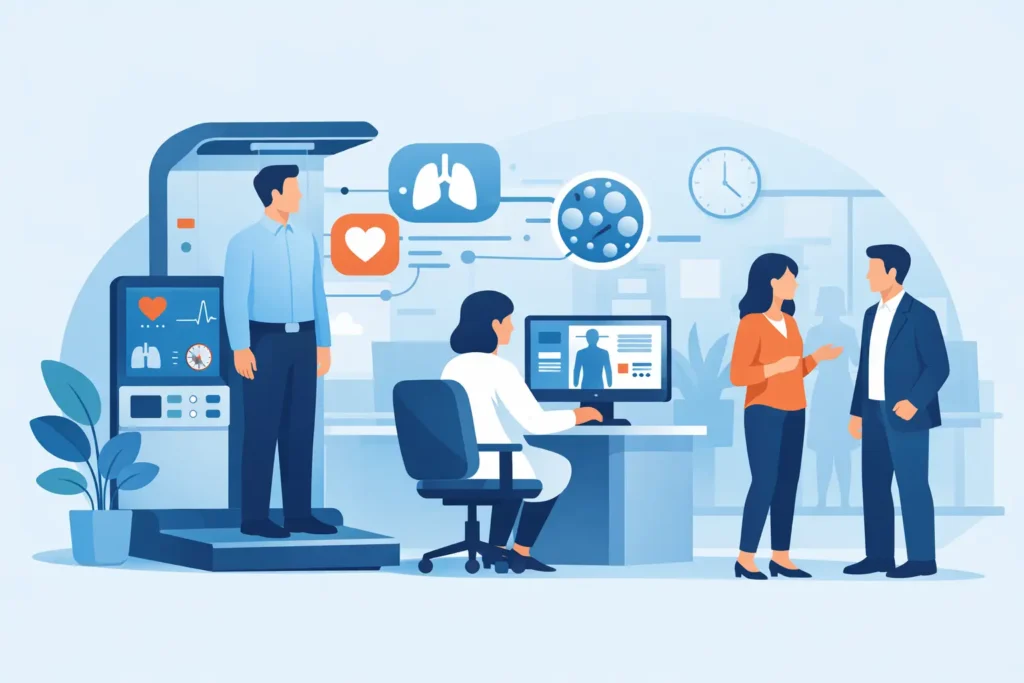
A workplace health screening machine is designed to give employees a quick snapshot of core biometric data. In most workplace settings, that means height, weight, BMI, blood pressure, pulse and body fat percentage. These are familiar measures, but their value comes from seeing them together rather than in isolation.
Height and weight provide the foundation for BMI, which gives a broad indication of whether someone is within a healthy weight range for their height. BMI is not a diagnosis and it does not tell the full story for every individual, but it is still a useful prompt. In a workplace context, it helps employees understand where they are starting from and whether lifestyle changes may be worth considering.
Blood pressure is often the metric that gets the strongest reaction. Many employees have not had it checked recently, and high blood pressure can sit unnoticed for years. A quick on-site reading can encourage earlier action, whether that means reviewing diet, increasing activity or speaking to a GP.
Pulse adds another simple but useful measure, especially when viewed alongside blood pressure. Body fat percentage gives a little more context than weight alone and can help employees think beyond the number on the scales.
None of this replaces medical care, and it should not be presented as such. The role of a workplace screening machine is to support awareness and early action. For many employers, that is exactly the point – helping people know their numbers in a format that is simple, fast and non-disruptive.
Why uptake is often better than appointment-based screening
Traditional health checks can be valuable, but they tend to lose people at the logistics stage. If employees need to choose a slot, leave their desk at a fixed time or commit to a longer consultation, some will opt out. Others will mean to take part and never get round to it.
A self-service health screening machine changes that dynamic. It is visible, easy to access and quick to complete. That combination lowers the threshold for participation, particularly in office environments, hybrid workplaces and larger sites where people work to different schedules.
There is also a psychological advantage. A kiosk-style screening point can feel less formal than a one-to-one appointment. For employees who are curious but hesitant, that can make the first step easier.
This does not mean self-service is always the right answer. In some workplaces, especially those with a clinical occupational health model or a workforce that needs a more guided approach, booked screenings may still have a place. But if the aim is broad engagement across a large employee base, convenience usually wins.
What employers need to run one smoothly
From an operational point of view, the best workplace wellbeing services are the ones that do not create unnecessary work. A health screening machine should be straightforward to install and use. In practice, that means thinking about a few basics early.
First, you need a suitable space. It does not have to be large, but it should be easy to access and offer a reasonable degree of privacy so employees feel comfortable using it. A machine placed in the middle of a busy thoroughfare may be technically available but underused.
Second, you need power and a clear plan for placement. If the unit is rentable and supported by a field service team, delivery and installation should be handled for you. That matters because HR and facilities teams rarely want to spend time troubleshooting equipment.
Third, consider the employee journey. If results are printed instantly, people leave with something tangible, which tends to increase the sense that the screening was worthwhile. It also removes the need for later distribution or follow-up admin.
Support is another practical point that should not be overlooked. Machines used on-site need maintenance, consumables and occasional technical attention. A provider with UK-wide engineers and field service support reduces that risk significantly. For employers with multiple sites, that national coverage becomes even more important.
The value goes beyond one screening day
A health screening machine is most useful when it is part of a wider wellbeing plan rather than a one-off gesture. The screening itself gives employees immediate data, but what happens next is where the programme becomes more meaningful.
Someone who sees an unexpected blood pressure reading may be more likely to join a nutrition webinar, attend a movement class or take part in a wider wellbeing initiative. Someone who has been meaning to focus on fitness may find that seeing their results in black and white provides the push they needed.
That is where workplace screening works particularly well alongside broader services such as on-site massage, office yoga, mental wellbeing training, sleep sessions and resilience programmes. Screening creates awareness. The wider programme gives employees routes to act on it.
For employers, this joined-up approach is easier to justify internally. Instead of funding isolated activities, you create a connected wellbeing offer with measurable touchpoints. Screening participation, anonymised usage data where available, and follow-on engagement with other services can all help show that the programme is being used.
What to look for when choosing a health screening machine provider
Not every offer is equal, and buyers should look beyond the headline promise of on-site checks. The first question is practical: how much work will this create for your team? If delivery, installation, maintenance and basic training are all included, the programme is much easier to launch with confidence.
The second question is about employee experience. A machine should be simple to use, quick to complete and capable of producing clear results immediately. If the process feels confusing or slow, uptake will suffer.
The third is scalability. Can the service work across different office sizes, regional sites or hybrid attendance patterns? A provider that can support a single office but not a national rollout may be fine for some employers and limiting for others.
Then there is reliability. Workplace initiatives lose credibility quickly if equipment fails on the day or support is slow. A strong engineering and service model is not an optional extra. It is part of the product.
If you are looking for a low-friction option, Relaxa provides rentable on-site kiosks with UK-wide delivery, installation, support and immediate printed results, which suits employers who want screening to be simple to deploy rather than complicated to manage.
Where this kind of screening fits best
A health screening machine can work well in annual wellbeing campaigns, benefits fairs, seasonal health drives and ongoing office-based wellbeing programmes. It is especially useful where employee numbers are high and appointment-led models would be hard to coordinate.
It also suits employers who want to show visible action without committing staff to long periods away from work. A short screening completed during the day is easier to accommodate than a programme built around individual bookings.
That said, it is not a cure-all. If your workforce is largely remote, site access is limited or your objective is detailed clinical assessment, you may need a different model or a blended approach. The best decision depends on your workforce pattern, your available space and what you want the screening to achieve.
For many organisations, though, the appeal is straightforward. A health screening machine makes preventative wellbeing easier to access, easier to run and easier to scale. When employees can get a clear snapshot of their health in a few minutes, during the working day, participation stops being the problem. The conversation can move on to what people do with that information next.