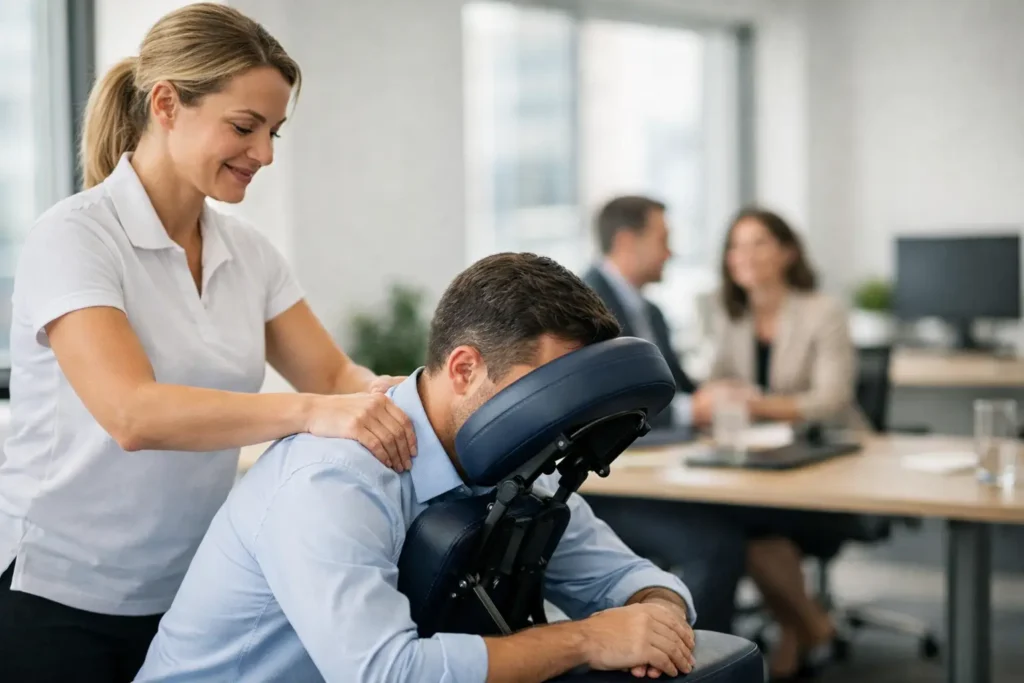
A wellbeing activity only works if employees actually use it. That is why massage at work benefits stand out. It is easy to understand, quick to deliver, and simple for employees to access during the working day. For HR teams and wellbeing leads, that matters just as much as the wellbeing outcome itself.
Unlike initiatives that rely on long booking journeys or high employee effort, workplace massage removes friction. A trained therapist arrives on site, sessions are delivered in a compact space, and employees can take part in short appointment slots without losing half a day. The result is a service that supports stress reduction while fitting the reality of busy offices, hybrid patterns and multi-site operations.
Why massage works so well in the workplace
The main reason massage performs well at work is convenience. Employees do not need to travel, rearrange personal commitments or wait weeks for an appointment. They can access support where they already are, during a normal working day, which increases participation and makes wellbeing feel practical rather than aspirational.
There is also a strong psychological benefit to the format. A short massage session gives employees permission to pause. In many organisations, that pause is valuable in itself. People often carry tension through the shoulders, neck and upper back, especially in desk-based roles or during periods of sustained pressure. A targeted session can help reduce that physical tightness quickly, which often improves comfort, concentration and mood afterwards.
For employers, there is a second advantage. Massage is visible. When employees see a wellbeing service running on site, it sends a clear message that support is available and being prioritised. That visibility can increase engagement not only with massage sessions, but with the wider wellbeing programme as well.
The practical Massage at Work Benefits employers notice
When organisations introduce massage on site, the first benefit they usually notice is demand. Employees understand it immediately, and uptake is often strong because the offer is straightforward. There is no need to explain complicated health data or ask employees to commit to a long programme before they see value.
Stress reduction is usually the clearest outcome. That does not mean massage is a replacement for broader mental health support, line manager training or workload management. It is one part of a bigger picture. But it can be a very effective part, particularly during high-pressure periods such as organisational change, peak operational cycles or busy project deadlines.
Another common benefit is improved focus after sessions. Employees often return to work feeling calmer and physically more comfortable. In practical terms, that can mean fewer distractions caused by tension headaches, tight shoulders or the general fatigue that builds up during screen-heavy days.
Massage can also support morale. A well-run on-site session feels tangible. Employees are not being sent another wellbeing email or asked to complete another e-learning module in their own time. They are being offered something immediate and usable. That distinction matters when employers are trying to improve trust and participation in wellbeing activity.
Retention and employer perception can benefit too. While massage on its own will not solve engagement or culture issues, it can contribute to a stronger employee experience when it is part of a wider, credible wellbeing offer. It shows that the employer is willing to invest in practical support, not just policy statements.
Where massage fits in a wider wellbeing strategy
Massage works best when it is treated as a delivery tool within a broader wellbeing plan, not as a one-off perk. For example, it can sit alongside health screening, mental wellbeing webinars, posture education and movement sessions. That combination gives employees different ways to engage depending on what they need.
An employee who attends a massage session because of neck and shoulder tension may also benefit from posture support. Someone using massage during a stressful period may be more open to resilience or sleep training afterwards. In that sense, massage can act as an accessible entry point into the wider wellbeing programme.
This is where implementation matters. Employers get more value when massage is scheduled with a clear purpose. It may support Stress Awareness Month, complement a health promotion campaign, or help re-engage teams after a demanding quarter. It can also be paired with related content such as How to Beat Stress at Work or Posture Management Training at Work if the goal is to reinforce the session with practical follow-up.
What employees typically value most
From the employee side, the strongest benefit is usually simplicity. A short chair massage session is accessible, low commitment and easy to fit around meetings. There is no need to change clothes, and very little space is required. That makes it suitable for office environments where time and room availability are limited.
Employees also value the fact that the benefit is felt straight away. Some wellbeing initiatives are important but abstract. Massage is different. Employees can usually tell immediately whether they feel less tense, more comfortable or more settled. That immediate experience helps build positive sentiment towards the programme.
There is a fairness point to consider as well. In hybrid or dispersed organisations, not every employee will access every on-site service in the same way. That is not a reason to avoid massage, but it does mean employers should think carefully about rotation across sites, frequency, and how on-site services are balanced with online provision. A good wellbeing strategy does not force every intervention to suit every employee equally. It does aim to provide a sensible mix.
How to run workplace massage with minimal admin
Operational simplicity is one of the biggest factors in whether a wellbeing service gets approved and repeated. Most HR and People teams are not short of ideas. They are short of time, space and administrative capacity.
Massage at work is effective when the setup is clear from the start. Employers need to know how much space is required, how sessions will be scheduled, how long each appointment lasts, and what support the provider handles directly. The more turnkey the service, the easier it is to deliver consistently across locations.
In most cases, short chair massage appointments work best because they keep throughput high and minimise disruption. They can be delivered in meeting rooms, breakout areas or other suitable private spaces. Session length depends on the event format and employee numbers, but shorter slots usually improve access and help more people take part across the day.
Communication also matters. Participation is stronger when employees know exactly what is being offered, how long it takes, and whether they need to book. Vague internal promotion tends to reduce uptake. Clear messaging increases trust and makes the service easier to manage on the day.
If you are considering delivery models, Chair Massage at Work That Employees Use is a useful reference point because it reflects what typically drives better participation in real workplace settings.
Trade-offs and limitations to plan for
Massage has clear benefits, but employers should be realistic about what it can and cannot do. It can help reduce stress and physical tension in the moment, but it is not a substitute for addressing root causes such as excessive workload, poor workstation setup or weak management capability.
There is also the question of scale. A single therapist can only see a certain number of employees in a day, so larger organisations may need multiple therapists, staggered delivery, or recurring dates across sites. If the workforce is spread nationally, planning becomes even more important.
Budget is another consideration. A massage day often delivers strong engagement, but the value is highest when it is tied to broader wellbeing objectives rather than treated as an isolated event. Employers should ask what outcome they want: stress reduction, engagement, visibility for a wider campaign, or support during a high-pressure period. The answer will shape the right format and frequency.
Some employees may not want to take part, and that is fine. Good workplace wellbeing is about offering relevant options, not mandating participation. Massage should be one accessible route among several.
Measuring value beyond attendance
Attendance is a useful metric, but it should not be the only one. Employers often want to know whether massage has helped engagement, supported wellbeing messaging or improved uptake of other initiatives.
Useful measures include booking fill rate, repeat participation, employee feedback, and whether massage days increase interest in related services. If massage sits alongside health checks or training, employers can also look at overall campaign participation. For example, massage may work well within a broader company wellbeing initiative where the goal is to increase visibility and remove barriers to access.
The strongest programmes usually combine immediate services with measurable follow-on activity. An employee might attend a massage session, then join a posture webinar, use a health screening kiosk, or engage with stress management content afterwards. That is where workplace wellbeing becomes more than a one-day event.
When massage makes the most sense
Massage is particularly effective in office-based environments, call centres, professional services firms, and other settings where employees spend long periods sitting or working under sustained cognitive demand. It also works well during wellbeing weeks, peak stress periods, return-to-office campaigns and employee appreciation events.
It is less effective when used as a token gesture without wider support behind it. Employees can usually tell the difference between a thoughtful intervention and a box-ticking exercise. If the wider culture does not allow people to take breaks or managers discourage participation, even a well-delivered massage day will have limited impact.
For employers who want a practical wellbeing activity with high visibility, low friction and clear employee appeal, massage remains one of the more dependable options. The strongest results come when it is easy to access, simple to run and positioned as part of a wider workplace wellbeing plan rather than a standalone fix.
If that is the objective, massage at work is not difficult to justify. It is one of the few wellbeing services that employees understand immediately, use willingly and often ask to see again.