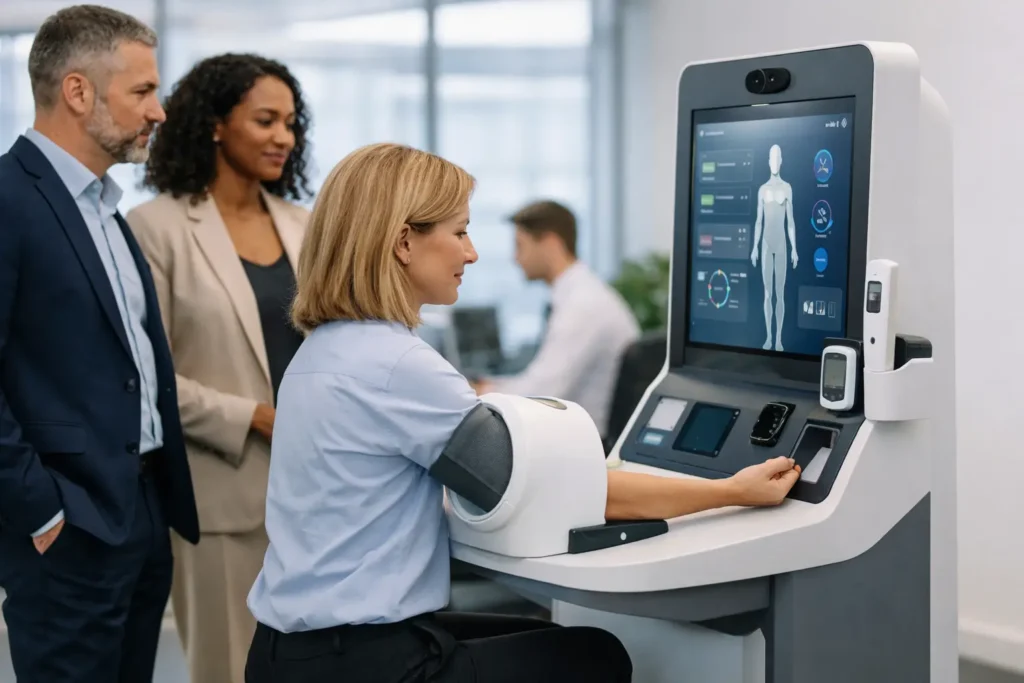
A wellbeing week can attract strong interest, yet appointment slots often create the very barrier an initiative is meant to remove. Future workplace health kiosks address that problem by giving employees a quick, private way to check key health measures during the working day, without requiring a clinician, diary management or time away from the site.
For HR and wellbeing teams, the value is not simply the equipment. It is the ability to turn a broad message – know your numbers – into a practical activity that employees can complete in minutes. When screening is visible, easy to access and supported properly, participation can extend beyond the people who would normally book into a wellbeing event.
Why future workplace health kiosks will focus on access
Workplace health provision is moving towards options that fit around varied schedules. Office-based staff may be able to attend a set session, but shift workers, field teams and employees splitting time between home and site often cannot. A kiosk can remain available throughout a campaign day or for a longer hire period, allowing people to take part when their workload permits.
This matters because preventative wellbeing depends on repeatable habits, not a single annual message. A health kiosk does not replace a GP, occupational health assessment or clinical screening programme. It does, however, offer a straightforward starting point. Employees can see baseline figures, consider whether a change is needed and seek appropriate medical advice where a result causes concern.
The strongest future workplace health kiosks will therefore be designed around convenience as much as technology. A clear screen, simple instructions and immediate printed results reduce uncertainty for the user. For the employer, an unattended format can support high uptake without the administrative load of allocating individual appointments.
The measures employees need to understand
A workplace health kiosk is most useful when it focuses on core biometric measures that employees can recognise and discuss with confidence. Typical checks include height, weight, body mass index (BMI), blood pressure, pulse and body fat percentage.
Height and weight provide the basis for BMI, a broad indication of whether weight is proportionate to height. BMI has limitations: it does not distinguish between muscle and fat, and it should not be treated as a diagnosis. It remains a useful population-level measure and a prompt for an individual to consider their wider health picture.
Blood pressure is particularly relevant to preventative health. High blood pressure often has no obvious symptoms, so an employee may be unaware that they should follow up. A single kiosk reading can be affected by recent movement, caffeine, stress or how the measurement is taken. Employees should be encouraged to rest before testing and to speak with a healthcare professional if they receive a concerning result, especially if it is repeated.
Pulse gives an indication of heart rate at the time of the check. Body fat percentage adds context that weight alone cannot provide. Taken together, these figures give employees more useful information than a set of scales in a changing room or a generic wellbeing email.
What a good on-site deployment looks like
The practicalities determine whether a health screening kiosk feels simple or becomes another project for an overstretched HR team. Before booking, employers should identify a suitable indoor location with enough space for the unit and for employees to use it comfortably. The space should offer a degree of privacy, particularly where colleagues may be reluctant to take measurements in a busy reception area.
A standard power supply is also required. Beyond that, the ideal location is usually somewhere accessible but not exposed: a wellbeing room, a quiet meeting space or a screened section of a communal area. Clear signage can explain what the kiosk measures, how long the check takes and where employees can get support if they have questions about their results.
For a multi-site organisation, consistency is just as important. The same communications, setup expectations and local wellbeing contacts should be in place at each location. This prevents the programme from being perceived as an office-only benefit and makes reporting easier at the end of the campaign.
Relaxa provides health screening kiosks available for hire with UK-wide delivery, installation, maintenance and basic user training handled by field service technicians and engineers. This service-led approach removes many of the logistics that otherwise delay a screening initiative, from moving equipment into position to ensuring consumables are available.
Designing for participation, not just presence
A kiosk in the building is not automatically an engaged workforce. Employees need a reason to use it and reassurance about what will happen to their information. Communications should be direct: explain the measures available, confirm that no appointment is needed and make clear that the check is intended to support personal awareness rather than judge performance or fitness for work.
Timing can make a material difference. A kiosk placed on site during a health awareness week may create momentum, while a longer hire period gives shift patterns and annual leave less influence over uptake. Some organisations use a launch day with a wellbeing champion nearby, then leave the kiosk available for employees who prefer to participate quietly later in the week.
The message should also avoid promising medical certainty. Encourage employees to use their printed results as a prompt for reflection and, where appropriate, a conversation with their GP or another qualified healthcare professional. This protects the integrity of the programme and helps employees understand the purpose of basic screening.
Privacy and data need clear decisions
Health information is sensitive. Employers should decide before deployment whether the kiosk will be used solely for private employee results or whether anonymised usage data will be collected to assess engagement. The distinction must be clear in employee communications.
Anonymised information can help a wellbeing team understand participation by site or campaign period, identify where promotion needs improving and demonstrate that a budget has resulted in meaningful activity. It should not be used to identify individuals or make employment decisions. If an organisation intends to collect any data beyond anonymous usage figures, it needs appropriate governance, transparency and data protection advice.
Printed results are valuable because the employee leaves with their own information immediately. They can choose whether to keep it private, share it with a healthcare professional or use it as motivation for a personal health goal. The employer does not need to hold individual results in order to demonstrate a proactive duty of care.
Where kiosks fit in a year-round wellbeing plan
A health kiosk works best as a practical anchor point within a wider programme. Screening can create interest in topics that need further support, such as stress management, movement, nutrition, sleep or cardiovascular health. It can be paired with an office yoga class, a posture session, on-site massage or an online webinar, depending on the needs of the workforce.
This does not mean every screening campaign needs a large event programme. For a smaller employer, the most effective approach may be a kiosk hire supported by a short communication plan and a follow-up resource on blood pressure or healthy routines. Larger organisations may use screening as part of a quarterly calendar, with different themes and services introduced across the year.
The right mix depends on workforce size, shift patterns, budget and existing provision. The key is to avoid treating health screening as a standalone gesture. Employees are more likely to value it when they can see what to do next, whether that is taking a movement class, accessing mental wellbeing training or speaking to their GP.
Questions to ask before you book
A useful supplier conversation should cover more than the equipment specification. Ask how delivery and installation are managed, what space and power are needed, who provides basic training, how maintenance is handled and what happens if technical support is required. These details affect the experience for both employees and the person responsible for the booking.
It is also sensible to ask how results are presented, whether the kiosk prints them immediately and what anonymised reporting options are available. A screening programme should be easy to explain to senior stakeholders: defined measures, clear employee access, minimal site disruption and an understandable indication of engagement.
Future workplace health kiosks will not make healthy choices on behalf of employees. Their value is more practical: they make a useful health conversation easier to start. Give people a convenient check, clear information and a credible next step, and workplace wellbeing becomes something employees can act on rather than simply read about.