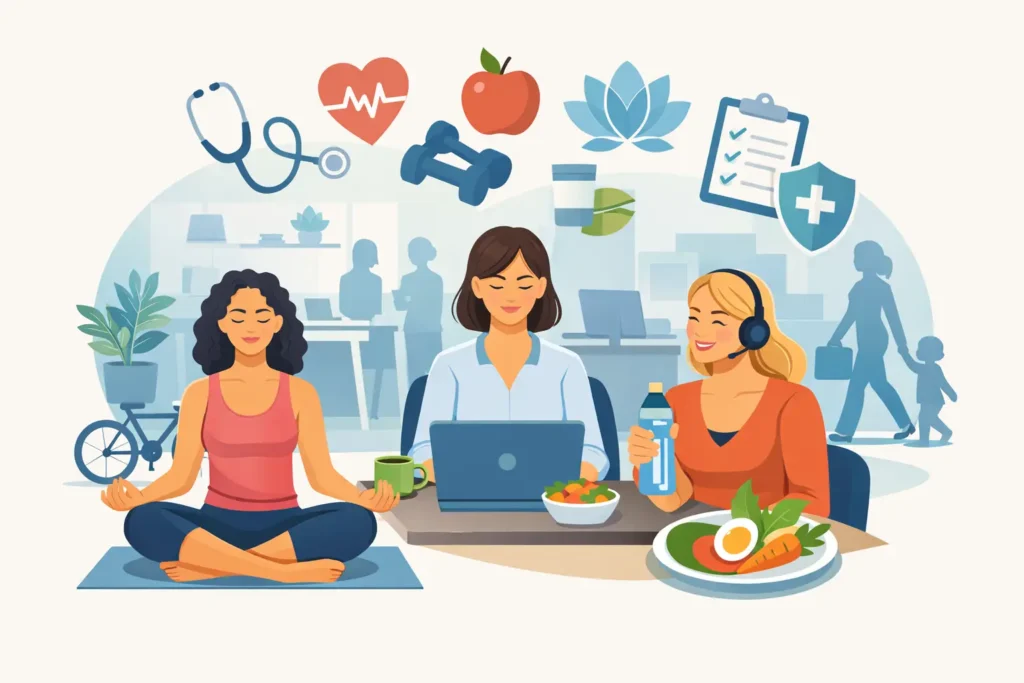
A women’s health initiative only works if people actually use it. That is where many workplace plans fall short. Good intentions get lost in awkward booking systems, low awareness, or activities that do not fit the working day.
The most effective women’s health at work ideas are the ones that remove friction. They should be easy to access, relevant to different life stages, and simple for HR teams to run across office, hybrid, and multi-site environments. That usually means combining visible on-site activity with flexible digital support and clear follow-up.
Women’s health at work ideas that work in practice
A strong starting point is basic health screening. Many employees will not make time for a GP or pharmacy check during a busy week, but they are far more likely to use a convenient workplace option that takes minutes rather than requiring an appointment. On-site screening can help employees understand core measures such as blood pressure, BMI, pulse, weight, height, and body fat percentage. It also gives employers a practical way to support preventative health without creating a heavy admin process. If you are considering this approach, Workplace Blood Pressure Screening is often one of the simplest entry points because it is familiar, quick, and relevant across age groups.
Menopause support is another high-value area, but it needs more than a policy document. Line managers often want to help yet lack confidence, while employees may not want to raise symptoms formally. A well-structured menopause webinar or workshop can give people practical information on symptoms, sleep disruption, concentration, confidence, and available support routes at work. It also helps normalise discussion without putting individuals on the spot.
For employers that want broad reach, a Women’s Health Webinar works well because it can cover menstrual health, menopause, stress, sleep, nutrition, and preventive checks in one session. It is particularly useful for hybrid teams or organisations with multiple locations where equal access matters.
Make convenience part of the design
If the activity is difficult to access, participation will drop. This matters with women’s health because barriers are not always obvious. Employees may be managing caring responsibilities, fluctuating symptoms, remote working patterns, or simply a lack of time during core hours.
That is why flexible delivery matters. On-site options can create visibility and momentum, while online sessions allow wider participation. A mix usually works best. For example, a workplace could run a health screening day on-site, follow it with a webinar on women’s health topics, and add short movement or stretch sessions to support musculoskeletal health and energy levels.
Shorter formats often outperform longer ones. A 20-minute desk-based workshop or lunchtime webinar may attract more people than a half-day event. The trade-off is depth. Brief sessions improve uptake, but some topics such as menopause, hormonal health, or mental wellbeing may need follow-up resources or manager guidance to create lasting value.
Use measurable ideas, not just awareness campaigns
Awareness matters, but HR teams are usually under pressure to show participation and outcomes. The strongest women’s health activities have clear inputs and outputs. You should be able to answer practical questions quickly: how much space is needed, whether appointments are required, how long each activity takes, and what employees receive afterwards.
This is where kiosk-based screening can be useful. A workplace health screening kiosk can be installed on-site with minimal demands on internal teams, provided there is suitable space and power. Employees can complete a check in minutes and receive immediate printed results. For employers, that improves access while reducing the scheduling issues that often limit uptake. If you are comparing formats, Health Screening Machine for Workplaces explains how this model fits into workplace wellbeing programmes.
Measurable does not only mean biometric data. Attendance figures, repeat engagement, anonymised usage data, and post-session feedback all help build the case for future investment. That is particularly valuable when you are trying to move women’s health support from a one-off awareness day into a year-round wellbeing plan.
Topics worth prioritising
Not every organisation needs the same programme, but a few themes come up repeatedly. Menstrual health and menopause are obvious priorities, yet stress, sleep, musculoskeletal discomfort, and cardiovascular health are also highly relevant. Office-based and hybrid employees may be dealing with posture issues and long sedentary periods, while frontline and operational teams may face fatigue, physical strain, or limited time for appointments.
That means the best women’s health at work ideas usually combine education with action. A webinar gives context. A screening kiosk gives immediate personal insight. Yoga or movement sessions help employees respond in a practical way. This joined-up approach tends to deliver stronger engagement than isolated activities because employees can see how each part connects.
If your wider aim is to improve participation across the whole wellbeing calendar, it is worth looking at Employee Wellbeing Ideas That Get Used. The same principle applies here: reduce friction, make the benefit obvious, and keep access simple.
What good implementation looks like
For most employers, the best approach is phased rather than overly ambitious. Start with one visible activity that is easy to deploy and easy to understand. Health screening is often effective because it gives employees immediate, personal information and supports the wider message of knowing your numbers. Add a women’s health webinar to provide context and education, then build around that with follow-on wellbeing support such as stress management, sleep sessions, or movement classes.
Operationally, simple wins. Choose services that can be delivered with clear space and power requirements, minimal booking administration, and support from the provider for installation, maintenance, and basic training where needed. That is one reason many employers choose scalable delivery models rather than trying to coordinate multiple disconnected suppliers.
The real test is not whether an idea sounds supportive on paper. It is whether employees can use it easily during the working day, whether managers can signpost it confidently, and whether HR can show that it had a measurable workplace benefit.