When back pain starts costing more than comfort
Most office-based back pain does not begin with a dramatic injury. It builds quietly through long stretches at a screen, poor movement habits, makeshift home setups and a working day that leaves little room for recovery. By the time employees mention it, productivity has often dipped, concentration is patchy and absence risk is already rising.
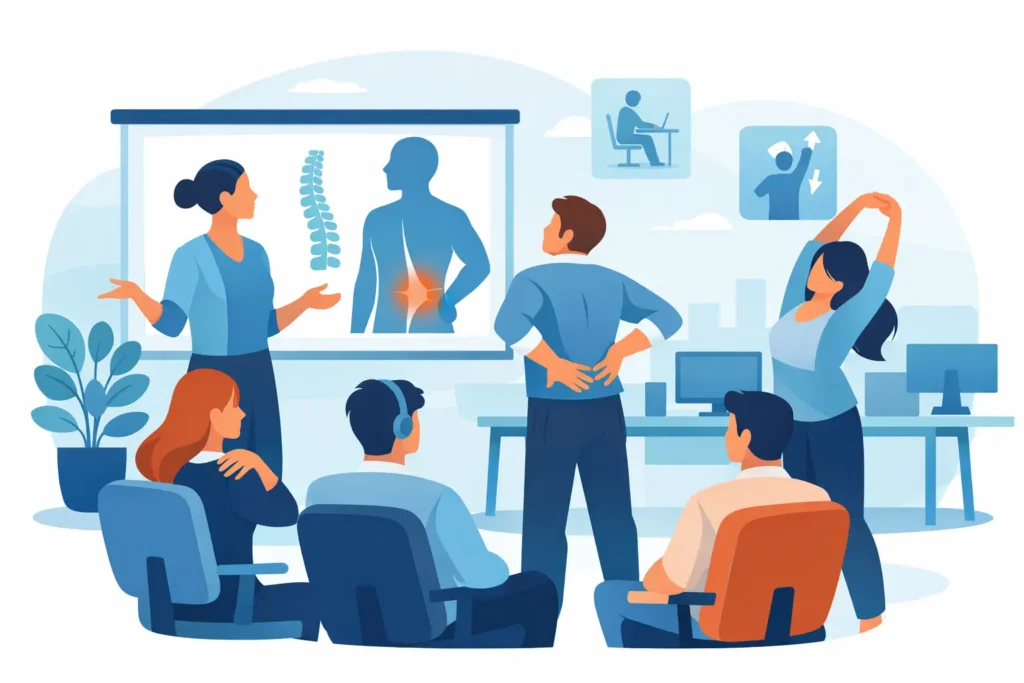
A desk worker back pain prevention workshop gives employers a practical way to address that pattern early. Done well, it is not a generic posture talk or a one-off wellbeing extra. It is a focused intervention that helps people understand why discomfort develops, what changes are realistic in a working day, and how managers and HR teams can support healthier habits without adding operational complexity.
For employers building a structured wellbeing plan, the value is straightforward. Back pain prevention is visible, relevant to a large share of the workforce and relatively easy to engage employees with, because the problem feels immediate. People do not need persuading that an aching lower back, stiff shoulders or a tight neck affects their day.
What a desk worker back pain prevention workshop should actually cover
The most useful workshops move beyond the old message of simply sitting up straight. For desk-based teams, back pain is rarely caused by one single posture held incorrectly. More often, it comes from a mix of static positions, repeated strain, lack of movement, stress-related tension and workstation setups that do not match the individual using them.
A strong session should explain this in plain language. Employees need to know that discomfort can be influenced by chair height, screen position and keyboard placement, but also by how often they move, how they use laptops, how they carry tension during busy periods and how little variety exists in the working day.
That matters because oversimplified advice can backfire. If a workshop tells staff there is one perfect posture, many will either ignore it or feel they are getting it wrong every time they shift position. A better approach is to teach adjustable, sustainable habits. The goal is not frozen alignment. It is better movement, better setup and fewer long periods of static loading.
Core topics worth including
A workplace-focused workshop should usually cover workstation basics, common pain triggers, movement strategies and simple self-management techniques. It should also address the reality of hybrid work, where employees may switch between a well-equipped office desk and a kitchen table.
In practice, that means showing people how to adjust what they can control, where to place screens and input devices, when to stand or walk, and how to spot early warning signs before discomfort becomes persistent. It should also make clear when self-help is no longer enough and further clinical support may be appropriate.
Why workshops work better than sending a posture PDF
Many organisations already distribute DSE guidance, workstation checklists or short intranet articles. Those resources have their place, but they often fail for one simple reason: they ask employees to translate advice into action on their own.
A workshop improves uptake because it provides structure, context and accountability. Staff can see examples, ask questions and understand how the advice applies to their own role. That matters for desk workers whose day includes more than sitting at one monitor. Some spend hours in video calls, others hot-desk, travel between sites or work from home several days a week. Their risks are similar, but not identical.
From an employer perspective, workshops also create a clearer wellbeing output. Attendance can be tracked, feedback can be gathered and common issues can be identified. If a large number of employees raise the same concerns, such as laptop-heavy working or lack of movement breaks, that gives HR and wellbeing leads practical information to shape future support.
What good delivery looks like in the workplace
The best format depends on your workforce. A single in-person workshop can work well for one-site teams, especially where employers want strong engagement and live demonstration. Online sessions suit hybrid and multi-site organisations, where accessibility and coverage matter more than physical attendance in one room.
Neither option is automatically better. On-site delivery tends to encourage interaction and can be easier for hands-on setup guidance. Online delivery is often more scalable and easier to repeat across regions. For many employers, a blend of both makes the most sense.
A practical session length is usually 45 to 60 minutes. That is long enough to cover causes, prevention and technique without losing attention. Shorter sessions can work as awareness briefings, but they often leave little room for questions or tailored advice. Longer sessions may be useful for high-risk groups, though they need a clear reason to justify calendar time.
The difference between awareness and behaviour change
One workshop alone will not solve workplace back pain. It can improve awareness quickly, but lasting benefit depends on reinforcement. That is why employers often get better results when back pain prevention sits within a broader programme rather than as a stand-alone event.
For example, a workshop can be followed by office yoga or movement classes, manager prompts around break habits, or wider wellbeing activity focused on stress, sleep and physical activity. That joined-up model reflects the reality of musculoskeletal health. People do better when support is consistent and easy to access, not limited to one awareness day.
How to judge whether a workshop is right for your organisation
If your workforce is largely desk-based, the case is usually strong. The bigger question is what outcome you need.
If you are seeing repeated complaints about aches and stiffness, a workshop can act as early intervention. If you are launching or refreshing a wellbeing calendar, it can be a high-relevance topic that drives participation. If you need something measurable, it works well alongside other initiatives because attendance, feedback and follow-on actions are relatively easy to capture.
It is also useful when employers want a preventative message rather than waiting for formal absence cases or occupational health referrals to increase. Prevention is typically more cost-effective, but it requires visible, low-friction activity that employees can join during working hours.
There are trade-offs. A workshop is not a replacement for individual ergonomic assessment where someone already has significant pain or a complex condition. It is also less effective if the organisation delivers the session but ignores obvious practical barriers afterwards, such as inadequate equipment or a culture that rewards staying seated all day.
Fitting a back pain workshop into a wider wellbeing plan
For HR and wellbeing leads, the operational question is usually not whether the topic matters. It is how to run it without creating more admin than value.
That is where service design matters. A workplace workshop should be easy to book, simple to deliver and realistic for the setting. Employers should know what format is available, what the session covers, how many people can attend, what space is needed for on-site delivery and whether remote access is available for hybrid teams.
It also helps to position the workshop as part of a year-round programme. Musculoskeletal health links naturally with movement classes, stress management, sleep education and basic health awareness. In many organisations, participation improves when employees can see how one session connects to the wider picture of feeling and performing better at work.
For some employers, there is additional value in combining educational sessions with measurable wellbeing touchpoints. A provider such as Relaxa can support broader workplace wellbeing activity through workshops, classes and practical health initiatives that are straightforward to deploy across UK sites. That joined-up approach tends to make engagement easier because employees are offered more than one route into healthier habits.
Questions buyers should ask before booking
Before choosing a desk worker back pain prevention workshop, it is worth checking how tailored the content will be to your workforce. A session for call centre staff may need a slightly different emphasis from one for hybrid professional services teams or employees who spend much of the day on laptops.
Ask whether the workshop is educational, interactive or both. Check whether it includes practical setup advice for office and home environments. Clarify how attendance works, what support materials are provided afterwards and whether the provider can scale delivery across multiple sites.
It is also sensible to ask what success looks like. That may be attendance volume, employee feedback, increased awareness, reduced discomfort reports or stronger engagement with wider wellbeing activity. Being clear about the purpose helps you choose the right format and follow-up.
The real opportunity for employers
Back pain prevention is not only about reducing discomfort. It is about making desk-based work more sustainable. Employees who understand how to set up their space, vary their posture and build more movement into the day are often more comfortable, more focused and more likely to engage with wellbeing support generally.
That is why this topic remains one of the most practical additions to a workplace wellbeing programme. It speaks to a widespread issue, it fits both on-site and online delivery, and it gives employers a visible way to show proactive duty of care.
A well-run workshop will not promise miracle fixes. It will give your people realistic actions they can use the same day, while giving your organisation a clear, low-friction step towards healthier working habits.