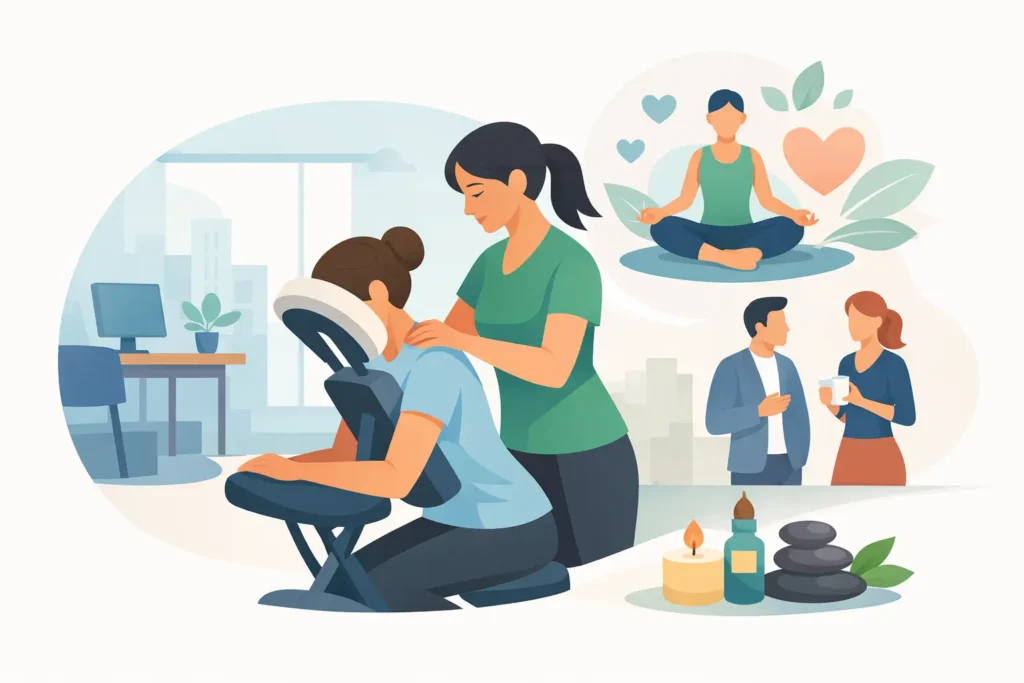
Stress shows up at work long before anyone says they are struggling. It appears in tight shoulders after hours at a desk, reduced concentration in the afternoon, and the steady drop in energy that affects morale and output. For employers running a serious wellbeing strategy, on-site massage UK services offer a practical way to respond early, with minimal disruption and clear value for staff.
This is not a luxury add-on. In the right setting, workplace massage is a simple intervention that helps employees reset during the working day. It supports stress management, gives people permission to pause, and often achieves strong participation because it is easy to access. There is no travel, no off-site appointment, and no complicated set-up for HR teams.
What on-site massage UK services look like at work
In most workplaces, on-site massage is delivered as seated acupressure massage. Employees remain fully clothed and sessions usually run for 10 to 20 minutes, depending on the format of the day. Treatment focuses on common tension areas such as the neck, shoulders, back, arms and scalp, making it well suited to office-based and hybrid teams.
From an operational point of view, it works because the footprint is small. A quiet meeting room, breakout area or screened corner is often enough. There is no need for complex equipment, and the schedule can be structured around your working day, whether that means short bookable slots, drop-in sessions, or support for a wider wellbeing event.
For employers with multiple sites, consistency matters. National delivery capacity, clear booking processes and reliable therapist cover are what turn a wellbeing idea into something repeatable across the business.
Why employers book office massage
The strongest reason is accessibility. If wellbeing support is difficult to use, uptake falls. Office massage removes that friction. Staff can attend during the day, return to work quickly afterwards, and feel an immediate benefit.
There is also a strong cultural signal. Providing massage at work shows employees that wellbeing is being addressed in practical terms, not just through policy documents or awareness campaigns. It can work well during busy periods, organisational change, staff appreciation days, health promotion weeks, and return-to-office initiatives.
That said, the value is not only about morale. For many organisations, massage sits alongside broader preventative support. It can complement initiatives such as Employee Health Checks, where employees gain objective health data, while massage addresses the day-to-day physical effects of stress and desk-based work.
What good delivery looks like
A well-run service should be straightforward for HR or People teams to manage. That means clear timings, simple room requirements, and a booking model that suits your workforce. In smaller offices, half-day sessions may be enough. In larger organisations, full-day delivery or multi-therapist cover may be more appropriate.
The best format depends on your aim. If the goal is broad engagement, shorter sessions allow more staff to take part. If the objective is deeper relaxation for a smaller group, longer appointments may be better. There is no single correct model, which is why practical planning matters.
Communication also affects uptake. Employees need to know what the session involves, how long it takes, and that they do not need to change clothes or leave the building. When expectations are clear, participation is usually stronger.
Where on-site massage fits in a wellbeing programme
Massage works best when it is part of a wider plan rather than a one-off gesture. Used on its own, it can still be valuable. Used alongside education and preventative support, it becomes part of a more credible wellbeing offer.
For example, employers often pair massage with movement sessions such as Office Yoga Classes for Staff, or with structured learning on resilience, sleep and stress. That combination helps employees feel immediate relief while also building longer-term habits.
It is also useful for mixed workforces. Office teams may use massage most frequently, but the model can also suit contact centres, public sector workplaces, universities and multi-site employers where short, on-site wellbeing interventions are easier to deliver than off-site benefits.
Choosing the right provider
When comparing providers, convenience should be matched with delivery reliability. For UK employers, that means checking service area, therapist availability, experience in workplace environments, and how bookings are managed. If you are running sessions across more than one location, coordination becomes just as important as treatment quality.
It is worth asking practical questions early. How many employees can be seen in a day? What space is required? Can the provider support recurring bookings? Do they work nationally or only in selected cities? Those details affect cost, participation and the amount of admin your team needs to handle.
A specialist On-site Massage UK provider should be able to answer those points clearly and help shape a format that fits your workplace rather than forcing a standard package.
A simple service with visible impact
On-site massage is effective because it is easy to use, easy to arrange and immediately understood by employees. In a workplace setting, that matters. The more straightforward the service, the more likely people are to engage with it.
For employers who want practical wellbeing support without heavy logistics, it remains one of the most accessible options available. And when it is delivered consistently, as part of a broader programme, it can do more than offer a short break – it can help make wellbeing visible in the working day.