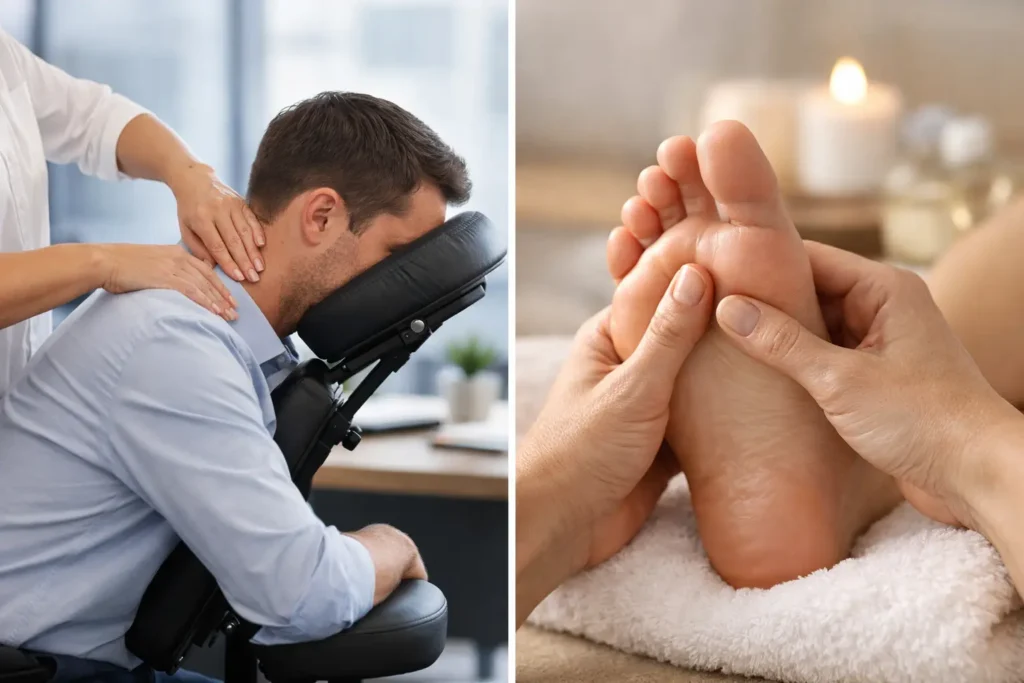
A lunchtime wellbeing session has to earn its place in a busy working day. Employees need to be able to take part without changing into sportswear, travelling off-site or losing half an afternoon to an appointment. That is why employee massage or reflexology is a practical choice for organisations looking to add a visible, valued benefit to a wider wellbeing programme.
Both services give people dedicated time away from screens, meetings and repetitive tasks. They can support relaxation, help employees notice areas of tension and create a positive focal point for a wellbeing week, benefits launch or regular engagement calendar. The right choice depends less on which treatment is universally better and more on your workforce, available space, budget and the outcome you want the session to support.
Employee Massage or Reflexology: The Practical Difference
Workplace massage usually focuses on the upper body: neck, shoulders, back, arms and hands. It is commonly delivered as seated acupressure massage through clothing, using a purpose-designed massage chair. Sessions are typically short, making it possible for a larger number of employees to take part over the course of a day.
This format is particularly suited to office-based teams, call centres and hybrid workplaces where people spend long periods at desks. Employees often identify shoulder and upper-back tightness as an immediate issue, so the purpose of the session is easy to understand. There is no need for oils, changing facilities or shower access, and the therapist can work effectively in a meeting room or quiet breakout area.
Reflexology is a treatment applied to the feet, based on pressure techniques. A workplace reflexology session normally takes place in a reclining chair, with the employee keeping their clothes on. It offers a calmer, more private-feeling experience than seated massage and may appeal to employees who do not want direct work on their shoulders, back or head.
The practical trade-off is capacity. Reflexology appointments are generally longer than short chair massage slots, so fewer employees can be seen in a day. It also requires a more settled environment, as participants remove footwear and need to recline comfortably. For a small team day or a premium wellbeing event, that may be exactly the right fit. For a large office where participation is the priority, massage is often easier to scale.
Neither service should be positioned as medical treatment or a substitute for clinical care. A qualified practitioner will ask appropriate health questions before the session and may decide that a treatment should be adapted, postponed or avoided. Employees with a health concern should seek advice from a suitable healthcare professional.
Choose the Outcome Before Choosing the Treatment
For HR and wellbeing teams, the starting point should be a clear brief. If the aim is to reach as many people as possible during a single workplace event, short seated massage sessions generally provide the strongest throughput. Employees can book a slot or join a managed queue, receive treatment without major disruption and return to work promptly.
If your aim is to offer a more individual restorative experience, reflexology may be a better match. It works well for smaller groups, leadership retreats, wellbeing days with pre-booked appointments or workplaces where employees have already asked for relaxation-focused support.
There is also an engagement consideration. Massage tends to be familiar and self-explanatory, which can help attract first-time participants. Reflexology can feel more distinctive and may create interest among employees who have tried massage before. Neither option will suit everyone, and participation should always be voluntary. Providing a short, plain-English explanation of what the treatment involves helps people make an informed choice.
For many organisations, the best answer is not to choose one service permanently. A quarterly massage day can give broad access, while reflexology can feature as part of a smaller wellbeing campaign. This approach keeps the programme varied without adding unnecessary complexity.
What a Workplace Session Requires
The operational requirements are straightforward, but planning them properly protects the employee experience. A private meeting room, wellness room or screened-off quiet area is usually sufficient. The space should be clean, warm enough for people sitting still and away from constant footfall, noisy equipment and confidential conversations.
For seated massage, allow room for the massage chair, therapist and a clear route for employees to enter and leave safely. For reflexology, allow additional space for a reclining chair and ensure employees can sit down and remove their shoes comfortably. Accessible entry is essential, and the provider should be told in advance about any site-specific requirements such as security procedures, parking restrictions or lifts.
A named workplace contact makes a material difference on the day. They can meet the therapist, confirm the room, help with access and deal with any last-minute questions. Employers should also decide whether sessions will be first-come, first-served or pre-booked. Pre-booking creates certainty for employees and can reduce queues. A mixed approach, with most appointments booked and a small number held for walk-ins, can work well where attendance patterns are less predictable.
Clear communications are equally important. Tell employees where the session is taking place, how long it lasts, what to wear and whether they need to bring anything. For reflexology, simply explaining that footwear will be removed avoids uncertainty. Remind participants to arrive on time, as a late arrival can affect the schedule for everyone else.
Measuring Value Beyond Attendance
Attendance is a useful starting point, particularly when a service is being trialled. Record the number of available appointments, sessions delivered and no-shows. These figures show whether the time, location and booking method were right for your workforce.
However, take-up alone does not tell the whole story. A short optional feedback form can provide practical insight: whether employees found the session relaxing, whether the timing was convenient and whether they would use the service again. Keep questions focused and anonymous. The purpose is to improve programme design, not to ask employees to disclose personal health information.
Massage and reflexology are most effective as part of a consistent wellbeing offer rather than a one-off response to a stressful period. Pairing them with office yoga, movement sessions, posture education, sleep webinars or mental health awareness training gives employees different ways to take action. A health screening activity can add another preventative element by helping people understand measures such as blood pressure, BMI, pulse and body fat percentage in a convenient workplace setting.
This combination matters because wellbeing needs vary. One employee may value a short treatment for desk-related tension; another may prefer a webinar they can access from home; someone else may be motivated by knowing their health numbers. A structured programme offers choice while giving employers a clearer view of what is being used.
Common Decisions That Affect Participation
The location can determine whether employees take part. A room tucked away in another building may protect privacy, but it can also reduce footfall. A central meeting room is convenient, provided it can be made quiet and confidential enough. For multi-site employers, rotating services between locations is often fairer than concentrating all activity at head office.
Timing matters too. Mid-morning and mid-afternoon sessions can suit office schedules, while early, late or shift-change slots may be needed in operational environments. Avoid assuming that a standard nine-to-five timetable represents the whole workforce. Ask managers and wellbeing champions about peak periods before setting the schedule.
It is also worth considering equity. Employees who work remotely, on shifts, in customer-facing roles or at satellite sites can be excluded from an office-only event. Where on-site treatments cannot reach everyone at once, balance them with online wellbeing learning or repeat sessions across locations. The goal is not identical provision in every instance, but a credible opportunity for all employees to access support.
Making the Choice With Confidence
Choose seated massage when you need high participation, short appointments and a simple setup that addresses common upper-body tension. Choose reflexology when you have more time per person, a suitably private space and employees who would value a quieter, foot-focused treatment. Both can sit comfortably within a practical workplace wellbeing plan when delivered by qualified professionals and organised around the realities of your site.
The most useful next step is to look at one ordinary working day: the rooms available, the number of employees on site, the shift pattern and the moments when people can genuinely step away. A wellbeing service works best when taking part feels easy, not like another task to fit into the diary.