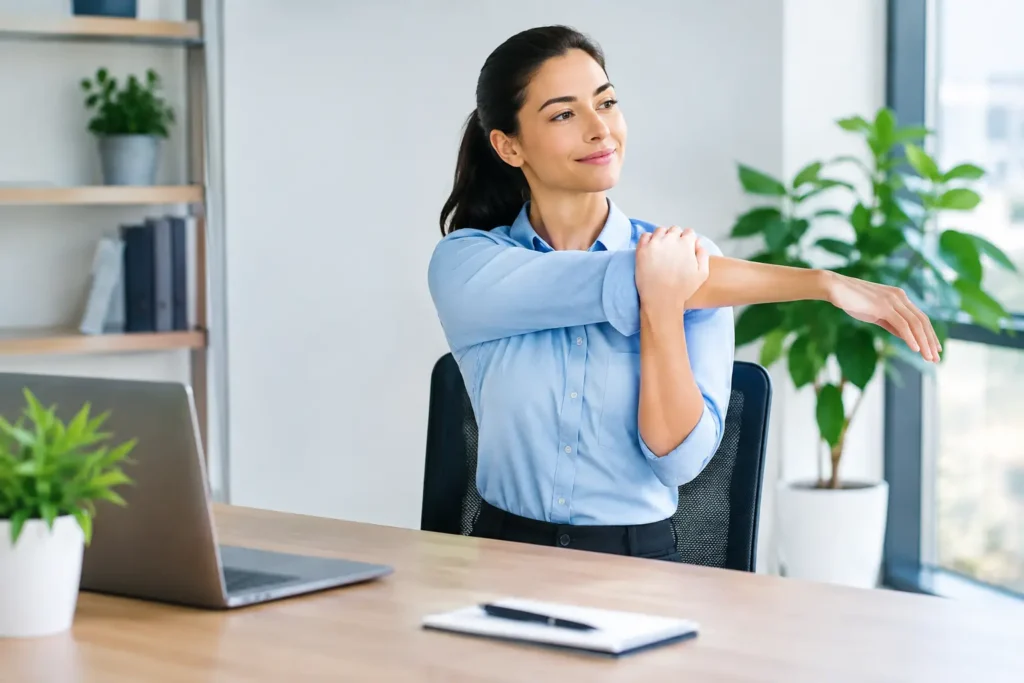
Most desk-related discomfort does not begin with one ‘bad’ sitting position. It usually builds through long, uninterrupted periods at a screen, limited movement between meetings and workstations that do not suit the individual. The best workplace posture exercises give employees short, practical ways to reset during the working day – without changing clothes, booking a gym session or leaving the office.
For employers, the aim is not to police how people sit. It is to make regular movement easier, reduce the likelihood of avoidable aches and support employees to feel more comfortable and focused at work. A well-designed posture initiative also works for hybrid teams, where workstation set-ups and daily routines can vary considerably.
Why posture exercises belong in a workplace wellbeing plan
Posture is dynamic. Even an ergonomically sound chair and desk will not feel comfortable if someone remains in the same position for hours. Small movements improve circulation, give tired muscles a break and encourage staff to notice when they are holding tension in their shoulders, neck or lower back.
This is why one-off workstation guidance has limits. It remains valuable, particularly when employees are new to a role or working from home, but it should be supported by regular movement habits. Short exercise sessions can be delivered as part of a wellbeing week, a lunch-and-learn, an office yoga class or a recurring five-minute team reset.
Employers should also set realistic expectations. Posture exercises may help with everyday stiffness and muscular tension, but they are not a substitute for clinical assessment. Employees with severe, persistent or worsening pain, numbness, dizziness, recent injury or a diagnosed condition should seek advice from an appropriate health professional before taking part.
10 best workplace posture exercises for staff
The following exercises are suitable for most office-based employees and require little or no equipment. Each movement should feel controlled and comfortable, never forced. Encourage staff to work within their own range of movement and stop if an exercise causes pain.
1. Seated chin tucks
Looking down at a laptop or mobile phone can encourage the head to drift forwards. While sitting tall, employees should gently draw the chin straight back, as if making a double chin, without tipping the head up or down. Hold for three to five seconds, then relax. Repeating this six to eight times can help bring awareness back to neck position.
2. Shoulder blade squeezes
Rounded shoulders are common after long periods of keyboard and mouse work. Staff can sit or stand, soften the shoulders away from the ears and gently draw the shoulder blades back and down. Hold for five seconds and repeat eight to ten times. The movement should feel like opening the chest rather than forcing the shoulders backwards.
3. Upper trapezius neck stretch
For a simple side-neck stretch, sit upright and let one ear move gently towards the same-side shoulder. Keep both shoulders relaxed and avoid pulling the head with the hand. Hold for 15 to 20 seconds on each side, breathing steadily. This can be especially useful after concentrated screen work, although employees should avoid it if they have an acute neck problem.
4. Seated thoracic rotation
The upper back can become stiff when employees remain facing one screen all day. Sitting towards the front of the chair, cross the arms over the chest and rotate slowly to one side from the ribs, keeping the hips facing forwards. Pause briefly, return to centre and repeat on the other side. Five rotations each way is enough for a quick movement break.
5. Chair-supported chest opener
Stand beside a stable chair or desk. Place one hand lightly behind on the chair back, then turn the body gently away until a stretch is felt across the front of the chest and shoulder. Hold for 15 seconds before changing sides. The chair must not be on wheels or likely to move, and the stretch should remain gentle.
6. Seated spinal extension
Employees can counter a prolonged forward-leaning position by sitting back in a supportive chair, placing their hands behind their head and gently lifting the chest towards the ceiling. The movement comes from the upper back rather than an exaggerated arch in the lower back. Perform five slow repetitions, returning to a neutral position between each one.
7. Standing hip flexor stretch
Sitting keeps the hips flexed for long periods. From a split stance, with one foot in front and both feet pointing forwards, staff can bend the front knee slightly and shift their weight forwards while keeping the torso upright. They should feel a stretch at the front of the rear hip. Hold for 15 to 20 seconds and switch sides.
8. Sit-to-stands
Sit-to-stands add useful leg movement to the day and interrupt prolonged sitting. From a chair that is stable and at a suitable height, stand up without rushing, then sit back down with control. A set of eight to ten repetitions is sufficient. Employees who find this difficult can use their hands on the chair arms or complete fewer repetitions.
9. Calf raises
Standing calf raises are an accessible option between calls. Hold a desk or chair lightly for balance, rise onto the balls of both feet, pause, then lower slowly. Ten to fifteen repetitions encourage lower-leg movement and can be completed in less than a minute. They are particularly useful for people who spend most of their day seated.
10. Wrist and forearm stretch
Mouse and keyboard use can create tension in the forearms. Extend one arm in front with the palm facing down, then use the other hand to guide the fingers gently towards the floor. Hold for 10 to 15 seconds, then turn the palm upwards and repeat with the fingers guided back gently. Avoid forcing the wrist into an uncomfortable position.
Make the exercises easy to use, not another task
The best programme is one employees can realistically repeat. A 20-minute class may suit a wellbeing event, while a two-minute movement prompt can work better between regular meetings. Offering both gives staff choice and avoids the assumption that everyone has the same schedule, mobility or confidence level.
For office teams, consider placing simple posture prompts in breakout areas or including a movement moment at the start of longer meetings. For hybrid and remote colleagues, provide a live online session and a short written routine they can use independently. Video participation should be optional, particularly where staff are joining from home.
Timing matters. Mid-morning and mid-afternoon are often practical points for a reminder, but the organisation should avoid creating a rule that feels intrusive. The purpose is to give permission to move, not to monitor individual behaviour. Managers can support uptake by taking part themselves and by avoiding back-to-back meeting cultures where no one has time to stand up.
Pair movement with practical workstation habits
Exercises work best alongside simple adjustments to the working environment. Employees should be able to position the top of their screen at roughly eye level, keep frequently used items within easy reach and use a chair that supports a comfortable sitting position. Laptop users may benefit from a separate keyboard and mouse, particularly when working for extended periods.
It also helps to reinforce that there is no single perfect posture to hold all day. Sitting, standing and moving are all useful when varied sensibly. Someone who has access to a sit-stand desk may benefit from alternating positions, but a standing desk alone is not a solution if it simply replaces long periods of sitting with long periods of standing.
A broader wellbeing offer can make these messages more credible. Office yoga or guided movement sessions provide structured support, while webinars on posture, stress, sleep and resilience help employees understand how work habits can affect physical comfort and energy. Where employers are running health screening activity, it can create a useful prompt for staff to consider everyday preventative behaviours alongside their core health measures.
Measure participation and keep improving
For HR and wellbeing teams, success is not measured by whether every employee completes every exercise. More useful indicators include attendance at sessions, repeat participation, employee feedback and whether staff feel able to take movement breaks without concern. Short pulse surveys can reveal whether employees want more desk-based options, longer classes or additional guidance for home working.
Keep the programme inclusive. Provide seated alternatives, make instructions clear, avoid language that shames people about posture and ensure sessions can be adapted for different physical abilities. A qualified instructor can help employees move safely while making the experience welcoming rather than performative.
A practical posture programme starts with a small commitment: create a few minutes of space in the working day, offer clear guidance and make movement normal. When staff can act on that permission consistently, workplace wellbeing becomes something they can feel as well as talk about.