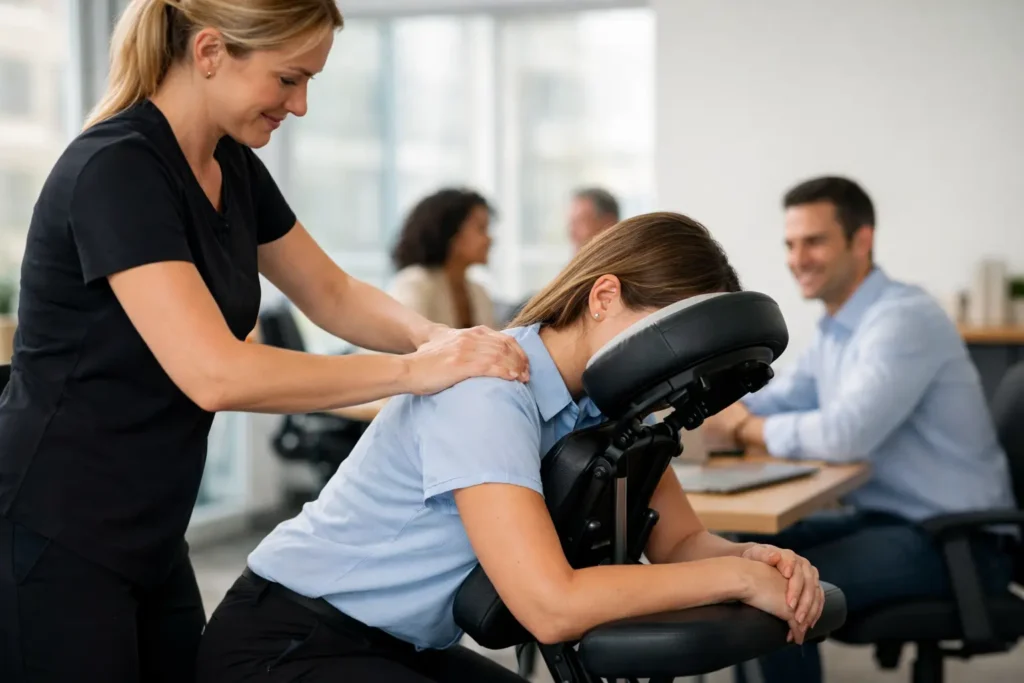
When wellbeing activity is hard to access, employees simply do not use it. That is why Chair Massage at Work remains one of the most practical on-site wellbeing services for busy employers. It is quick to deliver, easy for staff to try during the working day, and simple for HR teams to run without adding a heavy admin burden.
For organisations looking to improve engagement rather than just add another benefit, chair massage works because the barrier to entry is low. There is no need for specialist clothing, no shower facilities, and no long appointment times. Employees stay fully clothed, sessions can be delivered in a small meeting room or quiet area, and participation can be spread across the day with minimal disruption.
Why chair massage works well in the workplace
The main strength of chair massage is convenience. In most workplaces, uptake improves when a service is visible, easy to book, and short enough to fit around meetings, shifts, or desk-based work. A 10 to 20 minute session is often enough to give employees a meaningful break without taking them away from work for too long.
That matters because many of the issues employers are trying to address are day-to-day rather than clinical. Muscle tension across the neck and shoulders, mental fatigue, low energy, and the cumulative effect of stress are common in office, hybrid, and customer-facing roles. Chair massage is not a medical treatment, but it can support comfort, relaxation, and short-term stress reduction in a way employees immediately understand.
From an employer perspective, it also suits structured wellbeing plans. It can be used as a standalone event, as part of a wider awareness campaign, or alongside other services such as webinars, movement sessions, or health checks. If you already run broader Massage at Work activity, chair massage is often the most straightforward format to deploy at scale.
What employees actually receive
Chair massage is typically delivered on a specially designed massage chair that supports the upper body while keeping the employee in a comfortable seated position. Sessions usually focus on areas where workplace tension tends to build – the back, shoulders, neck, arms, and sometimes scalp.
Because employees remain clothed, the process is straightforward and workplace-appropriate. There is no need for oils, treatment rooms, or lengthy preparation time between sessions. That keeps turnover efficient, which is useful when you want a high number of employees to take part over a single day.
The format also helps first-time users feel more comfortable. Some employees will never book a full massage treatment outside work, but they will try a short, clearly structured session at the office. That makes it a strong engagement tool, especially during wellbeing weeks, stress awareness campaigns, or periods of high workload.
Chair Massage at Work and stress reduction
Stress support in the workplace often falls into two categories: long-term education and immediate relief. Both matter. Training helps employees understand stress, build resilience, and spot patterns. On-site wellbeing services give people a practical interruption to the day when pressure is already high.
Chair Massage at Work sits firmly in that second category. It creates a short pause, encourages people to leave their desk, and helps reduce physical tension that often travels with mental strain. Used in the right way, it can complement broader stress-management activity rather than replace it.
If your aim is to build a more complete programme, this works best when paired with resources that explain causes and coping strategies, such as How to Beat Stress at Work or Managing Stress at Work. The massage session provides the immediate experience. The supporting content helps maintain the effect beyond the event itself.
What HR teams need to plan
For most employers, the key question is not whether staff would like massage at work. It is whether the service can be delivered simply, safely, and without consuming too much internal time. That is where operational planning matters.
In practice, chair massage is a low-friction service. You normally need a small private or semi-private area, enough room for the chair and therapist to work safely, and a schedule that matches the number of employees you want to reach. A spare meeting room is often enough. In larger sites, a rotating pop-up arrangement can also work well.
Session length should be driven by your participation goal. Shorter sessions allow more employees to access the service in a day, which is useful for awareness events and larger headcounts. Slightly longer sessions may suit smaller teams or organisations focusing on a more premium wellbeing experience. There is a trade-off between depth and reach, so the right format depends on your objective.
Communication also affects uptake. When employees know where the service is, how long it takes, and that they can attend without changing clothes, booking rates tend to improve. Clear internal messaging removes uncertainty. So does making the process feel normal rather than indulgent. Position it as a practical wellbeing intervention, not a perk reserved for a few.
Where chair massage fits in a wider wellbeing strategy
Chair massage is most effective when it is not expected to carry the whole wellbeing programme on its own. It is a useful touchpoint, but sustained behaviour change usually comes from combining visible events with education, self-management tools, and preventative health support.
For example, employers often use on-site massage to increase engagement, then support that activity with posture training, stress education, or basic health screening. That combination gives employees both an immediate experience and a clearer picture of their wider wellbeing.
If musculoskeletal discomfort is a common issue in your workforce, a massage day can sit naturally alongside Posture Management Training at Work or workstation education. If your goal is broader participation in wellbeing activity, it may also complement a larger Company Wellbeing Initiative where different services are scheduled across the year rather than concentrated into a single campaign week.
This joined-up approach also helps HR teams demonstrate practical output. Instead of offering a one-off event with no follow-through, you can show a pattern of support across stress, posture, physical comfort, and preventative health.
Common concerns and the real answer
One concern is whether chair massage is suitable for all workplaces. In most office and hybrid settings, the answer is yes, provided there is enough space and sensible scheduling. In industrial, shift-based, or multi-site environments, it can still work well, but session planning needs more thought. Access windows may be shorter, room availability may be tighter, and employee flow may vary by shift.
Another concern is fairness. If demand is high, some employees may feel they have missed out. That is why capacity planning matters. It is often better to offer shorter sessions to more people than longer sessions to a small group, especially when the aim is visible wellbeing engagement.
There is also the question of measurement. Chair massage does not produce the same hard data as a health screening service, so success should be judged differently. Useful indicators include booking uptake, attendance rates, employee feedback, repeat demand, and whether the service increases participation in other wellbeing activity. For employers who want both engagement and measurable health outputs, massage can sit alongside a screening solution rather than compete with it.
Getting better participation from Chair Massage at Work
The difference between an underused wellbeing service and a well-used one is usually practical, not theoretical. Employees are more likely to take part when sessions are held in a visible location, timings are kept short, line managers support attendance, and booking is simple.
It also helps to present chair massage as part of normal working life. Midday slots, team wellbeing days, and themed campaigns often perform better than vague invitations to book whenever possible. The service should feel accessible and timely.
For national employers and multi-site organisations, consistency matters too. A wellbeing offer only works at scale if delivery is reliable across locations. That is one reason many employers choose a provider that can support on-site services as part of a broader workplace wellbeing programme, rather than sourcing ad hoc sessions site by site.
Relaxa positions chair massage in exactly that practical way – as one component of a wider service menu that helps employers run low-friction wellbeing activity with less internal coordination. For HR teams balancing engagement, budgets, and operational simplicity, that tends to matter just as much as the service itself.
Chair massage is not complicated, and that is part of its value. When employers need a wellbeing option that employees will actually use, fits into the working day, and supports a wider duty-of-care approach, simple delivery often gets the best results.