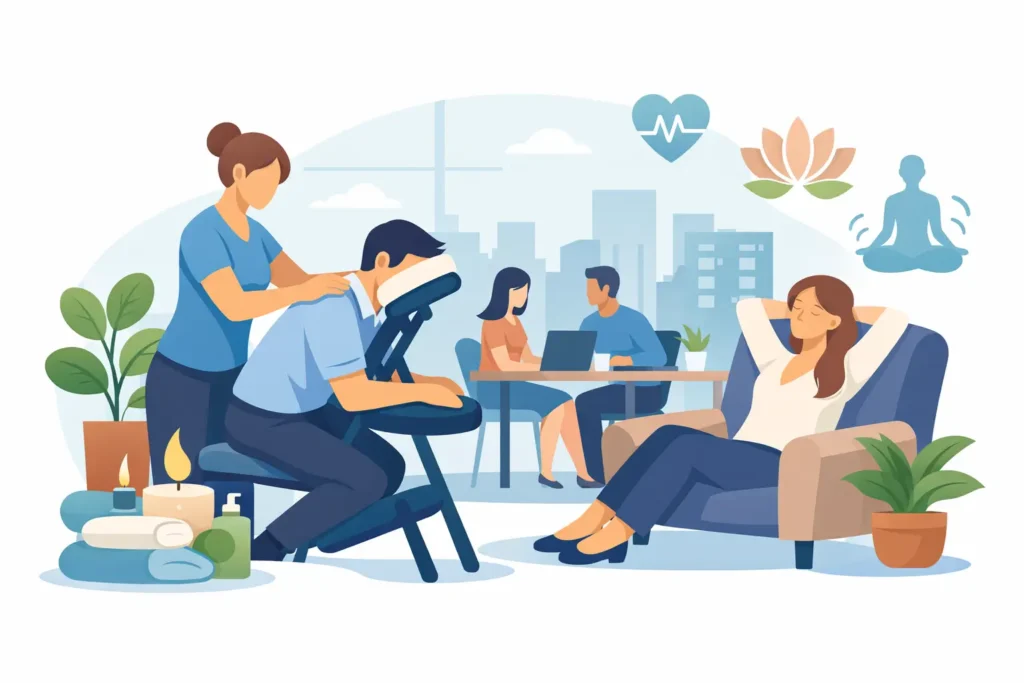
A wellbeing initiative only works if people actually use it. That is why corporate massage in the UK remains one of the most reliable ways to increase participation quickly. It is easy to understand, simple to deliver on-site, and gives employees an immediate benefit during the working day.
For HR teams and wellbeing leads, the appeal is practical as much as therapeutic. There is no need for complex scheduling, no specialist room fit-out, and no lengthy time commitment from staff. A corporate massage session can be delivered in a small office space, staff breakout area, or meeting room, with employees attending in short time slots that fit around meetings and operational demands.
Why corporate massage UK services work in the workplace
Most workplace wellbeing programmes face the same challenge: good intentions, low engagement. Employees may value support in theory, but uptake drops when activities require travel, long appointments, or too much admin. Corporate massage UK services solve that by bringing the service directly to the workplace.
On-site massage is built for convenience. Treatments are usually delivered on an ergonomic chair, fully clothed, and can be organised in short sessions, often from 10 to 20 minutes. That makes it suitable for office-based teams, hybrid workplaces during anchor days, contact centres, and larger multi-site employers that need a repeatable format.
There is also a clear workplace case beyond morale. Massage can help reduce feelings of tension in the neck, shoulders and upper back, which are common complaints for desk-based employees. It also gives staff a visible signal that wellbeing support is not just a policy document but something they can access during the day.
What employers should look for in a corporate massage provider
Not all services are equal. For employers, the main question is not simply whether massage is popular, but whether it can be deployed smoothly and at scale. A provider should be able to explain exactly how sessions work, what space is required, how bookings are managed, and how they cover different locations across the UK.
National coverage matters if you operate across more than one office. So does reliability. If an activity is part of a wellbeing calendar, managers need confidence that therapists will arrive on time, equipment requirements are minimal, and the service can run with limited support from internal teams.
It is also worth checking whether the provider can support wider wellbeing goals. Massage works well as a standalone intervention, but it is often more effective when paired with other services such as employee health checks, stress education, or movement-based sessions. That allows employers to offer both immediate relief and longer-term support.
How on-site delivery works in practice
A well-run corporate massage programme should be straightforward to set up. In most cases, the employer provides a suitable indoor space with enough room for a massage chair and some privacy. Session lengths are agreed in advance, along with the number of staff attending and the times available.
From there, delivery should be low friction. Employees attend their slot, receive treatment fully clothed, and return to work without the disruption of travelling off-site. This simplicity is one reason on-site corporate massage is often used during wellbeing weeks, peak-pressure periods, and recognition events.
There are, however, a few practical points to think through. Shorter sessions improve throughput, but they may feel more like a reset than a deeper intervention. Longer sessions offer more individual benefit, though fewer employees can be seen in a day. The right balance depends on whether your priority is broad participation, visible engagement, or targeted support for smaller teams.
Where corporate massage fits in a wider wellbeing plan
Massage should not carry the full weight of a workplace wellbeing strategy. It works best as part of a broader offer that supports prevention, education and behaviour change.
For example, if your workforce reports high pressure levels, massage can provide an immediate outlet while structured learning addresses the underlying issue. Pairing sessions with stress training that employees will use can help staff move from short-term relief to practical coping strategies. Equally, desk-based teams often benefit from combining massage with office yoga classes for staff to tackle posture, movement and muscular tension more consistently.
This joined-up approach also helps HR teams demonstrate range. Some employees will engage with hands-on services. Others prefer webinars, training, or screening activities. A stronger programme gives people different ways in, without creating heavy administration.
Is corporate massage right for every organisation?
Usually, yes – but the format may vary. Smaller offices may book a single therapist for a half day around a campaign or staff event. Larger employers may run full-day sessions, repeated visits, or combine massage with other on-site wellbeing services to increase footfall.
The main constraints are space, workforce patterns and objectives. A highly dispersed field-based workforce may need a mix of on-site sessions and digital support. A manufacturing site or operational environment may need careful planning around break schedules and room availability. None of those are barriers, but they do affect how the service should be organised.
For employers that want a visible, easy-to-run wellbeing activity with strong staff appeal, corporate massage remains one of the most practical options available. It is quick to deploy, simple for employees to access, and easy to build into a wider annual wellbeing plan. If the aim is higher engagement without adding operational complexity, it is a sensible place to start.