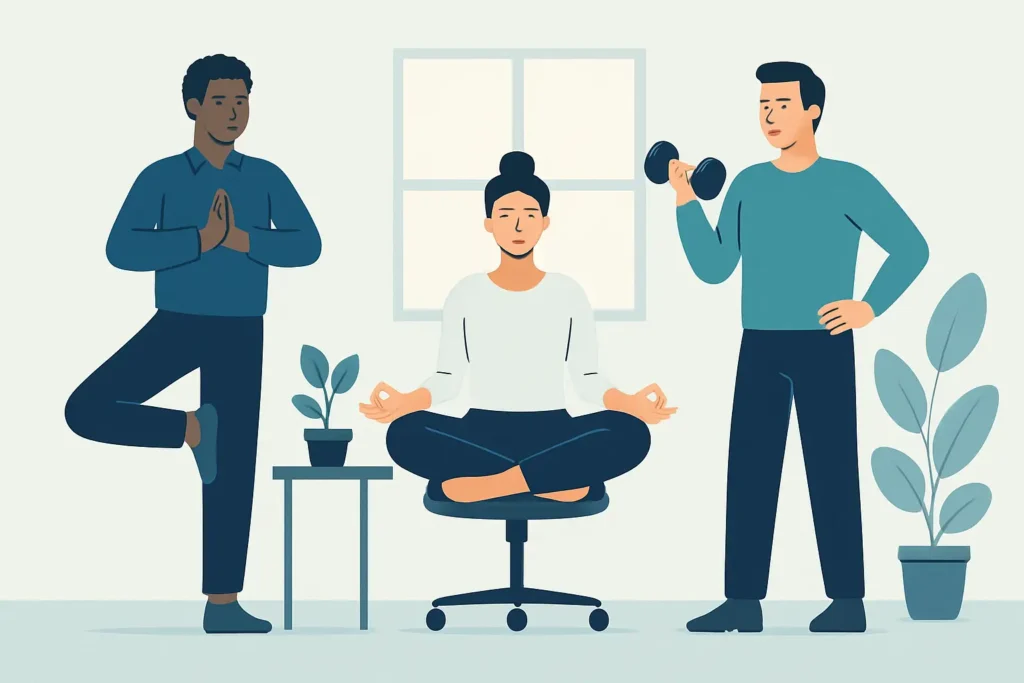
If your Corporate Wellbeing Programme needs three comms nudges, a calendar invite chase, and a spreadsheet of no-shows, it is not a wellbeing problem – it is a design problem. UK workplaces are busy, multi-site, and stretched. If taking part feels like extra work, participation drops. If it feels like something people can do in minutes, during working hours, with immediate value, uptake looks very different.
A programme that performs is not defined by the number of providers on a slide. It is defined by two outcomes: employees actually use it, and you can show sensible, defensible outputs to leadership without drowning HR in admin.
What a Corporate Wellbeing Programme needs to achieve
Most organisations are aiming for a mix of duty-of-care, engagement, and prevention. The practical question is how you build something employees will trust and use, while keeping operational effort low.
A workable programme typically does four things.
First, it makes health feel accessible. That means removing appointments, long forms, and anything that signals judgement. Second, it builds repeatable habits – not one-off events that disappear after a wellbeing week. Third, it gives employees clear next steps, so the experience does not end with a vague “you should look after yourself”. Fourth, it gives HR measurable activity that can be reported without collecting sensitive personal data.
The trade-off to be aware of: the more “bespoke” you make everything, the harder it is to scale across locations and shift patterns. Simplicity is not a lack of ambition. It is often the reason a programme survives beyond the first quarter.
Start with low-friction health screening: “know your numbers”
If you want quick engagement, start with something tangible. Health screening works well in workplaces because it is immediate, private, and practical. Employees do not need to prepare, and they do not need to talk about personal topics to participate.
A screening approach built for the workplace should capture core biometric measures that people recognise and can act on. In practice, that usually means height and weight (to calculate BMI), blood pressure and pulse, and body fat percentage. The value is not the metric itself – it is the moment of awareness. Many employees simply have not checked their blood pressure for years. Making that easy, on-site, during the day, can shift behaviour.
The strongest programmes also avoid the classic bottleneck: appointment scheduling. If participation relies on time slots, you reduce uptake and increase admin. A self-serve model removes that barrier.
If you are considering kiosks as part of your Corporate Wellbeing Programme, this is the most relevant starting point: Health Screening Kiosks: fast checks, real uptake.
What employees get from a quick screening
Employees respond well when the experience is clear and finishes with something useful. A good flow takes minutes and ends with immediate results.
Height, weight and BMI provide a baseline most people understand. BMI is not a perfect health measure – it does not account for muscle mass or individual circumstances – but it is a familiar starting point for a conversation about weight, activity, and general risk.
Blood pressure is often the headline measure because it can be high with no symptoms. A workplace check does not diagnose anything, but it can prompt employees to follow up appropriately with a GP or pharmacist if a reading is consistently elevated.
Pulse offers a simple indicator that pairs well with general fitness discussions. Body fat percentage adds context alongside BMI. Taken together, these measures give employees a snapshot that feels personal and worth their time.
What HR gets: participation without the admin
From an employer’s perspective, screening is attractive because it is easy to explain and easy to measure. You can track the number of checks completed and, if you choose, use anonymised usage data to understand participation by site or time of day without handling medical data.
Operationally, the goal is to avoid tying up your team. A deployable, rental-based kiosk model works because the on-site requirement is minimal: a small footprint and power. The difference between a smooth rollout and a painful one is whether the provider handles the practicalities – delivery, installation, basic training, and maintenance – so HR is not troubleshooting hardware or chasing consumables.
If blood pressure is your priority measure, this is a useful supporting read: Blood pressure checks at work made simple.
Build the year-round programme: screening plus targeted services
A one-off screening day can generate momentum, but it is the follow-on support that turns awareness into action. The most effective Corporate Wellbeing Programme looks like a simple rhythm across the year: a clear entry point (screening), then targeted interventions that match your workforce needs.
For office-based and hybrid teams, the repeatable areas tend to be stress, sleep, movement, and musculoskeletal comfort. For multi-site or operational teams, you may prioritise shift-friendly delivery and short sessions that do not disrupt operations.
The practical approach is to keep a structured catalogue of options rather than reinventing the wheel each quarter. That way, you can deploy quickly, measure attendance, and adjust based on what people actually use.
On-site sessions that fit into working hours
On-site services work best when they are easy to access and visibly supported by the organisation. Two formats consistently perform in workplaces.
First, short movement and mobility sessions. Office yoga and movement classes work when they are positioned as accessible – no special kit, no pressure, and designed for varied ability. They also pair naturally with posture and MSK education.
Second, workplace massage. This is often treated as a perk, but it can also be a practical intervention for desk-based discomfort. The key is operational fit: a simple booking system, a suitable private space, and clear session timings so managers can plan around it.
If you want a sense of how massage is delivered without workplace disruption, see: Corporate Massage that actually works at work.
Online learning that people will attend
Webinars and short online training courses are useful when they are specific and time-boxed. Attendance drops when topics are generic or the sessions feel like a lecture.
Programmes that perform tend to focus on real workplace needs: stress and resilience skills people can use the same week, mental health awareness that is practical (not performative), sleep education that respects shift patterns and family life, posture and movement guidance tailored to desk work, and nutrition content that avoids fads.
Online delivery also solves a common challenge: multi-site consistency. You can offer the same session to different locations without duplicating logistics.
For topics and formats that tend to get better attendance, this is relevant: Wellbeing Webinars Employees Actually Attend.
Make it measurable without making it intrusive
A Corporate Wellbeing Programme should give you outputs that are easy to report and difficult to argue with. That does not mean collecting sensitive personal information. It means focusing on participation, reach, and repeat engagement.
At minimum, you should be able to answer: how many employees took part, how often, and across which sites. For on-site sessions, that is attendance and utilisation. For screenings, it is number of checks completed. For webinars, it is registrations, attendance, and repeat attendance.
Where employers often trip up is overpromising outcomes. Wellbeing initiatives can support absence reduction and productivity, but attributing a direct financial return to a single webinar is rarely credible. A better approach is to report leading indicators you control – uptake, consistency, and coverage – and pair them with broader people metrics you already track.
Be clear internally about what “good” looks like. For example, you might aim for a certain percentage of the workforce to complete a screening over a set period, or a consistent monthly attendance rate for webinars. When targets are practical, the programme stays grounded.
Reduce friction: what stops programmes working
Most wellbeing programmes fail for predictable reasons. The fix is usually operational, not motivational.
If employees need to book weeks ahead, they will not bother. If the session is only delivered at lunchtime, shift workers and front-line teams are excluded. If activities rely on line managers to negotiate time off ad hoc, participation becomes inconsistent and can feel unfair.
Space and privacy are also common blockers. A screening kiosk or massage set-up needs a sensible location that is easy to find but not exposed. For webinars, the blocker is often calendar overload and unclear expectations about whether people are “allowed” to attend during work.
The simplest way to address these issues is to design for the real working day. Offer repeat sessions, vary times, keep everything short, and make the on-site requirements minimal and well-defined.
A practical way to structure your programme across the year
You do not need a complicated wellbeing calendar to run a credible programme. You need a repeatable structure that makes sense to employees and to leadership.
Many organisations benefit from running health screening as a campaign – a focused period where employees can quickly complete checks on-site without appointments – then using the findings as a steer for the next quarter’s content. If blood pressure awareness is a clear theme, you can follow with education on stress, sleep, and lifestyle. If MSK discomfort is dominant in feedback, prioritise movement sessions and posture training.
This is where operational simplicity matters. When the screening element is quick to deploy and supported end-to-end by the provider, you can run it more than once a year across multiple sites without it becoming “that big HR project”.
For a campaign-led approach, this is worth reading: Know Your Numbers at Work: A Practical Campaign.
Choosing a provider: what to check before you commit
Workplace wellbeing providers often look similar on paper. The differences show up in delivery.
Check whether the service can scale nationally if you have multiple sites. Ask who handles delivery, installation, maintenance, and day-to-day support. Clarify what is required from you on-site – space, power, booking admin, and comms. If the provider needs your team to manage logistics, you have not bought a service, you have bought a project.
Also check how the provider reports usage and attendance. You want clear, simple outputs you can use in internal reporting. If data handling feels vague, push for specifics.
Finally, consider breadth. A programme is easier to manage when screening, on-site sessions, and online learning can be organised under one operational model, with consistent service standards.
If you want a Corporate Wellbeing Programme that gets real uptake, design it around convenience first, then layer in support that employees can actually use. Make screening easy, keep sessions practical, and measure participation consistently – the rest tends to follow.