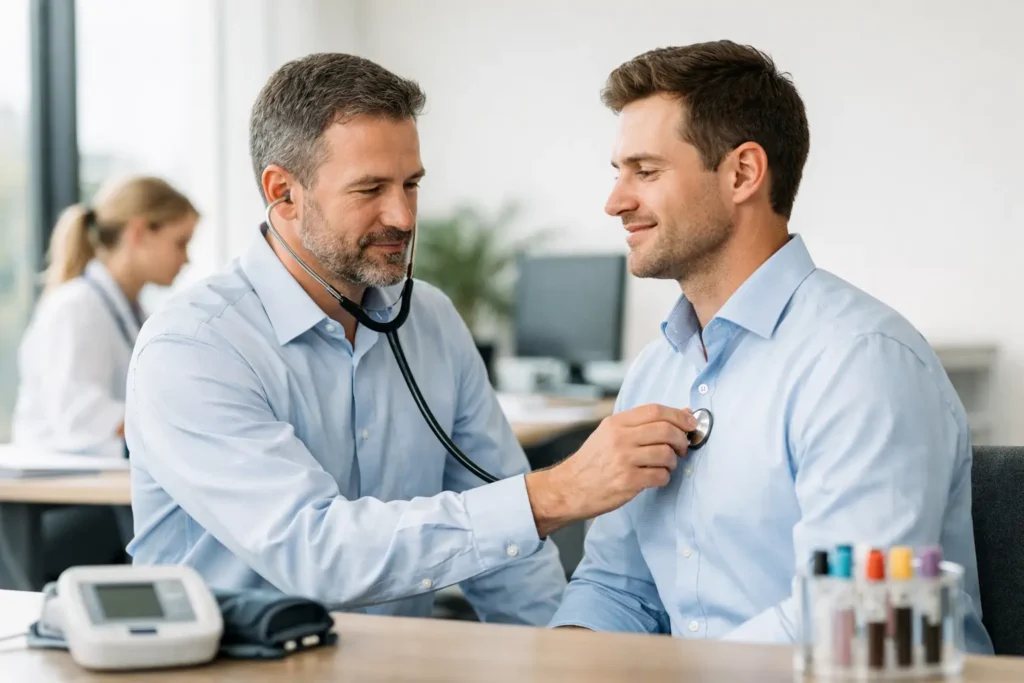
At most workplaces, the problem is not whether employees would benefit from basic health screening. It is whether enough people will actually take part once bookings, room schedules and line manager approvals get involved. This employee health checks case study looks at a more practical model – one built around quick access, visible participation and minimal admin for HR.
The scenario will be familiar to many UK employers. A mid-sized, multi-site business wanted to strengthen its wellbeing offer and give staff a straightforward way to check key health indicators during the working day. The organisation had run awareness campaigns before, but uptake tended to drop when activity relied on appointments or when staff had to travel off site. What they needed was a simple intervention that could sit in the workplace, work across different shifts and produce measurable outputs.
The challenge behind this employee health checks case study
The employer had three clear objectives. First, increase participation by removing friction. Second, give employees useful data they could act on immediately. Third, provide HR with a visible wellbeing initiative that did not create a large operational burden.
There were constraints as well. The workforce included office-based staff, hybrid workers on anchor days and teams with limited time away from their desks. Any solution had to fit in a modest amount of space, run reliably and avoid the complexity of one-to-one bookings. The organisation also wanted a service that could be repeated across the year rather than treated as a one-off event.
This is where many wellbeing plans stall. A good idea on paper becomes difficult in practice when every health check needs a clinician, a private room and a diary slot. The more moving parts involved, the harder it is to scale.
The solution: on-site screening built for high uptake
The employer chose an on-site health screening kiosk model to make checks available throughout the day without appointments. Staff could step up, complete a short screening and receive immediate printed results. That changed the dynamic from formal assessment to accessible workplace wellbeing.
The screening covered six core biometric measures: height, weight, BMI, blood pressure, pulse and body fat percentage. For employers, that combination matters because it gives employees a quick overview of the basic numbers most often associated with preventative health conversations. It is not a diagnosis, and it should not be presented as one, but it does prompt awareness at the right moment – while the employee is already engaged.
Operationally, the appeal was straightforward. The employer provided the space and power supply. Delivery, installation, maintenance and basic training were handled for them. That reduced the usual back-and-forth between HR, facilities and local site contacts.
A solution like this works best when it is clearly positioned. The message to employees was simple: know your numbers, take five minutes, collect your results and decide whether you want to make any changes. That is a much easier proposition to communicate than a health campaign wrapped in complicated booking instructions.
How the deployment worked on site
The first step was selecting suitable locations. The employer placed the kiosk in a visible but practical area with good footfall, rather than hiding it in a room employees had to seek out. This matters more than many organisations expect. If the screening point looks difficult to access, participation falls. If it is easy to notice and easy to use, uptake tends to follow.
The second step was internal promotion. HR used light-touch communication before launch, focusing on convenience and speed. Employees were told what the kiosk measured, how long it would take and what they would receive at the end. That clarity helped manage expectations. People knew they were not signing up for a clinical appointment. They were taking a quick, useful health snapshot.
The third step was support. Because service engineers handled installation and upkeep, the employer did not need internal teams to troubleshoot equipment issues. For organisations with several sites, that support model is often the difference between a scheme that gets used and one that quietly loses momentum.
There is a practical trade-off here. A kiosk-based approach will not replace clinical occupational health services where those are needed. It does something different. It makes foundational health checks available to a larger number of employees with far less friction. For many employers, that is exactly the gap they are trying to fill.
What employees actually received
One reason this format performed well is that the output was immediate. Employees completed the assessment and received printed results there and then. That tangible result matters. It gives the interaction a clear endpoint and avoids the common problem of people completing a wellbeing activity but hearing nothing afterwards.
Each metric had a purpose. Height and weight support BMI calculation, which remains a simple screening indicator when used with care. Blood pressure and pulse offer a useful prompt around cardiovascular health. Body fat percentage adds another layer to the picture, especially for employees who may not read weight alone as meaningful.
For HR teams, the value sat in both the individual and programme level. Individually, employees left with something useful. At programme level, anonymised usage data could help show engagement and support reporting on wellbeing activity without overcomplicating administration.
Results from the employee health checks case study
The strongest result was uptake. Once appointments were removed, participation increased because staff could use the kiosk around meetings, breaks or quieter periods in the day. The format suited employees who would not normally commit to a scheduled health check but were willing to spend a few minutes on an accessible, self-directed screening.
The second result was visibility. The employer was able to demonstrate a clear, practical wellbeing initiative in the workplace rather than relying solely on policy statements or awareness emails. That visibility matters for culture. Employees are more likely to engage with wellbeing support when they can see it, use it and talk about it with colleagues.
The third result was reduced admin. HR did not need to manage large booking lists, repeated reminders or extensive local troubleshooting. For lean teams, that is a substantial benefit. A wellbeing initiative that consumes too much time can quickly become difficult to repeat.
There was also a useful secondary effect. Screening created a natural opening for broader wellbeing conversations around stress, sleep, movement and nutrition. In other words, the kiosk did not need to do everything on its own. It worked well as an entry point into a wider programme of support.
What this means for employers planning health checks
If there is one lesson from this employee health checks case study, it is that convenience drives engagement. Many employers spend time refining the message but underestimate the impact of practical barriers. If employees need to find a slot, travel elsewhere or wait weeks for access, participation will be lower than expected.
That does not mean every workplace should use the same model. A small office may prefer a one-day event. A larger employer may benefit from a longer rental period. A multi-site organisation may need to rotate equipment between locations. The right setup depends on headcount, shift patterns, available space and the role wellbeing plays in the wider people strategy.
What should stay constant is operational simplicity. The easier it is to deploy, the easier it is to repeat. And repeatability is what turns a single health check into a credible wellbeing programme.
For employers that want year-round impact, screening also works best when paired with follow-on support. An employee who sees an elevated reading may then be more open to a webinar on stress, a session on nutrition or a workplace movement class. That is where a broader service model becomes useful. The screening starts the conversation, but the surrounding wellbeing offer helps sustain it.
Relaxa’s approach reflects that practical reality: give employers a straightforward way to run health screening on site, support it properly and make it easier to build wider wellbeing activity around it.
The most effective wellbeing initiatives are rarely the most complicated. They are the ones employees can use easily, managers can support without disruption and HR can deliver without carrying the whole process alone.