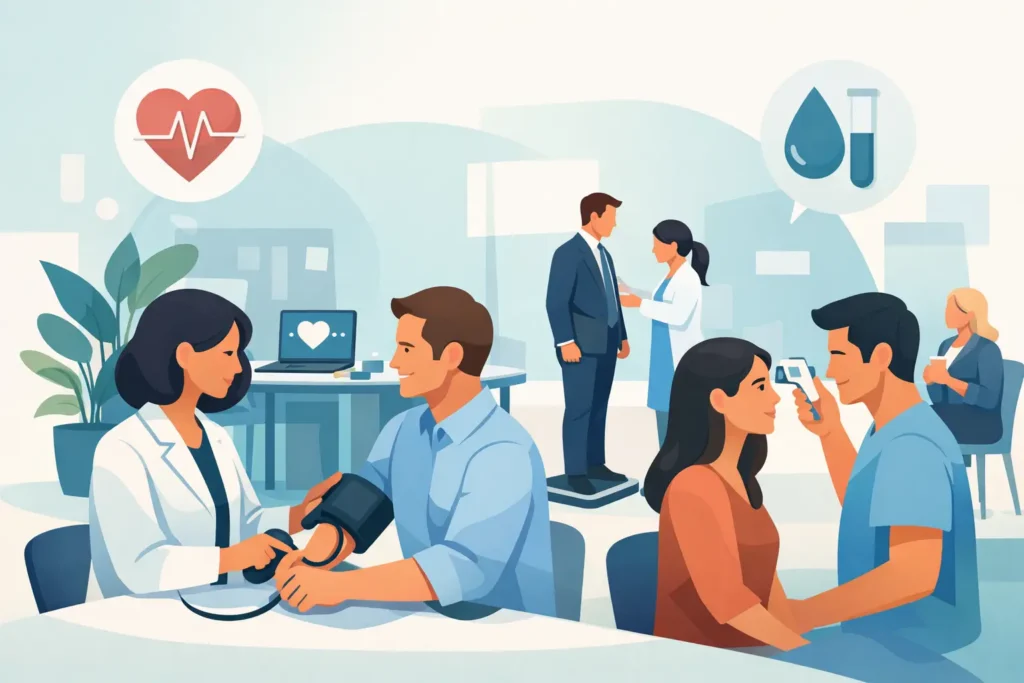
If your wellbeing campaign depends on people finding a free slot, remembering it, and turning up on time, participation will always be lower than you hoped. That is the practical problem with traditional workplace screening. It asks busy employees to fit one more task into an already crowded day.
Employee health checks without appointments remove that friction. Instead of asking staff to book ahead, wait for a clinician, or move meetings around, you place a screening point in the workplace and let people use it when they have ten spare minutes. For HR and wellbeing leads, that changes the economics of engagement. The barrier to entry drops, uptake usually rises, and the admin burden becomes much lighter.
For employers running structured wellbeing plans, this is less about novelty and more about access. If people can check key health indicators during working hours, in their own building, with immediate feedback, you are much more likely to create a preventative health habit rather than a one-off event.
Why employee health checks without appointments work
Convenience is not a soft benefit. In workplace wellbeing, it is often the deciding factor between a scheme that gets used and one that gets ignored. When employees can step up to a kiosk between calls, after lunch, or before they head home, participation feels manageable rather than disruptive.
This matters especially in hybrid and multi-site organisations. Appointment-led models can work well for small groups or high-touch assessments, but they become harder to coordinate at scale. Diaries clash. Managers need to release people at set times. No-shows waste capacity. Rescheduling adds another layer of admin. A walk-up model avoids most of that.
There is also a behavioural advantage. People are more likely to act when the process feels immediate and private. If the screening station is already there, and the result is available straight away, curiosity does some of the work for you. Employees do not need to make a formal commitment days in advance. They can simply decide to check their numbers there and then.
What employees can check in minutes
The value of a workplace screening kiosk is that it focuses on core metrics employees can understand easily and use as a starting point for healthier choices. A standard setup can capture height, weight, BMI, blood pressure, pulse, and body fat percentage, then print results immediately.
Each of these measures has a clear role. Height and weight support BMI calculation, which gives a broad indication of whether weight is proportionate to height. BMI is not the full picture, and it should not be treated as a diagnosis, but it is a familiar benchmark that helps employees place themselves on a recognised scale.
Blood pressure is often the metric people pay most attention to, and for good reason. High blood pressure may have no obvious symptoms, so giving employees a simple route to monitor it can support early awareness. Pulse adds another useful reference point and helps round out the cardiovascular picture.
Body fat percentage gives additional context alongside BMI, particularly for employees who want a more rounded sense of body composition. Again, it is a screening measure rather than a clinical assessment, but that distinction does not reduce its value. In a workplace setting, the aim is to help people know their numbers and prompt informed next steps where appropriate.
How the on-site model works in practice
The strength of employee health checks without appointments is that the setup is straightforward. You do not need to build a clinic inside the office. In most cases, you need a suitable space, access to power, and a clear internal plan for encouraging use.
A health screening kiosk can be placed on-site for a rental period, allowing employees to use it throughout the day rather than during a narrow event window. That changes the rhythm of participation. People can engage over several days instead of feeling they have one chance only.
For HR teams, the key practical question is usually support. If a solution creates technical issues, replenishment problems, or setup delays, any convenience benefit disappears quickly. That is why a managed service model matters. With a provider such as Relaxa, field service technicians and engineers handle delivery, installation, maintenance, and basic training across the UK, which keeps the operational load off internal teams.
That support model is more important than it may first appear. Wellbeing initiatives often lose momentum because ownership sits awkwardly between HR, facilities, and office management. A service-led arrangement gives you a defined process and a named responsibility outside your own team.
The employer case for appointment-free screening
For most organisations, the real question is not whether health screening is useful. It is whether it can be delivered at scale without becoming a scheduling exercise. Appointment-free screening answers that directly.
First, it reduces administration. There is no need to allocate hundreds of time slots, chase bookings, or deal with repeated changes. That saves time for HR and avoids frustration for employees.
Second, it supports higher uptake. In workplace wellbeing, easier access usually means broader reach. Employees who would never book a formal health assessment may still use a kiosk if it is nearby, quick, and uncomplicated.
Third, it creates measurable output. Instant printed results give employees something tangible, and anonymised usage data can help employers understand participation levels if that option is built into the service. For organisations reporting on wellbeing activity, that is useful evidence of engagement.
Fourth, it fits naturally into wider wellbeing programmes. A screening point can stand alone, but it also works well alongside awareness campaigns, health-themed internal communications, or complementary services such as webinars on stress, sleep, posture, nutrition, or resilience. In that sense, screening is often the entry point rather than the whole strategy.
Where this approach fits best – and where it does not
Employee health checks without appointments are particularly effective in office environments, shared workplaces, and larger sites where employees can access the kiosk during the day without needing to travel. They also work well for organisations looking to support preventative health behaviour without commissioning a full clinical programme.
That said, a kiosk-based model is not the answer to every requirement. If you need detailed medical interpretation, individual clinical follow-up on site, or role-specific occupational health assessments, a broader clinical service may be more appropriate. Appointment-free screening is best understood as an accessible first-line wellbeing tool. It helps employees identify baseline health information quickly, but it does not replace medical advice.
There are practical considerations too. Space needs to be sufficient for safe use and a degree of privacy, even in a busy office. Internal communication matters. If employees do not know what the kiosk measures, how long it takes, or why the initiative is there, uptake may be slower than expected. The format is low-friction, but it still benefits from clear promotion.
Making employee health checks without appointments successful
Good deployment is usually simple rather than elaborate. Put the kiosk somewhere visible but sensible, explain the measures in plain language, and give employees confidence that the process is quick. Most people are far more likely to participate when they know it takes minutes, not half an hour.
It also helps to frame the screening correctly. This is not about judging staff or collecting intrusive personal information. It is about giving employees an easy opportunity to understand key biometric measures during working hours. The wording you use internally matters. A supportive, preventative message will always land better than one that sounds compliance-led.
Managers can help by allowing visible permission to take part. If employees feel they need to justify ten minutes away from their desk, use will fall. If they see participation treated as a normal part of the wellbeing offer, the opposite usually happens.
Finally, think beyond the day the kiosk arrives. Screening tends to work best when it connects to a broader wellbeing calendar. Someone who checks their blood pressure this month may be more likely to attend a stress webinar next month or join a movement class later in the quarter. The measures provide a prompt, but sustained wellbeing improvement comes from what employees do next.
For employers trying to make wellbeing easier to access, that is the real advantage. When health checks are available without appointments, the programme starts to fit around working life instead of competing with it.