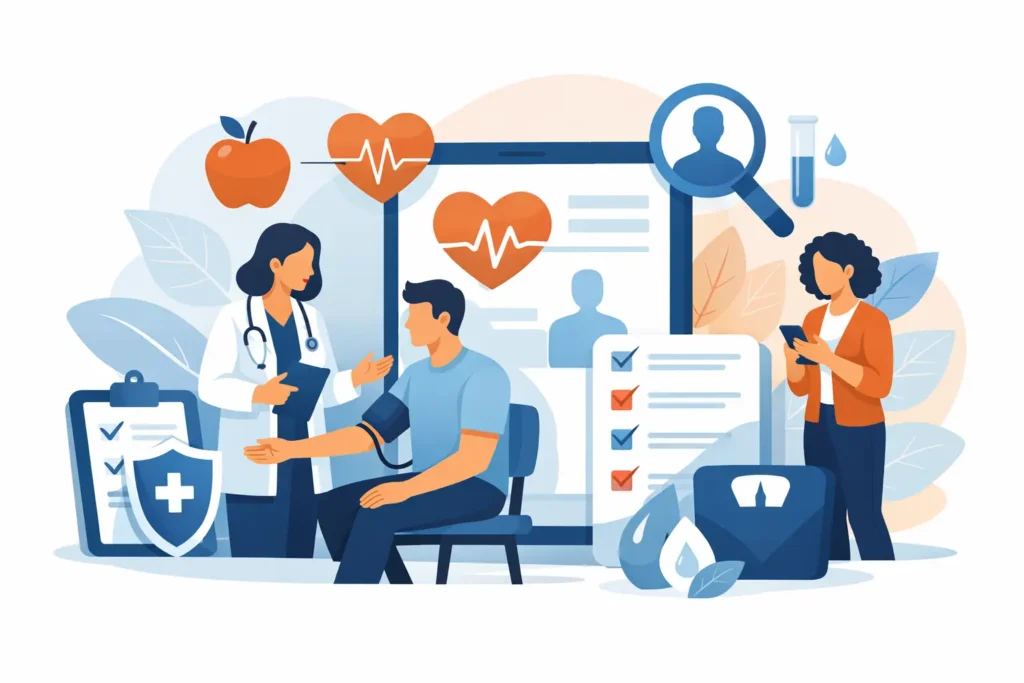
If staff have to book appointments, leave site, or wait weeks for feedback, uptake drops fast. Employee health checks work best when they are easy to access, quick to complete, and simple for HR teams to run.
For most employers, the aim is not to create a clinical pathway on site. It is to give employees a practical way to know their numbers, spot potential concerns early, and engage with wellbeing during the working day. That makes delivery model just as important as the health metrics themselves.
What employee health checks should cover
At workplace level, the most useful checks are the ones that are fast, familiar, and easy for employees to understand. Core biometric measures such as height, weight, BMI, blood pressure, pulse, and body fat percentage give a clear snapshot of baseline health. They also create a useful starting point for wider conversations around lifestyle, stress, sleep, movement, and nutrition.
Blood pressure is often the metric that drives the strongest employee response because it is widely recognised and directly relevant to preventative health. BMI and body fat percentage can also be helpful, although they need sensible context. A single reading is not a diagnosis, and no one metric tells the full story. The value comes from giving employees immediate, private feedback that encourages follow-up where needed.
If your priority is a focused rollout around cardiovascular awareness, Workplace Blood Pressure Screening may be a useful next step.
Why convenience matters more than good intentions
Many wellbeing initiatives fail for operational reasons rather than lack of interest. If a programme requires multiple suppliers, detailed scheduling, or heavy internal coordination, it becomes difficult to sustain across busy teams and multiple sites.
Employee health checks need to fit around the working day. That means no appointment bottlenecks, no lengthy assessments, and no complicated room requirements. A model that can be placed on site, plugged in, and used by a high volume of employees without clinical administration tends to perform far better than a process built around one-to-one booking slots.
This is especially relevant for hybrid organisations, regional offices, and employers trying to reach a broad workforce with limited onsite time. Participation rises when checks are visible, convenient, and completed in minutes.
How employee health checks can work on site
A practical workplace screening set-up should answer three questions quickly. What does it measure, what does it need on site, and who supports it if anything goes wrong?
A kiosk-based approach is often attractive because it removes much of the friction. Employees can complete a health check without an appointment, receive immediate printed results, and move on with their day. For employers, the inputs are straightforward: a small amount of floor space, access to power, and a suitable location with reasonable privacy. The outputs are clear as well – employee participation, instant results, and in some cases anonymised usage data to support reporting.
That matters to HR and People teams because it reduces admin burden. Delivery, installation, maintenance, and basic training can be handled externally, which lowers operational risk and makes multi-site planning much simpler.
For a fuller overview of workplace deployment, Employee Health Screening at Work explains how on-site screening can be used within a broader wellbeing plan.
What employers should look for in a provider
Not all employee health checks are equally easy to implement. The strongest option is usually the one that balances health value with operational simplicity.
Look for a service that provides clear measurements, fast employee throughput, and defined site requirements from the outset. National engineering and field support also matter, particularly if you need delivery across more than one location or want confidence that maintenance issues will not fall back on internal teams.
It is also worth asking how screening fits into the rest of your wellbeing calendar. Health checks can generate strong initial engagement, but they have more value when followed by relevant education and support. For example, if blood pressure readings prompt questions around stress, sleep, or lifestyle habits, employers should be able to connect that interest to further resources rather than leaving it there.
Turning health checks into a wider wellbeing programme
The most effective employee health checks do not sit in isolation. They work best as an entry point into a broader, year-round strategy.
A screening event can be paired with wellbeing talks, mental health awareness sessions, or practical movement and recovery services on the same day or across the same campaign period. That gives employees both information and action. Someone who sees an elevated reading or simply wants to improve their general health is more likely to engage if the next step is visible and easy.
That is where linked services can strengthen results. Corporate Wellbeing Talks can help explain topics such as sleep, nutrition, resilience, and stress in a structured format, while on-site services such as On-Site Corporate Massage can support immediate engagement during busy workplace wellbeing events.
For employers, the practical benefit is clear. You are not just offering a one-off check. You are building a simple pathway from awareness to action, with measurable participation and far less administrative complexity than traditional appointment-led models.
If employee health checks are going to earn attention internally, they need to be easy to deploy, easy to use, and useful from the first interaction. That is usually what drives real uptake.