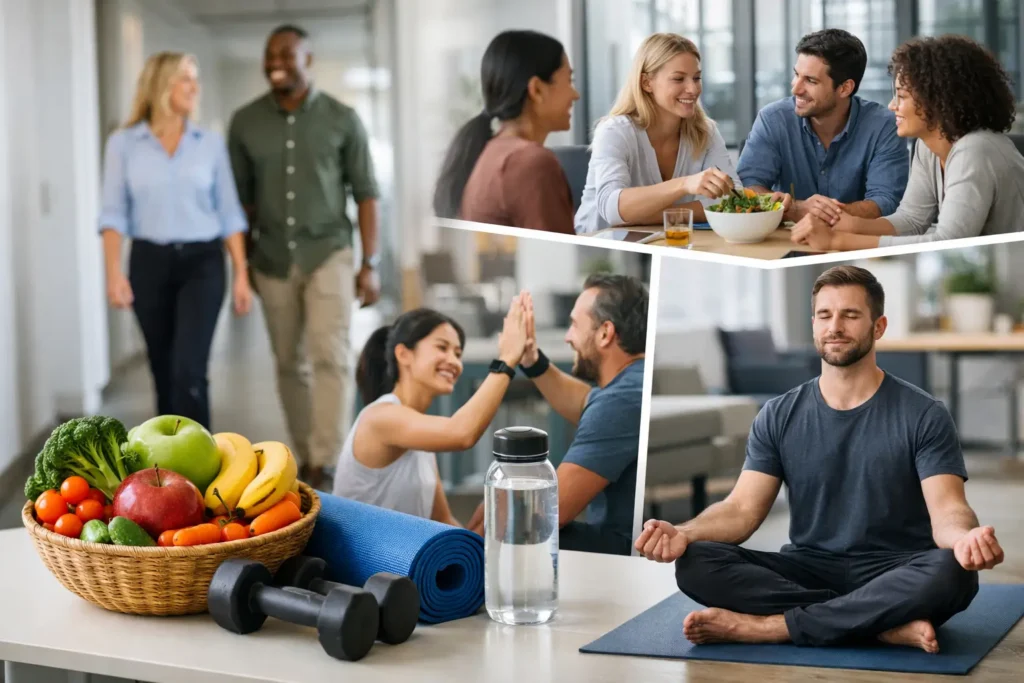
Most workplace wellbeing plans fail at the same point: good intentions meet busy diaries, limited space and too much admin. The best Employee Health Promotion Ideas are not the flashiest ones. They are the ones employees can use quickly, managers can support easily and HR can run without building a project plan around every activity.
For UK employers, that usually means choosing practical, low-friction options that make healthy action easier during the working day. If an initiative needs appointments, repeated chasing or heavy coordination across multiple sites, participation often drops. If it is visible, simple and relevant, uptake tends to follow.
What makes employee health promotion ideas work?
The strongest workplace health initiatives do three things well. They remove barriers, they give employees something useful straight away, and they create a clear next step.
That matters because wellbeing is not only about awareness. Most employees already know they should move more, sleep better or pay attention to stress. The gap is usually between knowing and doing. A practical programme closes that gap by making action easy on-site or online, in working hours, with minimal effort.
There is also a business case for keeping things measurable. HR and People teams increasingly need evidence that a wellbeing activity was used, not just offered. Participation levels, repeat engagement and anonymised usage insights all help show that a programme is supporting preventative health rather than sitting quietly on an intranet page.
1. Offer on-site health screening without appointments
If you want strong participation, convenience matters. On-site health screening is one of the most effective ideas because it gives employees immediate, personal information in minutes. A workplace health screening kiosk can measure height, weight, BMI, blood pressure, pulse and body fat percentage, then print results straight away.
That combination is useful for two reasons. First, it supports the simple but important message of knowing your numbers. Second, it removes the scheduling barrier that often limits uptake with booked appointments. Employees can complete a check during the day without travelling, waiting for a clinician or finding a free slot weeks ahead.
For employers, the operational side matters just as much. A kiosk-based model is easy to deploy at a single site or as part of a wider campaign across multiple locations, provided there is suitable space and power. It also gives HR teams a more manageable way to run screening at scale.
2. Build campaigns around a clear theme
Single wellbeing events can attract attention, but themed campaigns usually create better momentum. A month focused on heart health, stress awareness, sleep or musculoskeletal wellbeing gives employees a reason to engage more than once.
The key is to keep the theme connected to practical actions. For example, a heart health campaign could pair screening with short nutrition sessions and movement classes. A posture theme could combine workstation awareness with Workplace Posture Training. A broad campaign with no clear thread can feel fragmented, even when the individual activities are good.
If you are planning across a full year, it helps to map each campaign to seasonal pressures, workforce needs and reporting periods. That approach is covered in more detail in How to Plan an Annual Wellbeing Campaign.
3. Make movement part of the working day
Many employers promote exercise, but participation improves when movement feels realistic rather than aspirational. Not everyone is going to sign up for a fitness challenge or join a running club. Short office yoga, stretch sessions or guided movement breaks are often more inclusive because they meet employees where they are.
This is especially relevant in office-based and hybrid teams where long periods of sitting are common. A 20 to 30 minute class can be enough to reduce stiffness, improve energy and encourage healthier routines. The format also works well for mixed fitness levels, which matters if you want broad engagement rather than only attracting people who are already active.
There is a trade-off, though. Movement sessions are visible and popular, but they should not be treated as a complete musculoskeletal strategy on their own. If posture issues, discomfort or desk-based strain are recurring themes, training and education usually need to sit alongside classes.
4. Use webinars to reach hybrid and multi-site teams
One reason wellbeing programmes underperform is uneven access. Head office gets the activity, while remote and regional teams get the email about it. Webinars and online training help close that gap.
They are particularly effective for topics such as stress, resilience, sleep, mental health awareness and nutrition, where the value comes from practical advice employees can apply immediately. For employers with several sites, webinars also simplify delivery because they remove travel and room-booking issues.
That does not mean digital is always better. Some topics work best face to face, especially where interaction or physical demonstration matters. If you are deciding between formats, Webinars vs Workshops for Wellbeing is a useful starting point.
5. Focus on posture before discomfort becomes absence
Posture is one of the most overlooked health promotion areas because it can seem ordinary. In reality, poor desk habits, static working and workstation issues affect a large share of office and hybrid employees.
Posture support works best when it is practical and specific. General reminders to sit properly are rarely enough. Employees need clear guidance they can use at their desk, whether that is through workshops, webinars or targeted training sessions. Good posture content should explain what to adjust, why it matters and what warning signs to take seriously.
This is also an area where preventative action can be easier to justify internally. It supports comfort, concentration and day-to-day function, not just long-term health outcomes.
6. Put mental wellbeing into the regular calendar
Mental wellbeing should not appear only during awareness weeks. Employees are more likely to engage when support is visible all year and presented as a normal part of working life.
In practice, that can mean a rolling programme of resilience sessions, stress management webinars, sleep education and manager awareness training. The most useful approach is usually a mix of universal content for all staff and more targeted support where teams are under higher pressure.
One common mistake is making mental wellbeing too abstract. Broad messages about self-care sound positive, but employees often respond better to specific help: how to switch off after work, how to recognise stress responses, how sleep affects concentration, or how to speak up early.
7. Bring in massage for visible, immediate engagement
Some wellbeing activities generate interest simply because employees can feel the benefit there and then. Office massage is one of them. It is easy to understand, quick to use and suitable for busy workplaces where people may not commit to longer sessions.
From an employer perspective, massage can work well as part of a wider wellbeing day or campaign because it increases visibility and gives staff a positive, accessible entry point into the programme. It is not a substitute for broader health promotion, but it can help bring people into the conversation.
If you are considering this format, Office Massage shows how it fits into a workplace setting.
8. Use nutrition education that employees can actually apply
Nutrition is a common wellbeing topic, but generic healthy eating advice often has limited effect. Employees need practical guidance that fits real working patterns, including commuting, meetings, shifts and home working.
A good nutrition session should deal with familiar workplace issues such as skipped breakfasts, energy dips, lunch habits and hydration. It should help people make better choices without becoming preachy or unrealistic.
This is where short, structured learning tends to work better than passive content. A targeted Nutrition Webinar for a Healthier Workplace is often more useful than a bundle of static resources that few people open.
9. Tailor support for groups with different needs
One-size-fits-all wellbeing rarely performs well across a whole workforce. Different employee groups face different health risks, engagement barriers and preferences. Office staff, drivers, field teams and hybrid workers will not all respond to the same activity in the same way.
The same applies to gender-specific health topics. Men, for example, may be less likely to engage with preventative health unless the activity is easy to access and clearly relevant. Targeted communication and practical formats can help. For employers looking at this area, Mens Health in the Workplace offers useful direction.
Tailoring does not mean running dozens of separate programmes. It means making sensible adjustments to topic choice, messaging and delivery format so the activity fits the audience.
10. Give employees a next step after each activity
A wellbeing initiative has more value when it leads somewhere. Screening should point towards action. A webinar should leave employees with habits to try. A workshop should change what people do at their desk, in their schedule or in how they manage pressure.
This is where many programmes lose momentum. An employee receives useful information but no clear follow-up. The result is interest without behaviour change.
Simple next steps work best. After a blood pressure reading, that might be encouraging the employee to monitor trends and seek further advice where appropriate. After a sleep session, it might be one or two specific routine changes. After posture training, it might be adjusting screen height and reviewing break patterns that same day.
11. Choose services that reduce admin, not add to it
The quality of a wellbeing idea is only part of the decision. HR teams also need to know how easy it is to deliver. If the supplier requires constant coordination, complicated booking systems or a high level of internal resource, even a good concept can become difficult to sustain.
That is why turnkey delivery matters. Services with clear on-site requirements, straightforward installation, national support and minimal scheduling overhead are often the best fit for structured workplace programmes. Relaxa’s model, for example, is built around simple deployment and UK-wide support, which is exactly what many employers need when they are balancing participation goals against limited admin time.
12. Measure what employees actually use
The final test of any health promotion idea is not whether it looked good in a launch email. It is whether employees used it.
That means tracking participation, looking at repeat engagement and paying attention to which formats perform best in your environment. Screening uptake, webinar attendance, class utilisation and anonymised reporting can all help shape a stronger programme over time.
Not every successful activity will produce the same type of data, and not every useful outcome is immediate. Still, if an initiative is consistently hard to access or poorly attended, that is usually a design problem rather than an employee problem.
The best employee health promotion ideas are practical enough to run smoothly and relevant enough to get used. Start with convenience, build around real workforce needs, and choose services that make healthy action easier during the working day.