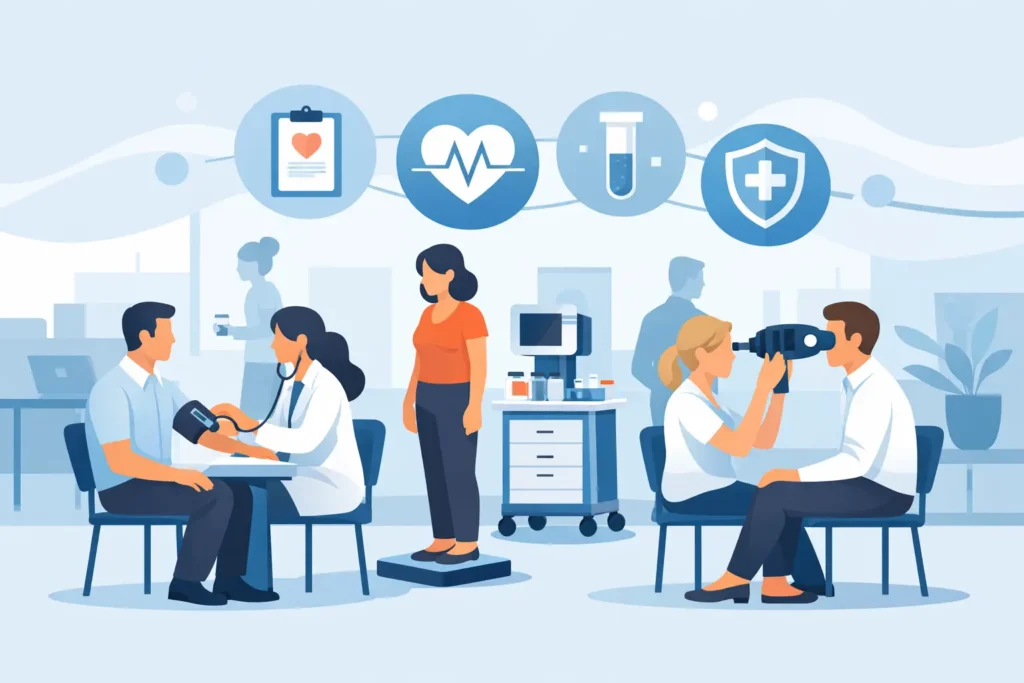
Employee health screening without appointments
If you have ever tried to run a workplace screening day through booked slots, you will know where the friction starts. Someone forgets their time, another meeting overruns, a team on shift cannot make the allocated window, and HR ends up chasing attendance instead of running a wellbeing initiative.
That is why employee health screening without appointments is gaining ground in UK workplaces. For employers who want stronger participation without adding admin, an on-site self-service model is often the more practical option. It gives employees quick access to core health checks during the working day, while giving employers a simple way to support preventative wellbeing.
The appeal is straightforward. People can check their numbers when it suits them, in a matter of minutes, without the awkwardness of booking a slot or rearranging their day. For HR and wellbeing leads, the process is easier to deploy across offices, hybrid teams, and multi-site operations because the screening itself does not depend on a tightly managed appointment schedule.
Why appointment-based screening often limits uptake
Booked appointments can work well in some settings, particularly when a clinical consultation is needed or when results require immediate interpretation from a practitioner. But for basic workplace screening, appointments can create unnecessary drag.
The first issue is participation. Employees are far more likely to engage when access is easy and informal. If the process feels like another diary commitment, uptake tends to fall, especially in busy operational teams or workplaces where staff are moving between sites, shifts, or meetings.
The second issue is administration. Someone has to manage the booking process, reminders, room availability, and no-shows. That may be manageable for a small head office, but it quickly becomes inefficient when you are rolling out screening across larger populations.
The third issue is pace. Traditional booked models can only screen as many people as there are available slots. A self-service approach can support much broader participation over the course of a day, a week, or longer, depending on how the programme is set up.
How employee health screening without appointments works on-site
A workplace kiosk model is designed to remove those barriers. Employees visit the unit when convenient, complete a short screening, and receive immediate printed results. There is no need for one-to-one booking and no need to tie the whole programme to a clinician’s diary.
In practice, the process is simple. The kiosk is installed on-site in a suitable location with access to power and enough space for safe use. Employees step on, follow the on-screen instructions, and complete a series of basic biometric measurements. The assessment typically takes only a few minutes.
For employers, that simplicity matters. The deployment is clear from the start – what space is required, what power supply is needed, how the equipment arrives, who installs it, and who supports it if anything needs attention. That lowers operational risk and makes the screening realistic to run in ordinary workplace environments rather than only at large one-off events.
The health metrics employees can access
The value of this approach is not in replacing medical care. It is in making basic health awareness more accessible. A well-designed workplace screening kiosk usually captures height, weight, BMI, blood pressure, pulse, and body fat percentage.
Each metric has a role. Height and weight provide the base data for BMI, which offers a useful broad indicator when interpreted sensibly rather than in isolation. Blood pressure is often the metric employees are most interested in because it is not something many people check regularly, yet it can prompt an early conversation with a GP if readings are outside the expected range. Pulse gives another immediate cardiovascular measure, while body fat percentage adds further context that weight alone cannot provide.
The point is not to overwhelm employees with clinical detail. It is to help them know their numbers and take a simple, practical next step if needed. For some, that means reassurance. For others, it becomes the nudge to look more closely at stress, sleep, activity levels, or nutrition.
Why convenience changes behaviour
Convenience is often underestimated in wellbeing planning. Many employees are not avoiding health checks because they are uninterested. They are putting them off because life and work get in the way. Remove the booking barrier, keep the process short, and place it where people already are, and participation usually improves.
That is particularly relevant in hybrid and office-based settings where employees may only be on-site on certain days. It also matters in workplaces with varied shift patterns, where fixed appointments can unintentionally exclude part of the workforce.
There is a trade-off, of course. Appointment-free screening is excellent for broad access and volume, but it is not a substitute for a full occupational health assessment or a medically supervised consultation. Employers need to be clear on the purpose. If the goal is preventative engagement, awareness, and easy access to core metrics, the no-appointment model is a strong fit. If the goal is detailed clinical review, another service model may be more appropriate.
What HR and wellbeing teams need to run it smoothly
The most successful programmes are usually the simplest. Before launch, employers should think about location, visibility, privacy, and communication.
A good location is easy to access but does not leave users feeling on display. A staff breakout area, wellbeing room, or quiet corner of an office can work well if there is enough room around the unit. Clear internal communication also helps. Employees should know what the kiosk measures, how long it takes, whether they receive printed results, and what to do if a result causes concern.
Support matters too. A screening initiative becomes much easier to approve when there is a defined service model behind it. Delivery, installation, maintenance, and basic user training should be handled as part of the setup, rather than pushed back onto internal teams. For employers with multiple locations, UK-wide engineering coverage is often a deciding factor because it reduces disruption and avoids burdening site teams with technical issues.
Consumables and upkeep should not be overlooked. If the kiosk prints results, paper supply and servicing need to be factored into the plan. These are small details, but they affect reliability and the employee experience.
Measuring impact beyond the screening itself
For many employers, screening is only worthwhile if it leads to usable engagement data and a broader wellbeing conversation. That does not mean tracking individual health information inappropriately. It means understanding whether people are using the service and whether it is helping your wellbeing strategy gain traction.
Anonymised usage data can be useful here, depending on the deployment model. It can show uptake levels, identify interest across sites, and help justify future wellbeing activity. If one location sees particularly strong engagement, that may indicate appetite for follow-on support such as nutrition webinars, movement sessions, resilience training, or mental health awareness programmes.
This is where a standalone screening initiative can become part of a wider annual plan. A simple health check often opens the door to broader conversations about lifestyle, energy, musculoskeletal discomfort, stress, and sleep. Used well, it becomes an entry point rather than a one-off gesture.
Where this model fits best
Employee health screening without appointments is especially well suited to employers that want high participation with low internal administration. It works well in head offices, contact centres, shared workspaces, manufacturing support environments, and multi-site organisations where central teams need a repeatable solution.
It is also a practical fit for employers who have limited space and no appetite for complex event planning. If you can allocate an appropriate area, provide power, and communicate the purpose clearly, the model is relatively easy to run.
For organisations building a broader wellbeing offer, it pairs naturally with year-round support. A screening kiosk can sit alongside on-site sessions such as massage, yoga, or movement classes, and it can be reinforced with online learning around stress, posture, sleep, nutrition, and resilience. That combination tends to produce better engagement than isolated initiatives because employees can move from awareness to action.
Relaxa supports this kind of workplace rollout with rentable on-site screening kiosks, UK-wide delivery and engineering support, and a wider wellbeing service menu that helps employers build momentum beyond a single campaign.
Making the business case internally
When presenting this kind of service internally, the strongest case is usually practical rather than promotional. The argument is that appointment-free screening lowers barriers to participation, reduces scheduling admin, and gives employees immediate access to useful health information during working hours.
For leadership teams, the value often sits in three areas: visible duty-of-care, measurable engagement, and operational simplicity. Employees see a tangible wellbeing offer. HR avoids a time-heavy booking exercise. The business can run a preventative initiative at scale without turning it into a major project.
That will not mean the same thing in every organisation. Some employers will prioritise engagement numbers, others will focus on accessibility across sites, and others will want a service that is easy to repeat annually. The right model depends on your workforce, your space, and what you are trying to achieve.
The best workplace wellbeing initiatives are usually the ones people can actually use. When health screening is quick, visible, and available without appointments, employees are far more likely to take that small but meaningful step of checking their numbers.