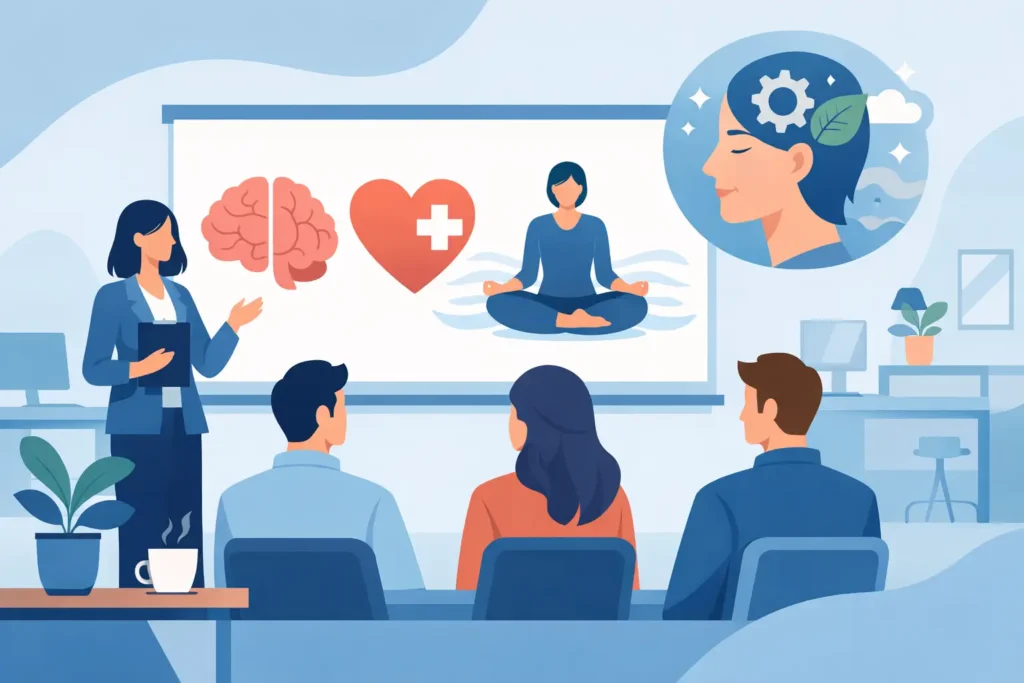
Poor mental health rarely shows up as a single issue at work. It tends to appear as rising absence, lower concentration, strained team dynamics, higher turnover, or managers feeling out of their depth. That is why employee mental health training matters. Done well, it gives organisations a practical way to build awareness, improve day-to-day conversations, and support earlier intervention before problems become more costly.
For most employers, the priority is not simply offering training for the sake of it. It is making sure the training is relevant, easy to roll out, and useful in real workplace situations. HR teams and wellbeing leads need something that fits around operational pressures, works across office-based and hybrid teams, and gives employees clear, usable guidance rather than broad theory.
What employee mental health training should actually do
Good training should make people more confident, not more cautious. Employees need to understand common signs of stress, anxiety, burnout, and low mood, but they also need to know what to do next. That may mean checking in with a colleague appropriately, recognising when someone may need signposting, or understanding the boundaries of their own role.
For managers, the requirement is usually more specific. They need help spotting changes in behaviour, handling sensitive conversations, and responding consistently. They also need clarity on what support the organisation already provides and when to escalate concerns. Without that practical layer, training often increases awareness without improving action.
A useful programme also reflects the reality that mental health is not one topic. Workload, sleep, financial pressure, physical discomfort, isolation, and poor routines can all affect how people feel and perform. That is why standalone sessions can be helpful, but they are often stronger when positioned within a broader wellbeing plan.
Employee mental health training works best when it is part of a wider strategy
Mental wellbeing training has more impact when employees can connect it to visible support in the workplace. If a business says mental health matters but offers no other wellbeing activity, uptake can be limited. People notice the gap between policy and practice.
A more effective approach is to combine training with practical services that support prevention and engagement throughout the year. That might include Mental Health Webinars for accessible education, Stress Training That Employees Will Use for more focused skill-building, and complementary wellbeing activity that helps staff take action on stress and recovery in everyday working life.
This is where employers often see better participation. Training opens the conversation, but wider wellbeing delivery keeps it active. Employees are more likely to engage when support feels normal, visible, and easy to access during working hours.
What to look for before you book
The right format depends on your workforce. A manager-focused session will be different from an all-staff awareness webinar, and a multi-site employer may need online delivery to reach teams consistently. There is no value in buying a polished session that does not match your structure or your workforce challenges.
In practice, buyers should look at four things. First, whether the content is suitable for employees, managers, or both. Second, whether delivery is straightforward enough to run without heavy admin. Third, whether the provider can support scale across multiple locations if needed. Fourth, whether the training sits alongside other services that help you maintain momentum after the session ends.
This matters because mental health training is rarely a one-off fix. If the only intervention happens during a single awareness week, results are likely to be limited. Behaviour change usually comes from repeated, low-friction touchpoints over time.
Why engagement improves when wellbeing is practical
One reason some mental health initiatives underperform is that they rely too heavily on messages and not enough on action. Employees may understand that stress matters while still feeling unsure how to manage it. Practical wellbeing services help close that gap.
For example, some employers pair training with movement sessions, recovery-focused wellbeing activity, or health checks that encourage staff to pay attention to their wider health. A programme that includes Employee Wellbeing Training alongside Health Screening at Work can support a more preventative approach. Physical and mental wellbeing are closely linked, and employees often engage more readily when support feels broad, useful, and easy to access.
That does not mean every organisation needs a large programme. It means the training should fit into something employees can see and use. Even a simple mix of webinars, awareness training, and a visible workplace initiative can be more effective than a more ambitious plan that is difficult to deliver.
Making employee mental health training easier to implement
For HR and People teams, administration is often the main barrier. If delivery requires complex scheduling, repeated coordination, or significant on-site management, uptake can suffer before the training even begins.
A better model is one that is simple to deploy, clear in scope, and easy to communicate internally. That is why many employers prefer providers that can deliver online or on-site, support national rollouts, and offer a structured wellbeing catalogue rather than isolated sessions. Relaxa’s approach reflects that need, combining mental wellbeing training with practical workplace services that are designed to be straightforward for employers to run.
The most useful question is not whether employee mental health training is worth doing. It is whether the training you choose will be practical enough to use, relevant enough to trust, and visible enough to make a difference once the session is over.