A practical look at a workplace rollout
The difference between a wellbeing idea and a wellbeing service people actually use usually comes down to friction. If staff need to book appointments, travel off-site, or wait weeks for availability, participation drops fast. That is why the most effective screening initiatives are often the simplest to access.
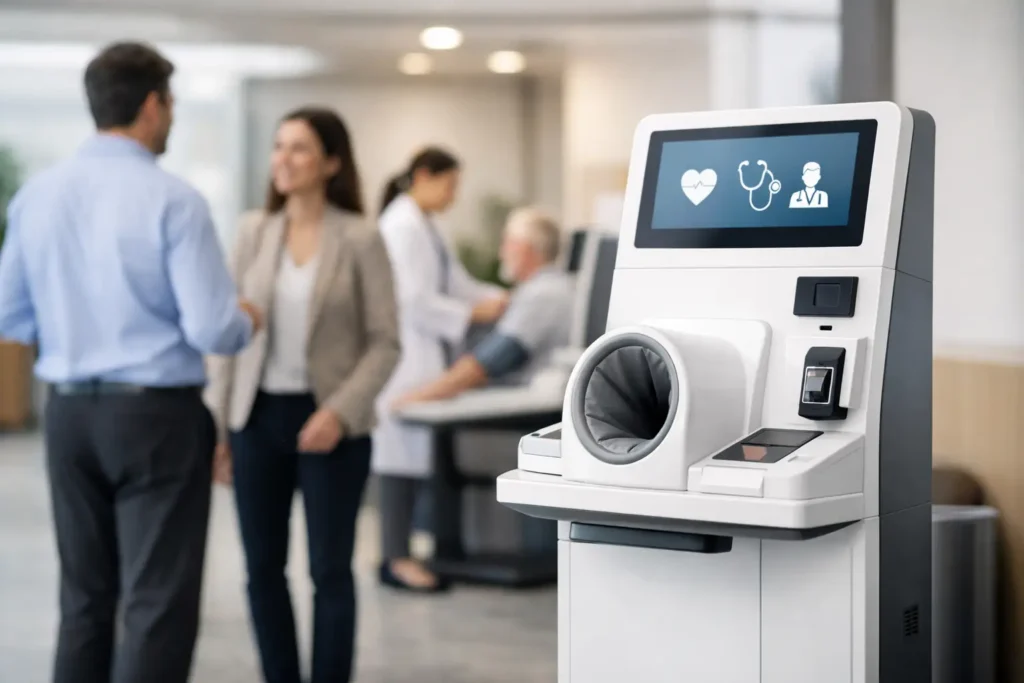
This case study health kiosk rollout looks at how a UK employer can deploy on-site screening across one or more workplaces without creating extra admin for HR. The value is not just in offering checks. It is in making them available during the working day, in a small footprint, with immediate printed results and minimal operational disruption.
For employers trying to improve engagement with preventative health, the kiosk model works because it answers three practical questions early. Can it fit in the workplace? Can employees use it quickly? Can the organisation measure uptake without building a complicated process around it? If the answer is yes to all three, rollout becomes far more realistic.
The rollout challenge most employers face
Many organisations already understand the case for basic health screening. Height, weight, BMI, blood pressure, pulse and body fat percentage are familiar, easy-to-understand measures that help employees know their numbers. The problem is rarely intent. The problem is delivery.
HR and People teams are usually balancing limited time, fixed budgets, and a workforce spread across offices, hybrid patterns, or multiple sites. Traditional appointment-based screening can work well for some campaigns, but it does place a scheduling burden on both organisers and employees. It can also cap daily throughput, which matters if the goal is broad participation rather than a small sample.
A kiosk changes that dynamic. Instead of managing a diary of one-to-one checks, the employer provides a self-service station that can be used in minutes. That makes it better suited to awareness weeks, benefit campaigns, ongoing wellbeing programmes, and multi-day workplace activations where convenience directly affects uptake.
Case study health kiosk rollout – the starting brief
In this scenario, the employer’s objective was straightforward. They wanted to increase participation in health screening, support a preventative wellbeing message, and do it without creating a long booking process for employees or additional coordination for HR.
The organisation had three common constraints. First, space was limited, so any equipment needed a modest footprint and simple positioning. Second, the workforce included a mix of office-based and hybrid staff, which meant availability had to be flexible over more than one day. Third, the internal team wanted confidence that delivery, installation and any technical issues would be handled externally.
Those requirements made a kiosk rollout a practical fit. It offered a clear input-output model. The employer provided space and power. The service provider handled delivery, installation, maintenance support and basic user guidance. Employees then completed their checks on-site and received instant printed results.
Why the kiosk model drove higher engagement
Participation improves when screening feels accessible rather than clinical. In a workplace setting, that means staff can approach the kiosk during a break, before a meeting, or at another convenient point in the day. They do not need to commit to a fixed appointment slot or leave the building.
That matters more than many employers expect. Even people who are broadly interested in their health will often delay action if the process feels awkward or time-consuming. A kiosk lowers that barrier. The interaction is short, familiar, and private enough for a workplace wellbeing setting.
There is also a communication advantage. The metrics are easy to explain in internal promotion. Height and weight support BMI calculation. Blood pressure and pulse are widely recognised indicators. Body fat percentage adds another useful reference point. Because employees receive an immediate printout, the experience feels complete rather than deferred.
The trade-off is that a kiosk is designed for efficient, standardised screening, not a deeper clinical consultation. For most employers, that is the right balance. The aim is to increase awareness and participation at scale, then signpost employees to further support where appropriate.
How the on-site deployment worked
The operational side of this case study health kiosk rollout was deliberately simple. The employer identified a suitable location with access to power and enough room for safe, comfortable use. In most offices, that could be a wellbeing room, breakout space, reception-side area, or a quieter section of the floor with reasonable privacy.
Delivery and installation were arranged in advance, removing the need for the client team to manage equipment setup. That point often matters more in practice than in procurement discussions. HR teams do not usually want to troubleshoot hardware, interpret setup instructions, or coordinate separate contractors. A managed deployment reduces that risk.
Once installed, the kiosk was available for staff to use during agreed hours. Basic guidance was provided so employees understood what the machine measured and how to complete the process correctly. Because results were printed immediately, there was no need for follow-up administration just to distribute individual outputs.
Where employers wanted reporting at programme level, anonymised usage data could also support internal evaluation. That helps answer common stakeholder questions such as whether the campaign reached enough people, whether one site outperformed another, and whether there is demand to repeat the service.
What made the rollout manageable for HR
From an employer perspective, the success of a rollout often depends less on the technology itself and more on what the internal team does not have to do. In this case, the administrative burden stayed light because there were no individual appointments to schedule, no clinician rota to manage, and no complex room plan to build around one-to-one sessions.
Communication was also simpler. Staff could be told where the kiosk would be, what it measured, how long it would take, and what they would receive at the end. That clarity tends to improve attendance because people know exactly what to expect.
Support coverage is another operational factor buyers should assess carefully. A national employer, or one with several regional offices, needs confidence that delivery and technical support can be handled consistently across the UK. Without that, a pilot may work in one location but become harder to scale. The stronger model is one that can be repeated with the same process at each site.
Results that matter in a workplace setting
The strongest outcome from this type of rollout is usually participation. When employees can complete a screening in minutes and receive immediate feedback, uptake is generally higher than with more admin-heavy formats. That creates a better foundation for a wider wellbeing strategy.
There are other gains as well. The employer can show visible commitment to employee wellbeing through a practical, accessible intervention rather than a message-only campaign. Staff gain personal health information they can act on or discuss further if needed. HR gains a service that fits around the working day instead of disrupting it.
That said, the best results come when screening is not treated as a one-off gesture. A kiosk can open the door to broader activity around stress, sleep, posture, resilience, movement and nutrition. Used that way, screening becomes the entry point to year-round engagement rather than a standalone event.
Where a health kiosk rollout fits best
A kiosk rollout is particularly well suited to employers who want strong reach with low friction. It works well in offices, shared workplaces, and multi-site organisations where employees benefit from quick access during the day. It is also a good fit for health awareness campaigns, benefits launches, wellbeing weeks and preventative health programmes.
It may be less suitable if the organisation needs highly personalised clinical interpretation during the same session, or if the workplace cannot provide even a small suitable space with power. As with any service, the right choice depends on the objective. If the aim is convenient screening at scale, a kiosk is a strong option. If the aim is detailed one-to-one health coaching, a different format may be better.
For employers weighing up delivery models, the main question is practical rather than theoretical. Will employees use it easily, and can the business run it without adding unnecessary complexity? In many cases, that is exactly where a managed kiosk service proves its value.
For organisations looking at a similar approach, the most useful starting point is often the simplest one – choose a screening format that employees can access quickly, that HR can run without extra strain, and that can be repeated across sites with the same dependable process. That is usually where wellbeing moves from good intention to something people genuinely take part in.