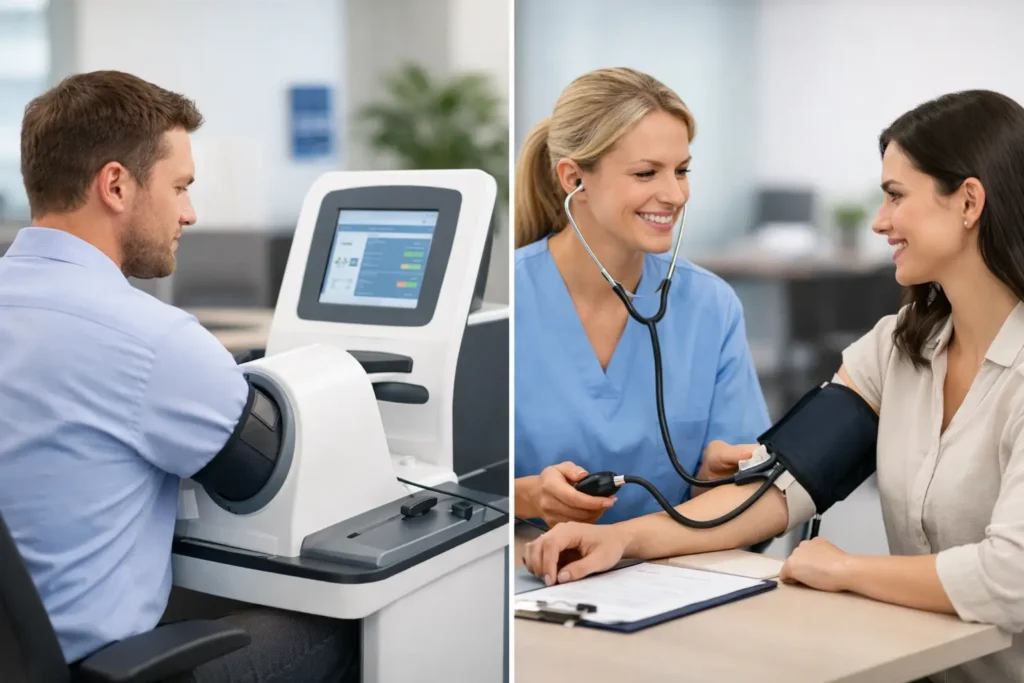
If you are weighing up health kiosk vs nurse screening for a workplace wellbeing programme, the real question is not which option sounds more comprehensive. It is which model will actually get used, fit your site, and give employees useful health data without creating a heavy admin load for HR.
For many employers, both options have a place. The better choice depends on what you want the screening to achieve, how many employees you need to reach, and how much time and coordination your team can realistically support on the day.
Health kiosk vs nurse screening: what is the difference?
A workplace health screening kiosk is a self-service station that allows employees to check core biometric measures on site. In a typical deployment, staff can measure height, weight, BMI, blood pressure, pulse and body fat percentage, then receive instant printed results. The process is quick, private and does not rely on booking individual appointments.
Nurse-led screening is different in both format and expectation. Employees usually attend a scheduled appointment with a clinician or trained screening professional, who takes measurements and may discuss results in more detail. Depending on the service, the appointment can extend beyond core biometrics into broader lifestyle or occupational health conversations.
That difference matters. A kiosk is built for accessibility and volume. Nurse screening is built for interaction and interpretation.
When a health kiosk makes more sense
If your main aim is to encourage participation and help employees know their numbers, a kiosk is often the more practical route. It removes one of the biggest barriers to workplace screening: scheduling.
In many organisations, appointment-based screening sounds good in principle but creates friction in practice. Managers need to release people at set times, employees miss slots because of meetings or shift patterns, and HR ends up coordinating reminders and rearrangements. A self-service kiosk strips most of that away. People can use it during the working day, complete the assessment in minutes and walk away with immediate feedback.
That simplicity tends to matter most in larger offices, hybrid workplaces and multi-site organisations. If you want broad uptake rather than a small number of in-depth assessments, kiosks are usually easier to deploy well.
There is also the question of space and logistics. A kiosk setup is straightforward. You need a suitable area, access to power and enough room for employees to use it comfortably. With the right provider, delivery, installation, maintenance and basic training are handled for you, which reduces operational risk and keeps the burden off internal teams.
For HR and wellbeing leads, that changes the shape of the project. Instead of organising a clinic-style event, you are placing a managed workplace wellbeing asset on site.
When nurse screening is the better fit
Nurse-led screening can be the stronger choice when you need more than a biometric snapshot. Some employers want a more personal experience, especially for senior leadership programmes, smaller teams, or initiatives where employees are likely to have questions about results and next steps.
A nurse can provide immediate context in a way a kiosk cannot. If someone gets a high blood pressure reading, for example, a trained professional can explain possible contributing factors, discuss whether a recheck is advisable and help the employee understand what action to take through normal healthcare channels.
This model can also work well where a programme is deliberately high-touch. If the goal is not just awareness but a more supported intervention, the value of a human conversation increases.
The trade-off is throughput. Nurse-led appointments take longer, cost more per participant and require tighter day planning. That does not make them the wrong option. It simply means they suit a different objective.
Employee uptake: convenience usually wins
In workplace wellbeing, participation is often the difference between a programme that looks good on paper and one that actually shifts behaviour. This is where the health kiosk vs nurse screening decision becomes less clinical and more operational.
Employees are far more likely to engage with screening if it feels easy, quick and low-pressure. A kiosk supports that. There is no need to sit through a formal appointment or explain personal habits face to face. For some people, that creates a more comfortable entry point into health awareness.
That matters in workplaces where health engagement is mixed. Not every employee is ready for a detailed conversation, but many will take five minutes to check blood pressure, weight or BMI if the process is right in front of them and does not interrupt the day too heavily.
Nurse screening can still achieve good uptake, particularly if the employer actively promotes it and protects time for attendance. But it asks more of both the employee and the organiser. If your workforce is busy, dispersed or hard to schedule, convenience tends to be the deciding factor.
Cost, scale and return on effort
Budget always matters, but so does the amount of internal effort needed to run the service well. A lower-cost option that creates weeks of planning is not necessarily the more efficient choice.
Kiosks are often better suited to scale because one installation can support a high number of users without requiring a clinician for every interaction. For employers running awareness campaigns, wellbeing weeks or ongoing health initiatives, that can make the cost per completed screening more favourable.
There is another benefit here: consistency. A well-managed kiosk offers the same process for every employee, and results are delivered instantly in a standard format. Some providers can also offer anonymised usage data, which helps employers understand engagement levels without complicating the employee experience.
Nurse-led screening may still justify the higher cost where the output is meant to be more consultative. But if your aim is broad access to preventative screening, the extra spend can narrow reach rather than improve outcomes.
What each option actually gives your employees
A kiosk gives employees a quick view of measurable health indicators. Height and weight feed into BMI. Blood pressure and pulse provide immediate cardiovascular markers. Body fat percentage adds another layer beyond the number on the scales. For many employees, simply seeing these figures in black and white is enough to prompt action.
That action might be as simple as paying more attention to daily movement, following up with a GP if a reading appears outside the normal range, or joining a wider workplace wellbeing activity such as nutrition, stress or sleep support.
A nurse-led screen gives the same person more interpretation at the point of testing. That can be valuable, especially if the employee wants reassurance or has concerns. But it is worth being honest about your programme objective. If you mainly want to increase awareness and access, a fast screening touchpoint may deliver more overall value than a smaller number of detailed appointments.
A blended approach often works best
It does not always have to be a straight choice between one model and the other. For some employers, the strongest approach is to use a kiosk as the high-volume entry point and support it with wider wellbeing activity across the year.
That could mean running screenings on site, then reinforcing the message with webinars, resilience sessions, nutrition training, movement classes or other interventions that help employees act on what they have learned. In that model, the screening is not a standalone event. It becomes the trigger for broader engagement.
This is often more realistic than expecting one day of nurse appointments to carry the full weight of a wellbeing strategy. Preventative health works better when it is easy to access and repeated over time.
For organisations that want a low-friction option with national delivery support, a managed kiosk service can fit neatly into that model. Providers such as Relaxa focus on practical deployment – delivery, installation, maintenance and support – so HR teams can concentrate on participation rather than troubleshooting.
How to choose the right model for your workplace
Start with the outcome you need. If you want high employee numbers, quick checks and a simple on-site setup, a kiosk is likely to be the stronger fit. If you want clinical interaction, more discussion and a smaller-scale service, nurse screening may be worth the additional cost and coordination.
Then look at your workforce reality. Are employees office-based, hybrid, shift-based or spread across multiple sites? Do you have the internal resource to organise appointments? Is privacy a concern? Do you want instant printed results and optional anonymised reporting, or a more consultative screening experience?
The best answer is usually the one that people will actually use. A screening service only supports wellbeing if employees can access it without unnecessary friction.
If you want to improve engagement with preventative health, think less about which option sounds more impressive and more about which one fits your workplace properly. The right screening model is the one that turns good intentions into real participation.