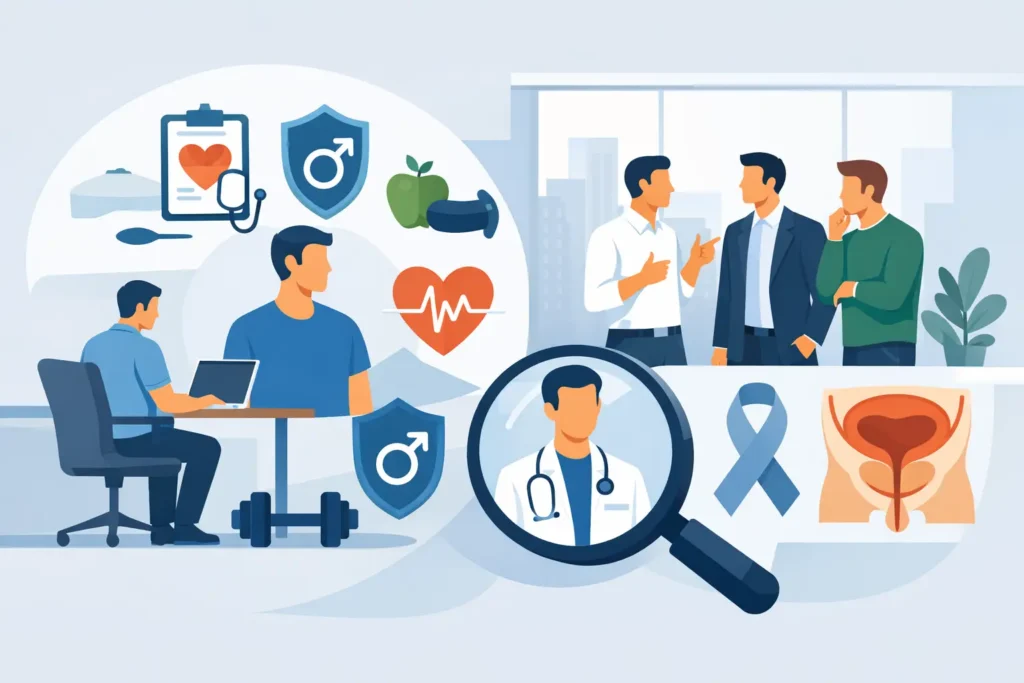
Men are often less likely to seek help early, book routine checks or talk openly about stress, sleep or physical health. In a workplace setting, that gap matters. It affects absence, engagement, productivity and, more importantly, whether people spot issues before they become harder to manage.
For employers, men’s health education is not about adding another awareness campaign that gets polite attention for a week and then disappears. It works best when it gives employees simple, relevant information they can act on during the working day, backed by convenient access to checks and follow-up support.
What men’s health education should cover
A useful workplace approach starts with the basics. Many employees do not know their blood pressure, BMI or body fat percentage, and without that starting point, health advice can feel vague. Education becomes more practical when it connects information to measurable health indicators and explains what those numbers may mean.
That is why men’s health education at work often works best when it includes cardiovascular health, weight management, stress, sleep, physical activity and mental wellbeing. These are common pressure points across office-based, hybrid and multi-site teams, and they are areas where early awareness can make a real difference.
For example, a session on heart health is more effective when employees can also access Workplace Blood Pressure Screening or broader Employee Health Checks. That turns a general message into something immediate and personal. Employees are not just hearing about prevention. They are seeing their own results and deciding what to do next.
Why the workplace is the right setting
The main advantage of workplace delivery is convenience. If support depends on employees making separate appointments off-site, participation usually drops. When education and screening are available where people already are, uptake is typically much stronger.
This is especially relevant for men who may not prioritise a GP visit for non-urgent concerns or may put off basic checks because of time, habit or uncertainty. A workplace health initiative removes much of that friction. It makes preventative action easier without creating a heavy admin process for HR teams.
That is also why practical delivery matters as much as the content itself. If an employer can offer on-site screening that takes only a few minutes, requires minimal space and provides instant printed results, the barrier to participation is much lower. In that setting, education becomes part of a usable wellbeing programme rather than a standalone message.
What good delivery looks like
For HR and wellbeing leads, the question is usually not whether men’s health matters. It is how to deliver support in a way that is simple to run and easy for employees to use.
The strongest programmes combine awareness with access. A men’s health webinar or wellbeing talk can help explain key risks, challenge unhelpful attitudes and encourage earlier action. Screening then provides a practical next step. Employees can check metrics such as height, weight, BMI, blood pressure, pulse and body fat percentage without needing appointments, which helps employers reach more people in less time.
This approach also gives organisations a clearer wellbeing story. Rather than offering information in isolation, they can show that they are helping employees understand their health, measure core indicators and engage with support throughout the year. For employers planning a broader campaign, Practical Ideas for Men’s Health at Work can help shape that activity.
Education should include mental wellbeing
Men’s health education should never be limited to physical metrics alone. Stress, poor sleep, burnout and mental health stigma are all highly relevant in male employee populations, particularly in demanding roles or workplace cultures where people are expected to keep going regardless.
The challenge is to keep the message practical. Generic encouragement to “speak up” rarely does enough on its own. Employees need clear explanations of how stress affects concentration, mood, sleep, blood pressure and long-term health, along with realistic ways to respond.
That may include structured Stress Management Training at Work, targeted webinars or manager education that helps leaders recognise when someone is struggling. When mental wellbeing is included as a normal part of men’s health conversations, engagement is usually stronger than when it is treated as a separate issue.
Making participation easier for employers and employees
Implementation is where many wellbeing ideas succeed or fail. If delivery is complicated, participation can suffer before the programme starts. Employers generally need a format that fits into existing workplace routines, works across different site types and does not create unnecessary scheduling pressure.
That is where a service-led model has value. A screening solution that can be delivered, installed and maintained with minimal input from the client side reduces operational risk. If employees can complete a check quickly, receive immediate results and use the service during normal working hours, organisations can support a much larger group without disrupting the day.
For companies looking to strengthen prevention and engagement, Employee Health Screening at Work gives a straightforward route into that process. It allows men’s health education to move beyond awareness and into practical action.
The most effective men’s health initiatives are not complicated. They give employees clear information, easy access to screening and a reason to pay attention now rather than later. In most workplaces, that kind of simplicity is what drives uptake.