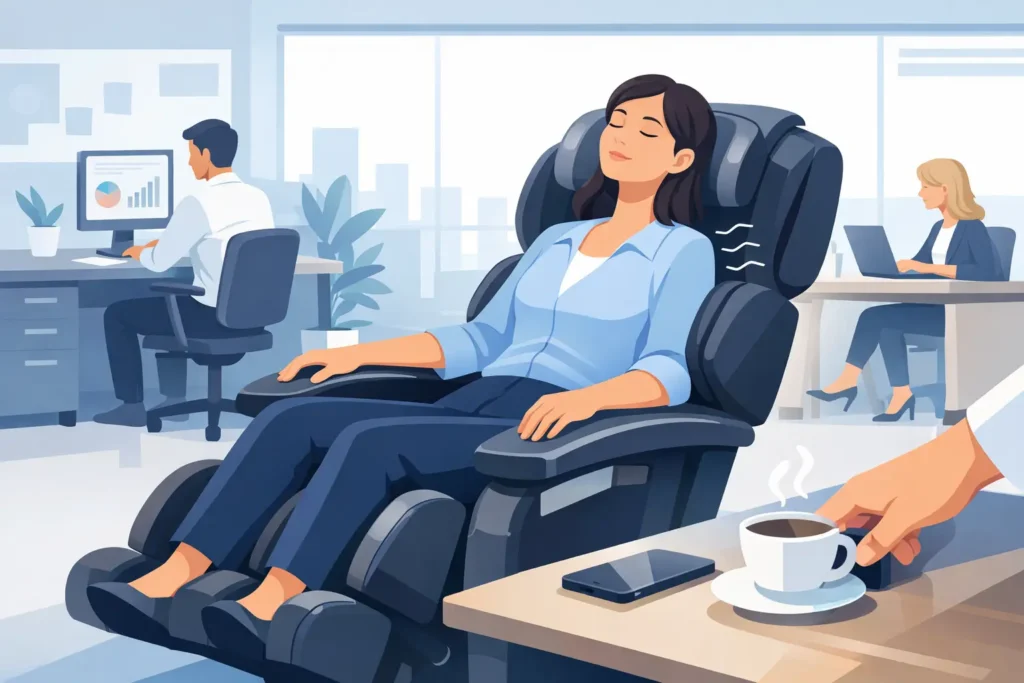
Office workers rarely complain about stress in abstract terms. They mention tight shoulders before a deadline, headaches after back-to-back video calls, and the stiff lower back that appears halfway through the afternoon. That is why office chair massage for employees works so well in practice. It responds to a problem people can feel immediately, and it does so in a format that fits the working day.
For employers, the appeal is not just that massage is popular. It is that chair-based sessions are easy to run on-site, require very little space, and tend to attract strong participation without complicated scheduling. When wellbeing budgets are under pressure, that combination matters.
Why office chair massage for employees works in real workplaces
Some wellbeing initiatives are valuable but hard to access. They need a private room, long appointments, or a high level of commitment from employees who are already busy. Chair massage is different. Sessions are short, fully clothed, and designed around the realities of the office.
That simplicity affects uptake. Employees who would not book a one-hour treatment outside work are often happy to take 10 or 15 minutes during the day. For HR and People teams, that lowers the usual barrier to engagement. You are not asking people to overhaul their lifestyle. You are offering a practical intervention that feels manageable.
There is also a visibility factor. When employees see colleagues taking part, interest tends to spread quickly. This makes office chair massage for employees useful not only as a standalone service, but as part of a wider wellbeing calendar where visibility and momentum matter.
What employees actually get from a chair massage session
The most immediate benefit is muscular relief. Office-based work places repetitive strain on the neck, shoulders, upper back and arms. Hours spent at a desk, poor posture, and limited movement can leave people uncomfortable even when they are not dealing with a formal musculoskeletal issue.
A chair massage session is typically focused on those problem areas. It can help reduce muscular tension, encourage relaxation, and give employees a clear physical reset in the middle of the day. That reset is often what people remember. They return to work feeling less cramped, less distracted by discomfort, and mentally calmer.
That said, it is worth being realistic. Chair massage is not a substitute for clinical treatment, ergonomic assessment, or broader workplace health support. If someone has ongoing pain linked to workstation setup or an underlying condition, massage may help in the short term but will not solve the root cause on its own. The best results usually come when massage sits alongside practical support such as posture education, movement sessions, and wider wellbeing provision.
The business case is stronger than it first appears
Some decision-makers still see massage as a perk rather than a workplace tool. In some settings, that is a fair concern. If the service is badly planned, poorly communicated, or detached from any wider wellbeing strategy, it can feel tokenistic.
Used properly, though, office chair massage for employees supports several things employers already care about. It can improve participation in wellbeing activity, demonstrate visible duty of care, and offer a simple way to address day-to-day stress and discomfort before they are ignored. It also gives line managers and HR teams something concrete to promote during high-pressure periods.
The practical value is often strongest in businesses where employees spend long periods seated, are balancing demanding workloads, or have limited time to engage with longer interventions. Hybrid teams can benefit too, particularly when massage days are scheduled for peak office attendance. In that case, the service helps make in-office days feel purposeful and supportive, rather than simply obligatory.
How to run office chair massage for employees smoothly
Operationally, chair massage is one of the easier on-site wellbeing services to deliver. It does not require a treatment room in the traditional sense, but it does need a sensible setup. A quiet meeting room, unused office, or screened area usually works well. Privacy does not need to be clinical, but employees should feel comfortable stepping away from their desks.
Session length matters. Ten to 20 minutes is usually the right range. Shorter sessions allow more employees to take part, which is useful for larger teams or single-day wellbeing events. Slightly longer sessions may suit smaller groups where the aim is a more restorative experience. The right model depends on headcount, budget, and whether the day is intended as a high-volume engagement activity or a more premium support offer.
Booking is another point worth deciding early. Open walk-ins can create energy and visibility, but they can also lead to queues and uneven access. Timed slots are easier to manage and give employees certainty. In many workplaces, a hybrid approach works best – advance booking with a small number of same-day spaces kept back.
Communication should be straightforward. Employees need to know how long sessions last, what to wear, whether they remain fully clothed, and who the service is suitable for. Removing uncertainty is one of the easiest ways to improve take-up.
Common questions employers should settle before booking
Before you put chair massage into a wellbeing plan, it helps to be clear about the purpose. Is the goal to boost participation during a wellbeing week? Support stress awareness activity? Offer relief during a demanding business period? Or create a regular monthly wellbeing touchpoint?
The answer affects how the service should be delivered. A one-off awareness day can be highly visible and create a positive response, but regular sessions often have more lasting value because they build trust and familiarity. Employees start to see wellbeing support as part of working life rather than a special event.
You should also think about workforce spread. A single head office event may be easy to arrange, but it will not reach hybrid or multi-site teams equally. If fairness of access is important, massage should sit within a broader programme that includes options for different locations and working patterns.
This is where a wider service mix becomes useful. For example, on-site massage can be paired with movement classes, stress or posture webinars, and practical health checks so employees have more than one route into support. Relaxa takes that kind of service-led approach, which is often what employers need when they are trying to build year-round engagement rather than just fill a wellbeing week.
Where chair massage fits in a wider wellbeing strategy
Massage is most effective when it is treated as one part of a system rather than the whole answer. It can create strong initial engagement because it is accessible and immediately appealing. Once employees are engaged, employers have a better opportunity to signpost other support.
For example, an employee who books a massage because of shoulder tension may also benefit from posture training, desk-based movement advice, or a basic health check that encourages broader preventative action. That is particularly relevant in office environments where physical discomfort, stress, fatigue and sedentary habits often overlap.
For HR teams, this joined-up approach also improves reporting and decision-making. A standalone massage day may be appreciated, but a structured programme gives more evidence of intent. It shows the organisation is not only offering reactive wellbeing moments, but also creating practical routes for employees to understand and improve their health over time.
The trade-offs to keep in mind
Chair massage is popular, but it is not universally suitable in every setting. Highly confidential environments may struggle with space or privacy. Some employees may feel self-conscious, especially if communication is vague or the setup is too exposed. Others may prefer different forms of support altogether.
There is also a capacity question. A single therapist can only see a certain number of people in a day, so larger organisations may need multiple practitioners or repeat dates to meet demand. If access feels too limited, the service can create frustration instead of goodwill.
That does not mean the model is flawed. It simply means planning matters. The employers who get the best results are usually the ones who match the format to the workforce, communicate clearly, and treat the service as part of a practical wellbeing offer rather than a box-ticking exercise.
Making office chair massage for employees worth the investment
If you are considering office chair massage for employees, the key question is not whether people will like it. In most workplaces, they will. The better question is whether it fits the way your organisation actually operates.
If you need a low-friction wellbeing service that works on-site, appeals to busy employees, and can be delivered with minimal disruption, chair massage is a strong option. It is visible, easy to understand, and capable of generating quick engagement. But its real value comes when it is planned properly, delivered reliably, and connected to wider workplace health support.
When wellbeing activity is simple to access, employees are more likely to use it. That is often the difference between a nice idea and a service that genuinely earns its place in the working day.