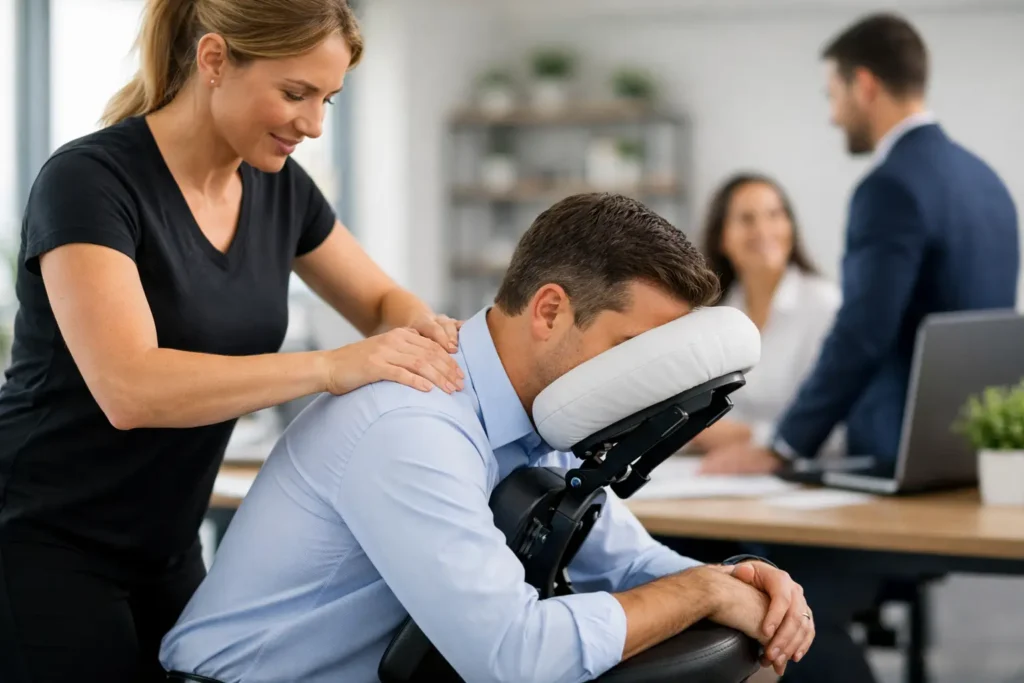
A tense afternoon shows up in small ways – shoulders creeping upwards in meetings, shorter tempers on calls, people standing up from their desks already uncomfortable. Office massage works because it tackles that pressure where it actually happens: during the working day, in the workplace, without asking employees to make extra time before or after work.
For employers, that matters. The best wellbeing initiatives are not always the most elaborate. They are the ones people use. When a service is easy to book, simple to run on-site and quick for employees to access, participation is usually higher and the admin burden is lower. That is a large part of why office massage remains a practical option for organisations that want visible, immediate wellbeing support.
Why office massage still works in modern workplaces
Workplace pressure has changed shape, but it has not gone away. Office-based teams now split time between home and workplace settings, spend long periods on screens and often move straight from one call to the next. Even in well-managed organisations, that can lead to muscular tension, mental fatigue and reduced concentration.
Office massage offers a straightforward response. Sessions are typically short, delivered on-site and designed to fit around the working day. Employees do not need to change clothes, travel to another location or block out a large part of their diary. That convenience is a major advantage for HR and People teams trying to improve uptake rather than simply offering another benefit that sounds good on paper.
There is also a cultural benefit. Bringing wellbeing support into the office sends a clear message that employee health is not an afterthought. It becomes part of the operating rhythm of the business, rather than something staff are expected to manage in their own time.
What employers actually get from office massage
The most immediate gain is visible relief from desk-based discomfort. Neck, shoulder and upper back tension are common in office environments, particularly where employees are working under time pressure or spending long periods in static postures. Short massage sessions can help reduce that tension quickly, which is why they are often well received even by employees who would not usually engage with wellbeing activity.
The second gain is engagement. Some workplace wellbeing services require a strong prior interest in health to attract participation. Office massage is different. It is accessible, easy to understand and requires little explanation. That makes it useful for wellbeing campaigns that need broad appeal across mixed teams, seniority levels and working styles.
The third gain is perception. Employees tend to notice practical support that is delivered in the flow of work. A one-off email about resilience may be ignored. A service that appears on-site, runs smoothly and gives people a genuine pause in the day is much harder to miss. That can help employers demonstrate active duty of care in a way that feels concrete rather than performative.
That said, it is best viewed as one part of a wider wellbeing plan. Massage can reduce short-term tension and improve the employee experience, but it will not solve workload problems, poor workstation set-up or weak management practice. Used well, it complements broader action rather than replacing it.
How office massage works on-site
From an operational point of view, the format is one of its strengths. In most cases, office massage is delivered using a portable massage chair in a quiet room or screened area. Sessions are short, often between 10 and 20 minutes, which makes them easier to schedule across the day without causing major disruption.
For employers, the main requirements are modest. You need a suitable space, a clear schedule and a straightforward booking process. That could mean pre-booked time slots, managed sign-up by an internal coordinator or a structured rota for teams. The right set-up depends on your workforce. A smaller office may manage perfectly well with informal sign-up, while a larger or multi-team environment will usually need tighter time control.
Privacy matters as well. Office massage does not require a treatment room in the traditional sense, but employees should still feel comfortable and unobserved. A meeting room, wellness room or screened breakout space is often sufficient. The goal is simple: create an environment where staff can switch off briefly without feeling self-conscious.
For HR teams, a turnkey service model is usually the most efficient route. That means clear booking arrangements, reliable practitioner attendance, straightforward room requirements and minimal internal administration. Providers that understand workplace delivery tend to make a real difference here, particularly when services are being rolled out across multiple sites or built into a larger wellbeing calendar.
When office massage makes the most sense
Not every organisation will need a regular weekly schedule. In some workplaces, office massage works best as part of a focused campaign, such as Stress Awareness Month, Mental Health Awareness Week or a wider wellbeing day. In others, it is more effective as a recurring benefit that employees can rely on each month or quarter.
The right frequency depends on what you are trying to achieve. If the goal is visibility and engagement, an event-based approach may be enough. If the aim is to provide ongoing support in a high-pressure environment, regular delivery is usually more valuable.
It is also particularly useful in certain contexts. Teams going through busy reporting cycles, contact centre environments, project-heavy departments and organisations managing change can all benefit from interventions that are quick, practical and easy to access. Equally, office massage can support return-to-office strategies by making on-site days feel better structured and more employee-friendly.
Making office massage part of a broader wellbeing plan
The strongest results usually come when massage is not treated as a standalone perk. It works better when it sits alongside other interventions that address the wider picture of employee health.
For example, if staff are reporting tension and fatigue, it may make sense to combine massage with desk-based movement sessions, posture education or webinars on stress and sleep. If the organisation is focused on preventative health, massage can sit alongside simple health checks that help employees understand core wellbeing measures such as blood pressure, BMI and pulse. This creates a more rounded programme – one that supports both how people feel in the moment and how they manage their health over time.
This is where a practical workplace wellbeing provider can add value. Relaxa, for example, supports employers with on-site massage, movement sessions, webinars and health screening options that are designed to be straightforward to deploy across the year. For HR teams, that joined-up model can reduce admin and improve continuity.
What to consider before booking
A successful service usually comes down to a few practical decisions made early. The first is capacity. If you have 200 employees on one site and only a handful of appointments, interest may outstrip availability quickly. That is not necessarily a reason not to run it, but it does mean expectations should be managed.
The second is fairness. Employers should think about how access will work for part-time staff, shift patterns, hybrid workers and teams with less diary flexibility. If the same people can always leave their desks while others cannot, the service may be appreciated by some but resented by others.
The third is communication. Staff need to know what the session involves, how long it lasts and whether they need to do anything in advance. Clear communication improves uptake and reduces no-shows. It also helps employees who may be unfamiliar with workplace massage feel more comfortable about taking part.
Finally, consider what success looks like. For some employers, the value is qualitative – better morale, positive feedback and visible engagement. For others, the service is part of a measurable wellbeing strategy tied to participation levels, campaign activity or broader retention and employee experience goals. Both are valid, but it helps to decide in advance what you want the service to deliver.
A practical wellbeing service, not just a nice extra
Office massage is sometimes dismissed as a soft benefit, but that misses the point. In workplace terms, its value lies in low-friction delivery, strong employee appeal and immediate relevance to desk-based strain and day-to-day stress. It is not a substitute for good job design or proper management support, but it is an efficient way to bring wellbeing into the working day in a form employees are likely to use.
For organisations trying to improve participation without creating more administration, that balance matters. A wellbeing service does not need to be complicated to be effective. It needs to be easy to run, easy to access and clearly useful to the people it is there to support.
If you are planning your next wellbeing activity, office massage is worth viewing through that operational lens. The question is not whether it sounds appealing. The better question is whether it gives your employees meaningful support in a format your workplace can deliver consistently – and for many employers, the answer is yes.