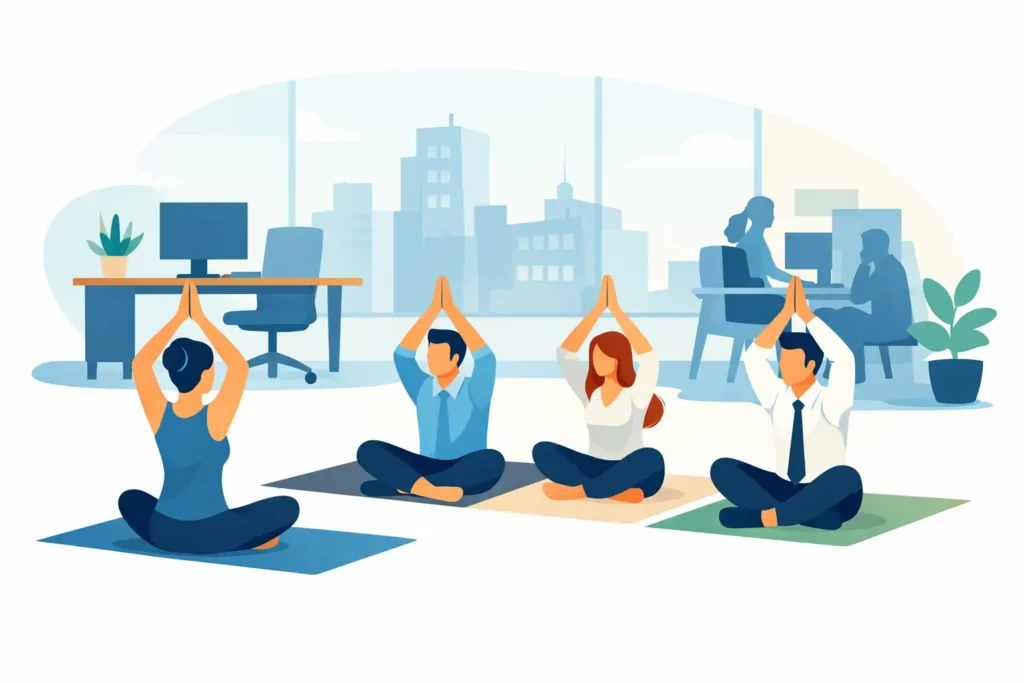
Do office yoga classes for staff actually work?
A 45-minute wellbeing session sounds easy to approve until it meets a real office diary. Meetings overrun, hybrid teams split attendance, and someone always asks whether yoga is really the best use of budget. That is usually the point where good intentions stall.
Office yoga classes for staff do work, but only when they are planned as a workplace service rather than treated like a leisure perk. For employers, the value is not in turning staff into yoga enthusiasts. It is in giving people a simple, low-friction way to move, reset and manage physical tension during the working day.
That distinction matters. If the class is accessible, easy to book and suited to a normal office environment, participation is far more likely. If it feels specialist, time-heavy or awkward to attend, uptake drops quickly. For HR and wellbeing leads, the question is less whether yoga is good in theory and more whether it can be delivered in a way that fits the realities of your workforce.
Why office yoga classes for staff appeal to employers
Most office-based wellbeing issues are not dramatic. They are cumulative. Stiff backs after long hours at a desk, tight shoulders from laptop work, mental fatigue after back-to-back calls, and reduced concentration later in the day all build over time. A practical yoga session addresses that pattern because it combines movement, posture awareness and breathing in one format.
For employers, that creates several useful outcomes. First, it gives staff a structured reason to step away from their screen without losing half a day. Second, it supports preventative wellbeing rather than waiting until discomfort, stress or disengagement become harder to manage. Third, it is visible. People can see that a session is happening, hear colleagues mention it, and understand that wellbeing is being supported during working hours rather than added as homework.
There is also a cultural benefit. Office yoga classes for staff can feel more inclusive than some fitness-led initiatives because they do not depend on sporting ability. A well-run class can be adapted for beginners, mixed ages and varied mobility levels. That makes it easier to position as a broad wellbeing offer rather than something only a small group will use.
What employees actually gain from a workplace yoga session
The immediate benefit is usually physical relief. People who spend most of the day seated often notice improvements in mobility, posture awareness and muscle tension quite quickly. Even a short class can help reduce the sense of compression that builds through the neck, upper back and hips.
The mental effect is just as relevant in an office setting. Guided breathing and focused movement can help staff transition out of task overload, which is particularly useful in high-pressure roles or during busy periods. That does not mean one class solves stress. It means it offers a practical intervention that helps people regulate energy and attention in the middle of a working week.
There is a wider point here for employers. Wellbeing initiatives often struggle when the benefit is too abstract. Yoga is different because employees usually feel something straight away – less stiffness, calmer breathing, clearer focus, or simply a useful break in the day. When staff can feel the value, repeat participation becomes easier to build.
The delivery model matters more than the idea
A yoga class can be a strong addition to a wellbeing programme, but success depends heavily on delivery. This is where many employers get mixed results.
Timing is one factor. Lunchtime can work well because it avoids the start and end of day rush, but some teams prefer a morning session to set people up before meetings begin. In other workplaces, a late afternoon class is more realistic. There is no universal best slot. It depends on operational demands, site patterns and how easy it is for staff to step away.
Format matters too. On-site sessions often create better visibility and a stronger sense of shared participation, especially in office-led environments. Online delivery can be more practical for hybrid and multi-site teams. In many organisations, the most effective model is a combination of both, so employees are not excluded by location.
The style of class also needs thought. A dynamic, fitness-oriented session may suit some workplaces, but a gentler format is often a better starting point. Chair yoga, desk-based mobility sessions and beginner-level mat classes tend to remove barriers and help first-time participants feel comfortable. If the goal is engagement, accessible usually beats ambitious.
Common barriers and how to avoid them
The biggest barrier is often perception. Some employees assume yoga is only for flexible people, or that they will be expected to perform in front of colleagues. Others worry they will need specialist clothing, mats or prior experience. If these concerns are not addressed up front, attendance can be lower than expected.
Clear communication helps. Staff should know whether the class is suitable for beginners, what they need to bring, how long it lasts, and whether they can join in normal workwear. In many office environments, the more convenient and low-pressure the session feels, the better the uptake.
Space is another practical issue. Not every office has a dedicated wellbeing room or large open area. That does not mean yoga is off the table. Short movement sessions can be delivered in meeting rooms, breakout spaces or multi-use areas if the format is adapted properly. Employers do not need a perfect studio setting. They need a provider that understands how to work within a real workplace footprint.
Manager support also makes a difference. If staff feel they have to justify attending, they are less likely to take part. When line managers actively support participation and the session is positioned as part of the working day rather than a nice extra, attendance becomes more consistent.
How to judge whether the programme is worth it
Not every wellbeing activity needs a complex evaluation model, but it does need a practical one. For office yoga classes for staff, the most useful measures are usually participation, repeat attendance and staff feedback. If people come back, recommend it to colleagues and ask for more sessions, that tells you a great deal.
There are also softer operational indicators worth noticing. Are employees engaging from different departments, not just one enthusiastic team? Are sessions filling with minimal chasing? Do staff comment that the class helps with posture, energy or stress levels? These are straightforward signals that the offer is landing well.
If your organisation already runs broader wellbeing activity, yoga can also complement other services. For example, posture and movement sessions sit naturally alongside stress management, resilience, sleep or nutrition education. In some cases, employers pair movement classes with health screening activity to create a wider preventative wellbeing programme rather than a one-off event. That joined-up approach often produces stronger engagement because employees can see a clearer link between awareness and action.
What good implementation looks like
A workable programme starts with a simple brief. Who is the session for, where will it run, how many people need to attend for it to be viable, and what level of class is appropriate? Once those points are clear, delivery becomes much easier.
From there, convenience should lead decision-making. Shorter sessions can be more practical than longer ones. A 30-minute class that runs consistently may outperform a 60-minute session that people struggle to fit in. Regular scheduling usually matters more than occasional intensity.
Communication should be plain and specific. Tell staff exactly what to expect, how the class will work and why it has been introduced. Avoid overselling it as a cure-all. A more credible message is that the class is there to support movement, comfort and mental reset during the day.
For employers managing multiple sites or hybrid teams, consistency is important. That means using a delivery model that can scale without creating extra admin. Relaxa’s workplace wellbeing services are designed around that kind of practical rollout, with on-site and online options that make it easier to support participation across different office environments.
When yoga may not be the first priority
It is worth being honest that yoga is not always the immediate answer. If your workforce has very low engagement in wellbeing activity overall, you may need a broader starting point first. If operational pressures make it nearly impossible for staff to step away even briefly, a class alone will not fix that.
Equally, some workplaces may benefit more initially from health checks, mental health awareness training or ergonomic support, depending on their risks and employee needs. Yoga works best as part of a considered wellbeing plan, not as a box-ticking substitute for one.
That said, when employers want something visible, practical and relatively easy for staff to try, it remains one of the more effective options. It can be adapted, repeated and scaled without major disruption, which is exactly why it continues to have value in workplace settings.
A good office yoga programme is rarely about teaching perfect poses. It is about giving employees a realistic chance to move better, feel better and return to work with a little more capacity than they had before they walked in.