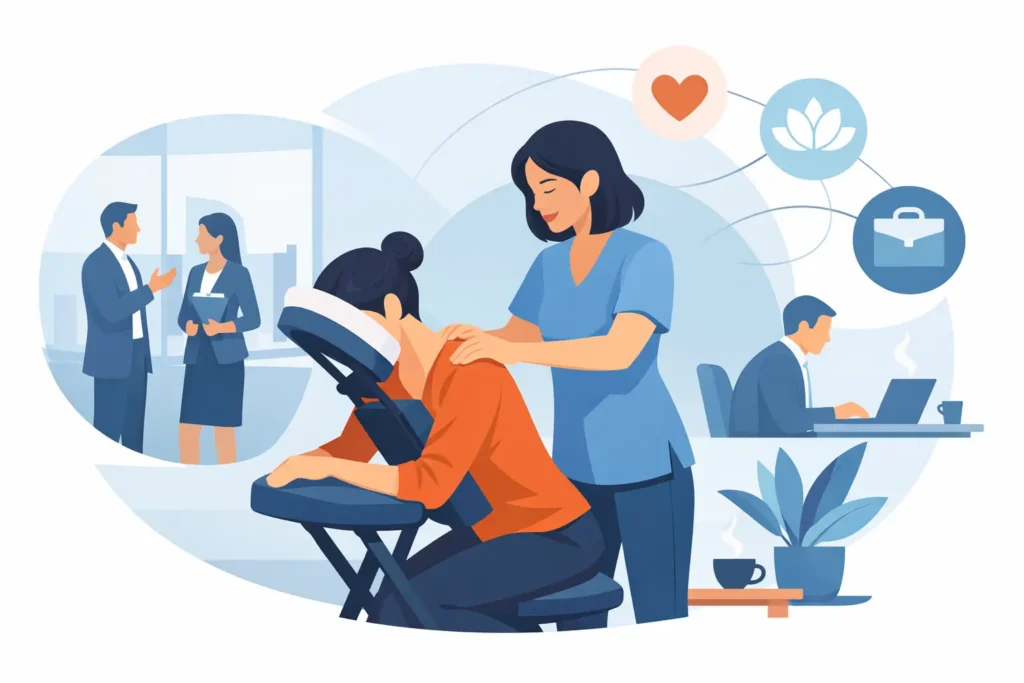
A wellbeing initiative only works if people actually use it. That is why On-Site corporate massage continues to be one of the most practical services employers can introduce – it is easy to deliver, easy to access during the working day, and easy for employees to feel the benefit straight away.
For HR teams and wellbeing leads, that matters. Many initiatives are well intentioned but struggle with participation because they require appointments, large spaces, or too much time away from work. Massage at work is different. It fits into a normal working day, requires very little set-up, and gives employees a clear, immediate reason to take part.
What On-Site corporate massage looks like in practice
In most workplaces, the service is delivered as short chair massage sessions. A trained therapist works from a small, quiet area and employees attend in pre-booked slots or during a managed schedule. Sessions are usually focused on the back, neck, shoulders, arms, and scalp – the areas where office-based staff most often carry tension.
This format works well because it removes the usual barriers. Employees do not need to change clothes, no oils are required, and each session can be completed in a short window. For employers, that means strong uptake without major disruption to operations.
Where teams are hybrid or spread across several sites, massage can also be rotated across locations as part of a wider wellbeing calendar. That makes it useful not just as a one-off event, but as a repeatable service that supports engagement over time.
Why employers use it
The appeal is straightforward. On-site massage is a visible, low-friction wellbeing intervention that supports stress management and helps employees pause during busy periods. In office environments, it also aligns with common physical complaints linked to desk work, including shoulder tightness, upper back discomfort, and posture-related tension.
From an employer perspective, the value is not limited to the session itself. It can help raise awareness of wellbeing support more broadly, especially when paired with activity around stress, mental health, posture, or movement. A practical service like this often acts as an entry point for employees who may not usually engage with wellbeing programmes.
That is particularly relevant during busy campaigns, awareness weeks, or seasonal periods when pressure is high. In those settings, a simple intervention with immediate benefit can achieve better participation than a more complex programme launched at the wrong time.
The operational benefits are often the deciding factor
For many organisations, the question is not whether massage is popular. It is whether it is easy to run. This is where a well-managed on-site service stands out.
The space requirement is modest. A meeting room, wellbeing room, or screened quiet area is often enough. Sessions are short, scheduling is predictable, and there is no need for specialist facilities. That makes the service suitable for head offices, regional sites, call centres, and many other workplace settings.
It is also easy to scale. Some employers use it for a single wellbeing day. Others build it into a broader calendar with health screening, talks, and training. When planned properly, it becomes a practical part of a structured programme rather than an isolated perk. For organisations reviewing wider strategy, this is where services like What Works in Corporate Wellbeing Programmes become relevant.
What results can you realistically expect?
The strongest result is usually engagement. Employees understand the offer immediately, and that simplicity helps participation. It also creates a visible sign that the employer is investing in support people can use during working hours, not just offering resources employees are expected to find in their own time.
There are, however, sensible limits. Massage is not a replacement for occupational health support, clinical treatment, or longer-term interventions where deeper issues are involved. It works best as part of a broader wellbeing approach that also covers education, prevention, and signposting.
For example, if your organisation is seeing high stress levels, massage may help employees manage immediate tension, but it should sit alongside manager awareness, practical stress education, and clear support routes. In that context, services such as Mental Health Training At Work can strengthen the wider offer.
Where it fits in a year-round wellbeing plan
On-Site corporate massage is often most effective when used with purpose. That could mean supporting a stress awareness campaign, improving attendance at a wellbeing day, or adding a practical element to a health-focused week.
It also pairs well with screening and preventative health activity. For example, an employer may use health checks to help people know key numbers such as blood pressure, then support broader wellbeing engagement with massage, webinars, and movement sessions. This combination works because it addresses both awareness and day-to-day experience.
If your workplace is specifically focused on desk-based discomfort and sedentary habits, massage also complements ergonomic and musculoskeletal initiatives, including Office Chair Massage at Work and posture-related campaigns.
Is it right for every workplace?
Not always. Environments with very limited privacy, highly restricted schedules, or operational conditions that prevent staff from stepping away even briefly may need a different format or a more carefully managed rota. The key is planning around the workplace rather than forcing a generic model.
That said, for a large proportion of UK employers, it remains one of the simplest wellbeing services to introduce. It is quick to understand, practical to deliver, and well suited to organisations that want visible support without heavy administration.
For employers looking for a dependable, easy-to-run service that employees are likely to use, on-site massage remains a strong option – particularly when it forms part of a broader, measurable wellbeing programme.