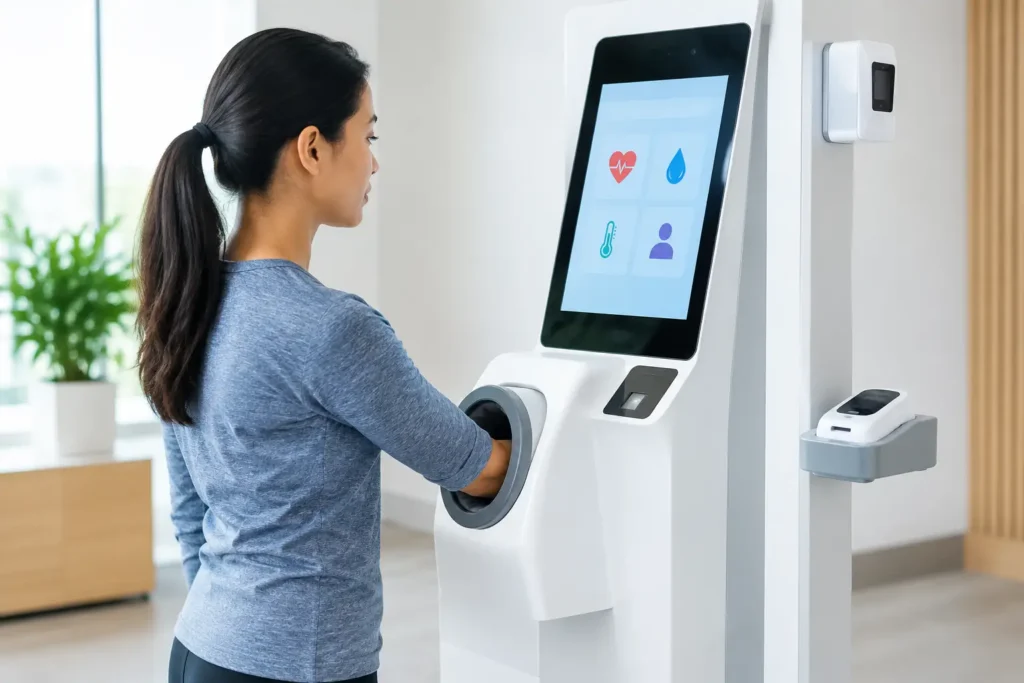
An employee can step away from their desk, complete a basic health check in a few minutes and leave with a printed record of their results. That convenience is the reason workplace screening can achieve far stronger participation than appointment-based initiatives. But what does a health screening kiosk measure, and what do those numbers mean for employees and employers?
A workplace health screening kiosk captures a set of core biometric measurements that help people understand their current health indicators. It is designed to support preventative wellbeing – giving employees a prompt to know their numbers, consider positive changes and seek clinical advice where appropriate. It is not a medical diagnosis, nor a replacement for a GP, occupational health assessment or emergency care.
What does a health screening kiosk measure?
The exact specification can vary by kiosk, but a workplace health screening service commonly measures height, weight, body mass index (BMI), blood pressure, pulse and body fat percentage. Together, these measurements provide a practical snapshot of cardiovascular and weight-related health indicators.
For an employer, the value is in making these checks easy to access during the working day. Employees do not need to book individual appointments or travel to a clinic. They can use the kiosk privately at a suitable point during an on-site wellbeing event or a longer rental period, then take away their results immediately.
Height and weight
Height and weight are the starting point for several useful calculations. Weight may change for many reasons, including diet, activity levels, sleep, medication and underlying health conditions. A single reading is not the full story, but recording it gives an employee a clear baseline.
Height is generally a stable measurement in adulthood and is used with weight to calculate BMI. Employees should remove heavy outerwear and items from their pockets where practical, as these can affect the reading. Clear on-site instructions help make the process consistent and straightforward.
Body mass index (BMI)
BMI is calculated from an individual’s height and weight. It is widely used as a population-level indicator to identify whether weight may be associated with increased health risk.
It has limitations. BMI does not distinguish between muscle and fat, so a muscular person may have a higher BMI without having excess body fat. It also cannot assess an individual’s diet, fitness, ethnicity, age or medical history. For that reason, the best approach is to present BMI as a useful screening indicator rather than a judgement or diagnosis.
In a workplace setting, BMI can encourage a constructive conversation about everyday habits such as movement, food choices and sleep. The kiosk result belongs to the employee, while the employer’s role is to provide accessible, respectful wellbeing support.
Blood pressure
Blood pressure measures the force of blood against artery walls. It is recorded as two figures: systolic pressure, when the heart pumps, and diastolic pressure, when the heart rests between beats.
High blood pressure often has no obvious symptoms, which is why a convenient check can be valuable. A reading that is higher or lower than expected should not be treated as a diagnosis from one test. Stress, caffeine, recent exercise, smoking, talking during the test and an incorrectly positioned cuff can all influence the result.
Employees should sit quietly for a few minutes before taking a reading, keep both feet on the floor and follow the kiosk instructions carefully. If a result causes concern, the sensible next step is to repeat the check at another time and contact a GP or qualified healthcare professional for advice. Urgent symptoms such as chest pain, severe breathlessness or signs of stroke require urgent medical help, not a further kiosk test.
Pulse rate
Pulse rate is the number of heartbeats per minute. It can vary naturally depending on whether someone has just walked up stairs, had a coffee, feels anxious or is taking certain medication. Fitness level, illness and hydration can also affect it.
A pulse reading is most useful when taken at rest and considered in context. For employees, seeing this measure alongside blood pressure can make cardiovascular wellbeing feel more tangible. It may also prompt them to consider regular activity, recovery and sleep rather than focusing only on weight.
Body fat percentage
Body fat percentage estimates the proportion of a person’s body weight that is fat tissue. This can add context that BMI alone cannot provide, particularly where body composition differs between individuals of the same height and weight.
Many kiosks use bioelectrical impedance analysis, which sends a very small electrical signal through the body to estimate body composition. Results can be affected by hydration, meals, exercise and other short-term factors. That means body fat percentage is generally more helpful for spotting a personal trend over time than for treating one reading as definitive.
Not every employee will want to take every measurement, and participation should always be voluntary. A well-run workplace event gives people a choice, clear information and enough privacy to use the kiosk confidently.
Why these measurements work well at work
The strength of kiosk screening is not that it produces a complete medical assessment. It is that it removes practical barriers to basic health awareness. Employees can access checks where they already are, without arranging a separate appointment or taking time away from work.
This format can be particularly useful for organisations with busy office teams, shift patterns, multiple locations or hybrid workforces. A kiosk provides a consistent experience and immediate printed results, allowing employees to keep their information private while acting on it in their own time.
For HR and wellbeing teams, screening can form part of a wider calendar rather than a one-off gesture. Blood pressure and body composition checks may sit alongside sessions on nutrition, movement, stress, sleep or mental health. The measurements create a practical starting point; the wider programme gives employees ways to respond.
Where usage information is collected, it should be anonymised and handled transparently. Aggregate participation data can help employers understand uptake and plan future wellbeing activity, but it should never become a route to monitoring individuals’ health data or performance.
What employees receive after a kiosk check
A key benefit of a health screening kiosk is the immediate result printout. Instead of waiting for an email or follow-up appointment, employees leave with their main measurements and can decide whether they would like to discuss them with a healthcare professional.
The printout should be easy to read and accompanied by plain-language guidance. Employers should also communicate ahead of time that screening is optional, confidential and intended to support personal wellbeing. This matters for trust, particularly when results concern weight, blood pressure or body composition.
It is also worth setting expectations carefully. Kiosks are suited to baseline checks and health awareness, not diagnosing disease, prescribing treatment or interpreting complex medical risk. Employees with an existing condition, a concerning result or questions about their medication should seek advice from their GP or relevant clinician.
Planning a smooth on-site screening day
A successful deployment depends as much on the practical set-up as the measurements themselves. The kiosk needs an appropriate, accessible location with a power supply, enough space for employees to use it comfortably and a degree of privacy. A quiet meeting room, wellbeing area or screened section of a larger space often works better than a busy reception area.
Communication drives uptake. Let staff know what the kiosk measures, how long a check takes, whether they need to prepare and what will happen to their information. Avoid language that pressures people to participate. Position the service as a convenient opportunity to understand personal health numbers.
For larger workforces, consider running the kiosk over more than one day or placing it at different sites. This gives shift workers, part-time employees and teams with customer-facing responsibilities a fair opportunity to take part. It also avoids queues that can discourage engagement.
Relaxa supports this operational side with UK-wide delivery, installation, basic user training and engineering support, so HR teams can focus on communicating the initiative rather than managing equipment. Printed result consumables and clear escalation guidance should also be planned before the screening begins.
A health screening kiosk is most effective when it makes the next positive step feel achievable. Give employees a private, convenient way to check their numbers, then make sure the wider wellbeing support is there when they are ready to use it.