Is workplace health screening kiosk rental the right fit for your workplace?
If your wellbeing calendar depends on employees booking appointments, turning up on time, and finding a private slot in a busy working day, participation usually falls away faster than planned. That is where workplace health screening kiosk rental becomes useful. It removes the bottleneck of one-to-one scheduling and gives employees a simple way to check key health measurements on-site, in minutes, during the normal working day.
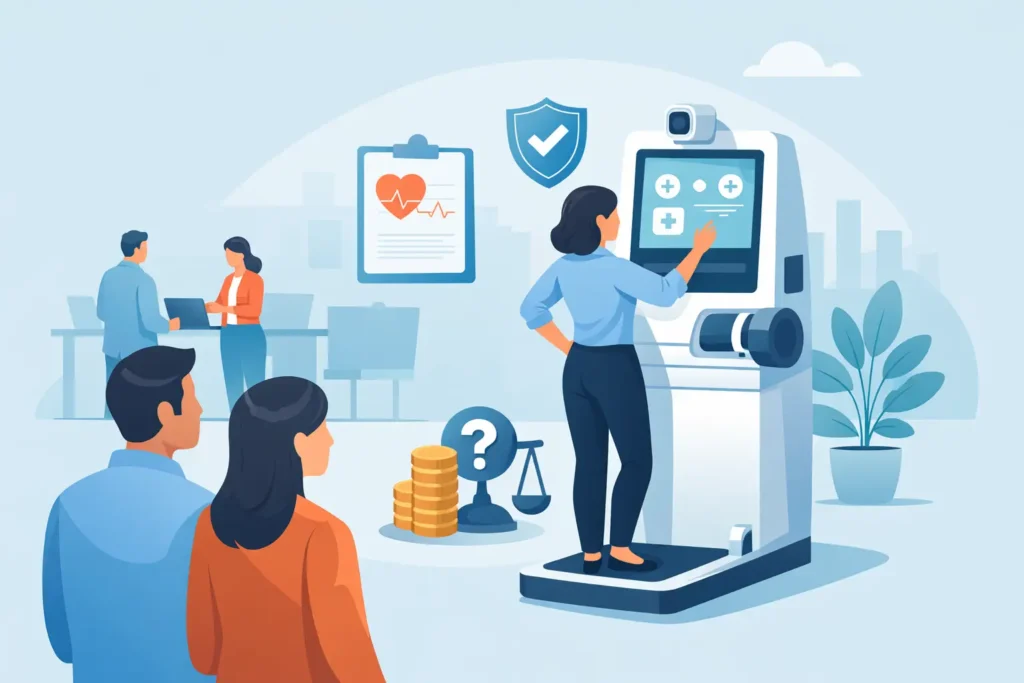
For HR teams, People leaders and wellbeing champions, the appeal is straightforward. You can offer a visible, practical health initiative without setting up a full clinic room, coordinating individual diaries, or taking on technical maintenance. Employees step up to the kiosk, complete a guided assessment, and receive immediate printed results. The employer gets a low-friction wellbeing activity that is easy to run and easy to explain.
What a workplace health screening kiosk rental actually delivers
A rented health screening kiosk is designed to capture core biometric data quickly and consistently. In most workplace settings, the measurements that matter are the ones employees recognise and can act on – height, weight, BMI, blood pressure, pulse, and body fat percentage.
These are not meant to replace GP care or occupational health assessments. Their value is in accessibility and awareness. When an employee can check their numbers without making an appointment, they are more likely to take that first step. For some, it is reassurance. For others, it is the prompt that encourages lifestyle changes or follow-up medical advice.
The best workplace health screening kiosk rental services keep the process simple. Staff use the kiosk independently, follow clear prompts, and receive printed results there and then. That immediate output matters. It turns a wellbeing initiative from a vague message into something concrete, personal and measurable.
Why employers choose kiosk rental over appointment-based screening
The main reason is throughput. In a busy office, call centre, warehouse support function or multi-floor corporate site, appointments create admin. They also create drop-off. People miss slots, move meetings, or decide they are too busy.
A kiosk changes the format. Instead of asking employees to commit to a timed session, you make screening available across a set period and let them use it when it suits them. That tends to increase uptake, especially among employees who would not usually engage with a formal health check.
There is also a cost and resource argument. A workplace health screening kiosk rental can support large numbers of employees with minimal organiser input once installed. For organisations trying to stretch wellbeing budgets across the year, that matters. You are not just paying for a one-day event. You are creating repeat opportunities for staff to engage at their own pace.
That said, it is not always an either-or decision. Some employers use kiosks for broad participation and pair them with targeted sessions, webinars or follow-up wellbeing activity. That model often works well because the screening creates interest, and the wider programme gives employees somewhere to go next.
The practicalities that matter on-site
For corporate buyers, the success of a screening initiative usually comes down to logistics rather than intent. The idea is easy. The delivery is where friction appears.
A good rental service should tell you exactly what the kiosk needs before it arrives. In most cases, that means a suitable footprint, access to power, and a sensible location where employees can use the equipment comfortably. It needs to be visible enough to drive participation, but not placed in a spot where staff feel exposed while checking personal measurements.
This is one reason rental is often a better option than purchasing equipment outright. With the right provider, delivery, installation, maintenance and basic user guidance are handled for you. UK-wide engineering support reduces the burden on internal teams and lowers the risk of downtime during a campaign.
From an HR point of view, that operational simplicity is a major advantage. You do not need to become experts in set-up, fault finding or consumables. You need a practical workplace space and a clear internal communications plan. The service does the rest.
What employees get from the experience
Convenience is the obvious benefit, but it is not the only one. Employees get a private, structured way to learn more about their current health picture without having to leave the workplace. The process is quick enough to fit into a break or between meetings, which makes it more realistic for hybrid and office-based teams.
The results themselves are useful because they focus on familiar indicators. Blood pressure and pulse can flag the need for closer attention. Weight, BMI and body fat percentage help employees build a broader picture of health rather than relying on a single number. Height is included as part of a complete and consistent measurement set.
The printed output also helps. Staff leave with something tangible, rather than trying to remember figures from a brief interaction. For employers running preventative health campaigns around heart health, healthy weight, movement or nutrition, that creates a clear link between awareness and action.
Making workplace health screening kiosk rental part of a wider strategy
Screening tends to work best when it is not treated as a one-off gesture. The strongest results usually come when employers place it inside a broader wellbeing plan.
For example, if screening data shows strong interest in blood pressure checks, that can inform follow-on communications around stress, sleep, physical activity or nutrition. If uptake is high at one site and lower at another, you can look at internal promotion, line manager support or location planning. Some employers also use anonymised usage data, where available, to understand engagement without compromising individual privacy.
This is where a broader wellbeing provider can add value. Screening can sit alongside on-site sessions such as massage, office yoga or movement classes, and online learning around resilience, sleep, posture, nutrition and mental health awareness. The screening kiosk becomes the entry point, not the whole story.
Questions to ask before you book
Not every service is equal, and the right choice depends on your workplace set-up. If you are considering workplace health screening kiosk rental, ask practical questions first.
How many employees is the kiosk expected to serve, and over what period? What space and power supply are required? Who handles delivery, installation and maintenance? What training is provided for first use? Are printed results included as standard? Can the provider support multi-site deployment across the UK if your programme expands?
It is also worth thinking about internal communications. Even a simple health initiative needs clear messaging. Employees should know what measurements the kiosk provides, how long it takes, whether they need to book, and what to do if a result prompts concern. The easier you make participation, the stronger the uptake tends to be.
When kiosk rental is a strong fit – and when it may not be
This approach is particularly well suited to employers who want high participation without high administration. It works well in offices, shared workplaces, corporate campuses and other settings where employees can access the kiosk during the day. It is also useful for organisations running wellbeing weeks, benefits campaigns, or year-round health engagement plans.
It may be less suitable if your objective is detailed clinical screening, personalised health coaching at the point of assessment, or support for a workforce with very limited access to the kiosk location. In those cases, a mixed model may be better.
For most employers, though, the question is not whether staff would benefit from knowing their numbers. It is whether the organisation can deliver that access in a way people will actually use. A well-supported rental model answers that problem directly.
Relaxa provides that kind of practical delivery with nationwide support, helping employers run on-site screening without creating extra admin for internal teams.
When a wellbeing initiative is simple to access, quick to complete and easy to run, employees are far more likely to take part – and that is usually where better outcomes begin.