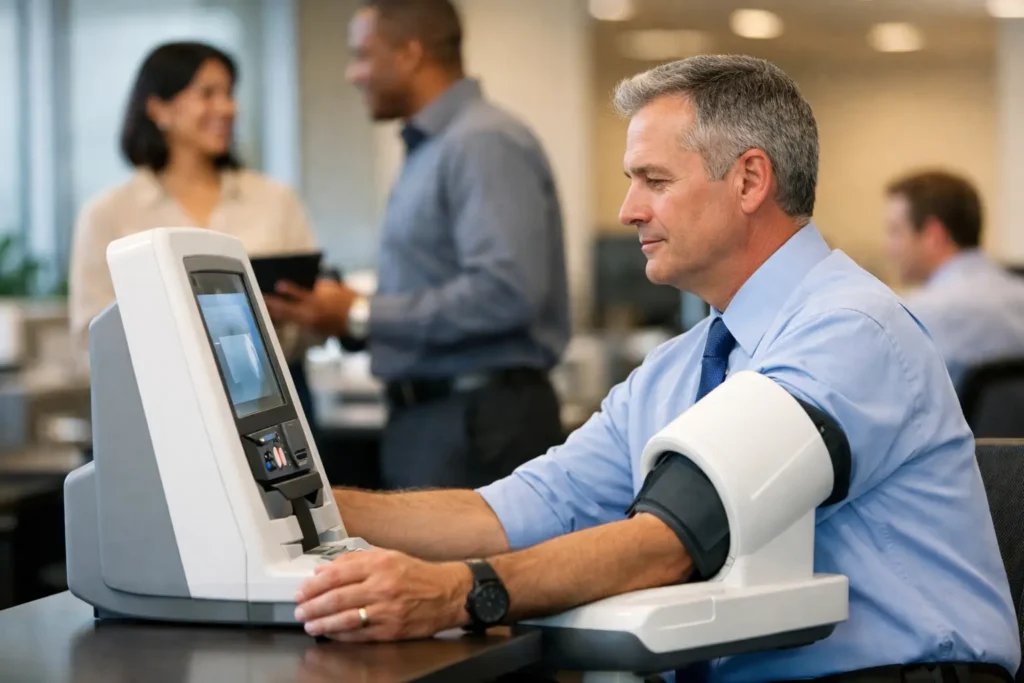
A blood pressure check can take only a few minutes, yet it may give an employee a reason to speak to their GP about a health risk they did not know they had. So, can kiosks detect hypertension? They can identify a raised blood pressure reading and help employees understand when follow-up is sensible. They cannot, however, diagnose hypertension on their own.
For employers, that distinction matters. A workplace health screening kiosk is a practical way to make basic checks accessible during the working day, without the administration of individual appointments. It supports a preventative, know-your-numbers approach while keeping the clinical next step where it belongs: with an appropriate healthcare professional.
Can kiosks detect hypertension accurately?
A well-maintained health screening kiosk can measure blood pressure and flag readings that are above the expected range. This makes it useful for identifying people who may have high blood pressure, also known as hypertension, or who would benefit from a repeat measurement.
Hypertension is not normally confirmed from one reading in one setting. Blood pressure changes throughout the day and can be affected by activity, stress, caffeine, smoking, talking during the check, a full bladder, and even an incorrectly positioned cuff. Some people also experience a temporary rise in clinical environments, often called white-coat hypertension.
For that reason, a kiosk result should be treated as a screening outcome, not a medical diagnosis. If an employee receives a high or unusually low result, the appropriate action is to repeat the measurement after resting and, where indicated, arrange a check with their GP, pharmacy or occupational health provider. A clinician may use repeated clinic readings or home or ambulatory monitoring to establish whether hypertension is present.
That does not reduce the value of workplace screening. It gives employees a prompt to take action before a risk factor remains unnoticed for years.
Why blood pressure screening belongs in a workplace wellbeing plan
High blood pressure often has no obvious symptoms. An employee can feel well, remain productive and have no idea that their cardiovascular risk is elevated. Left unmanaged, hypertension is associated with a higher risk of heart disease, stroke and kidney disease.
Employers are not responsible for diagnosing or treating employees. They can, though, remove common barriers to basic health checks: lack of time, difficulty booking appointments, uncertainty about where to start and the tendency to put personal health off until later.
A kiosk placed in an accessible workplace area allows employees to complete a check when it suits them. There is no requirement to share a result with a manager or colleague, and no need to create a schedule for every participant. This low-friction format can increase participation, particularly during health awareness campaigns, wellbeing weeks and multi-site initiatives.
The wider benefit is engagement. A blood pressure figure is specific and personal. It can make broader wellbeing messages about movement, sleep, stress, nutrition, alcohol and smoking feel more relevant than a general campaign alone.
What a workplace kiosk can measure
A health screening kiosk commonly combines blood pressure with other core biometric measurements, including height, weight, BMI, pulse and body fat percentage. Taken together, these figures provide a useful snapshot rather than a complete assessment of health.
Blood pressure is recorded as two numbers, such as 120/80 mmHg. The first number is systolic pressure, measured when the heart contracts. The second is diastolic pressure, measured when the heart relaxes between beats. An employee should receive clear, plain-English guidance alongside the result, including when a repeat check or healthcare advice may be appropriate.
BMI compares weight with height and can help identify whether someone may benefit from further lifestyle support, but it does not distinguish between muscle and body fat. Body fat percentage adds another data point, while pulse can highlight the value of checking cardiovascular health regularly. None of these measures should be used in isolation or as a judgement of an employee’s health, fitness or capability.
Immediate printed results are useful because employees can take the information away privately and decide on their next step. They also avoid the delay that can reduce engagement after a wellbeing event.
Getting a more reliable blood pressure reading
The quality of a screening result depends on both the equipment and the conditions of the test. Employers should select a provider that maintains its equipment and gives users straightforward instructions. Employees also need a calm, private enough location and time to complete the check without feeling rushed.
Before measuring blood pressure, employees should sit quietly for around five minutes where possible. They should avoid talking, keep both feet on the floor, support their arm at heart level and use the correct cuff position. Recent exercise, caffeine, smoking and alcohol can affect the result, so a reading taken immediately after a coffee run or a gym session may not reflect the person’s usual blood pressure.
If the first result is raised, a second reading after a short rest is often more useful than reacting to a single number. The employee should follow the guidance shown by the kiosk and seek clinical advice if prompted. Symptoms such as chest pain, severe breathlessness, weakness on one side of the body, confusion or a severe sudden headache require urgent medical attention rather than a routine workplace screening follow-up.
Making screening simple for HR and employees
The most effective screening days feel straightforward to employees and manageable for the people organising them. A kiosk can be installed in a suitable area with sufficient space and a standard power supply, such as a meeting room, wellbeing room or quiet communal area. Positioning is important: choose somewhere easy to find but not so exposed that people feel watched while checking their results.
A simple internal message should explain what the kiosk measures, how long a check takes and that participation is voluntary. It should also be clear that the kiosk is not a diagnostic service and that individual results are private. Avoid language that pressures employees to take part or suggests that results will be used to assess performance, sickness absence or insurance eligibility.
For organisations that want to understand engagement without collecting personal health information, anonymised usage data can show overall participation levels. This gives HR and wellbeing teams a measurable output from the initiative while respecting employee confidentiality. If personal data is collected in any form, employers should have a clear lawful basis, privacy information, access controls and retention arrangements in place.
Operational support is equally valuable, especially for national or multi-site employers. Relaxa’s health screening kiosk service includes delivery, installation, maintenance and basic user training through UK-wide field support. That reduces the practical burden on HR teams and helps keep the focus on employee participation rather than equipment management.
What to do after a raised result
A raised reading should lead to calm, proportionate advice, not alarm. Employees may wish to record the result, arrange a repeat check on another day and contact their GP or local pharmacy for guidance. A clinician can assess the result in context, including medical history, medication and other risk factors.
Employers can support that next step by offering follow-on wellbeing activity rather than attempting to provide medical care. A programme of movement sessions, stress management webinars, sleep education, nutrition support or mental wellbeing training can help employees build healthier routines over time. These services work best as an invitation and a practical resource, not as a response imposed on people with particular readings.
It also helps to set expectations before the kiosk arrives. Some employees will receive results within the expected range; others may be advised to monitor or seek further support. Both outcomes are useful when communicated responsibly. The purpose is awareness and early action, not a pass-or-fail health test.
Choosing a kiosk for hypertension awareness
When assessing a workplace screening solution, look beyond the headline list of measurements. Ask how results are explained, what happens if equipment needs attention, whether the provider can support your locations, and how employee privacy is protected. Consider the space required, power requirements, event duration and whether the format suits shift workers, hybrid teams and smaller sites.
A kiosk is particularly effective where appointment-based screening would create low uptake or too much administration. It may be less suitable where employees need an in-depth clinical assessment, have complex medical concerns or require tailored health advice. In those cases, a kiosk can still be a useful starting point, but it should sit alongside access to qualified clinical services.
A well-run screening initiative gives people a convenient moment to stop, check a few meaningful numbers and decide whether further action is needed. For many employees, that small moment of awareness is the practical beginning of better long-term health.