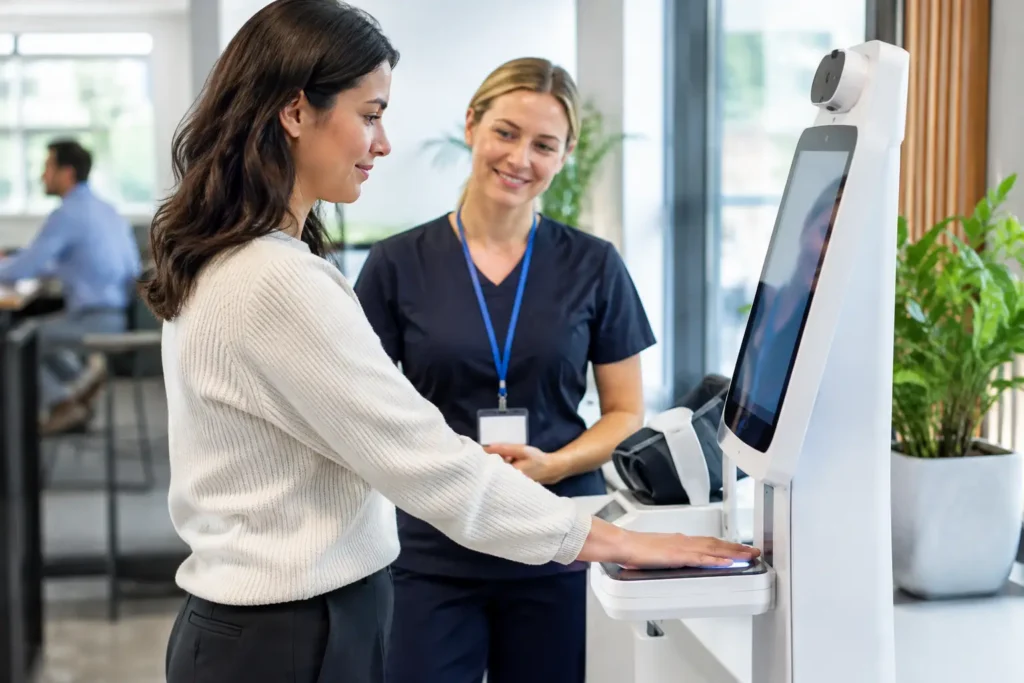
A health kiosk can turn a wellbeing day from an appointment-heavy exercise into a practical workplace activity that employees can complete in minutes. For HR and wellbeing teams, the value is straightforward: people can check key health measurements during the working day, receive an instant printed record and decide what action, if any, they want to take next.
That convenience matters. Many employees will put off a health check if it involves booking time away from work, travelling to a clinic or waiting for an available appointment. A kiosk placed in a suitable workplace area removes much of that friction while giving employers a visible, preventative-health initiative that is easy to communicate and run.
What a health kiosk measures
A workplace health kiosk provides a quick assessment of core biometric measures. Depending on the screening set-up, employees can obtain readings for height, weight, body mass index (BMI), blood pressure, pulse and body fat percentage. The results are printed immediately, so each employee leaves with a personal record rather than needing to wait for follow-up.
These figures are not a diagnosis, and they should not be presented as one. Their purpose is to help employees understand their baseline numbers and spot where a conversation with a GP or other qualified health professional may be sensible. This is especially relevant where a blood pressure reading is unexpectedly high, low or irregular, or where an employee has concerns about their health.
Why the measurements are useful
Height and weight create the basis for a BMI calculation, which is a broad indicator used to assess whether weight may be affecting health risk. BMI has limitations – it does not distinguish between muscle and fat, for example – but it can be a helpful starting point when considered alongside other information.
Blood pressure and pulse offer a snapshot of cardiovascular health at the time of the check. A single result can be influenced by stress, caffeine, recent physical activity or simply rushing to the kiosk, so employees should be encouraged to sit quietly beforehand and treat unusual readings as a prompt to seek appropriate advice rather than a final answer.
Body fat percentage adds further context beyond weight alone. For many people, it can be more meaningful than a number on the scales, although readings are estimates and can vary with hydration and other factors. Clear, plain-language guidance around each measure helps employees use their results constructively.
Why health kiosk screening works in the workplace
The strongest workplace wellbeing initiatives make participation easy. A health kiosk does not require every employee to find an appointment slot, and it allows people to use the service at a time that suits their shift, workload or break. This can support stronger uptake than a screening programme that relies entirely on pre-booked consultations.
It is also a practical option for organisations with a large headcount or several sites. A kiosk can be hired for a planned wellbeing event, a campaign such as Know Your Numbers Week, or a longer on-site period. Employers can give teams enough time to take part without the administration involved in managing individual bookings.
For employees, privacy remains important. The kiosk should be positioned in a discreet area where people are not being watched while using it or discussing their result. A meeting room, wellbeing space or screened-off section of a communal area is often more appropriate than a busy reception or open-plan office.
A visible prompt for preventative action
Wellbeing communications often compete with operational priorities. A physical kiosk gives a campaign a clear focal point: employees can see it, understand what it offers and take part without needing to download an app or complete lengthy forms.
The printed result also creates a useful moment of reflection. An employee may choose to monitor a reading over time, improve activity or nutrition habits, or make an appointment with their GP. Employers do not need to interpret personal results to create value. Their role is to provide accessible, trustworthy opportunities for people to engage with their own health.
Planning a health kiosk on site
Good implementation starts with a small number of practical decisions. First, choose a location that is accessible to the intended users, offers reasonable privacy and has sufficient space for the unit and for employees to wait without blocking a walkway. The area will also need access to power.
Before the kiosk arrives, it helps to agree the campaign period, the audiences to be invited and how employees will be told what the screening includes. Clear messaging should explain that the check is voluntary, takes only a few minutes and produces an immediate printout for the individual. It should also make clear that the service is a screening tool, not medical treatment or a replacement for routine care.
For organisations with shift workers, multiple buildings or hybrid teams, timing needs more thought. A single lunchtime launch may work well for a head-office team but miss operational staff. Extending the hire period, arranging access across different shifts or rotating the kiosk between locations can improve fairness and participation.
Keep the employee journey simple
The most effective campaigns use direct instructions. Tell employees where the kiosk is, when it is available, what it measures and what they should do with an unexpected result. Avoid overloading the message with clinical detail.
It is sensible to remind employees to follow the on-screen guidance, remove heavy outerwear where appropriate and take a moment to settle before measuring blood pressure. If the environment is particularly busy, encourage them to return at a quieter time. Small details can improve the quality and consistency of the experience.
Support, servicing and reporting
A kiosk is only low-admin if the operational support is clear. Employers should not have to arrange specialist delivery, assemble equipment or troubleshoot technical issues during a wellbeing campaign. A managed rental service should cover delivery, installation, basic on-site instruction, maintenance and collection, with engineering support available if required.
This is particularly valuable for national employers. UK-wide support allows a programme to be delivered across offices, depots and other workplace locations without asking local HR contacts to manage different suppliers or technical arrangements.
Consumables also need consideration. If employees receive immediate printed results, paper supply and printer performance are part of the service, not an afterthought. Confirm who checks these items and what happens if a fault occurs during the hire period.
Employers may also want anonymised usage data to understand campaign reach. Used appropriately, this can show how many people took part and help inform future wellbeing activity without exposing an individual’s personal health information. The distinction matters: personal readings belong to the employee, while aggregated engagement data can help employers assess whether the initiative reached its intended audience.
Making screening part of a wider wellbeing plan
A health kiosk is most useful when it starts a conversation rather than standing alone. If screening identifies common areas of interest, such as stress, sleep, movement or healthy eating, employers can follow up with relevant support. This could include a webinar on resilience, an office yoga session, posture training or practical nutrition education.
The right follow-up depends on the workforce. A desk-based team may benefit from movement and posture support, while a high-pressure environment may respond better to stress-management training. Avoid assuming that every result calls for the same intervention. Engagement data, employee feedback and the nature of the work should shape the next step.
Relaxa provides health screening kiosks alongside on-site and online wellbeing services, allowing employers to build activity around the screening period rather than treating it as a one-off event. The objective is not to collect numbers for their own sake. It is to give employees a convenient starting point and provide practical support they can use afterwards.
A well-placed kiosk gives people time to pause, check their numbers and consider their next move. When the process is private, properly supported and easy to access, that small moment can become a credible part of an employer’s wider duty of care.