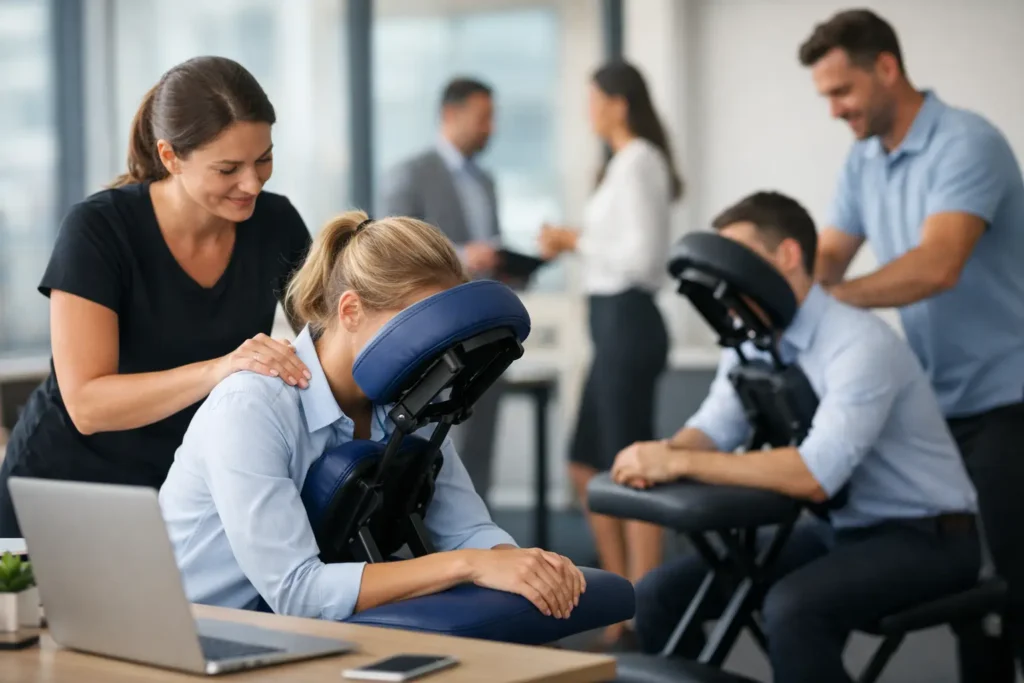
A well-timed 15-minute chair massage can give employees a genuine pause in a busy working day, particularly during high-pressure periods, change programmes or return-to-office activity. To organise office massage sessions successfully, the focus should be on simple logistics: a suitable private space, realistic capacity, clear communications and a booking approach that works for your workforce.
Office massage is not a replacement for occupational health support or medical treatment. It is a practical wellbeing activity that can help employees take time away from their screens, ease everyday muscular tension and feel that their employer is investing in their comfort at work.
Decide what the sessions need to achieve
Start with the reason for running the event. You may be looking to reward employees after a demanding project, support a wellbeing week, encourage attendance at an office day or add a practical benefit to a wider health initiative. The purpose affects the format, timing and number of appointments required.
For example, a one-off appreciation event can work well with short, bookable chair massage appointments over a single day. A monthly programme may be more useful where you want a regular wellbeing touchpoint, especially in workplaces with sustained desk-based work. For larger organisations, rotating sessions between sites can provide fairer access than concentrating all activity at head office.
Set a clear outcome before booking. It might be strong employee participation, an improvement in feedback on wellbeing provision, or simply offering a useful break during a particularly busy period. A defined objective makes it easier to choose the right level of service and assess whether to repeat it.
Choose the right office massage format
Most workplace massage sessions use a specialist ergonomic chair. Employees remain fully clothed while the therapist works on areas commonly affected by desk work, such as the upper back, shoulders, neck, arms and hands. This format is time-efficient, requires no changing facilities and is usually the most practical option for an office environment.
A 10 to 15-minute appointment is often enough for a busy workplace. It allows more employees to take part without being away from their role for too long. Longer sessions may suit a smaller team or a premium reward day, but they reduce total capacity and need more protected time in diaries.
Consider your workforce pattern as well. If employees are mainly on-site at the same time, a single full-day event may create good momentum. If teams work shifts, travel between locations or follow hybrid patterns, several shorter visits may deliver better access. There is no benefit in booking a high-capacity day if a large proportion of staff are not available to attend.
Plan capacity before you open bookings
Capacity is the point at which many wellbeing events become harder to manage than expected. A therapist delivering 15-minute appointments can generally see four employees per hour, although set-up, comfort breaks and a little flexibility between sessions should be allowed for. A six-hour appointment window may therefore accommodate around 20 to 22 people rather than a theoretical maximum of 24.
For a team of 30 employees, one therapist for a day may be sufficient. For 100 employees, you may need multiple therapists, several event dates or a booking process that gives priority to those attending the workplace on a particular day. Be transparent about capacity from the beginning so expectations remain realistic.
Advance booking is usually the most reliable option. It protects the therapist’s time, reduces queues and lets employees choose a slot around meetings and operational duties. A waiting list is helpful where demand is likely to be high. Walk-in appointments can work at smaller sites, but they may result in missed opportunities if employees assume the service is already full.
Prepare a suitable space for office massage sessions
A private meeting room is normally the best choice. It should be quiet enough for employees to feel comfortable, large enough for the massage chair and therapist to work safely around it, and located away from constant footfall. Natural light is welcome, but it is not essential.
Unlike some wellbeing services, chair massage generally has limited equipment requirements. Even so, check practicalities with your provider before the day. Confirm access to the building, parking or loading arrangements, reception procedures and whether the room needs to be available before the first appointment for set-up.
The room should not double as a busy meeting space during the event. Frequent interruptions undermine privacy and can cause appointments to run late. A simple sign on the door and a named contact for the day will help keep the space available.
Employees should also know what to expect. Explain that sessions are delivered professionally, that participants remain clothed, and that they can tell the therapist if they would prefer an area to be avoided or pressure adjusted. Individuals with a relevant medical condition, recent injury, pregnancy or other concern should be encouraged to raise it directly with the therapist before their session.
Communicate early and keep the message practical
The strongest invitation is specific. State the date, location, session length, booking process and who can take part. Avoid presenting massage as a cure for stress or pain. Position it as an optional wellbeing activity that offers a short, comfortable break during the working day.
Send the initial announcement far enough ahead for staff to plan around it, then issue a reminder a few days before the event. Managers can support participation by making it clear that employees are permitted to step away for their allocated time. Without this reassurance, people in customer-facing or deadline-driven roles may feel unable to book.
If demand is expected to exceed capacity, say so and explain how places will be allocated. A fair booking approach builds more trust than a first-come, first-served process launched without notice at 9am.
Make the day easy to run
Assign one workplace contact to meet the therapist, confirm the room and resolve any access issues. This person does not need to manage every appointment, but they should be available if there is a building query, a late running meeting or an employee who needs directions.
Keep the appointment list simple and protect employee privacy. HR teams do not need to collect personal health details to organise a massage day. The therapist should manage any suitability questions directly and confidentially with the participant.
Build a little breathing room into the schedule. Employees may arrive late from meetings, and therapists need time to reset between appointments. If there are no-shows, a waiting list or nearby staff who have expressed interest can help make good use of available time.
Measure whether the event was worthwhile
Office massage does not need an elaborate evaluation process, but a small amount of feedback will make future decisions easier. Record how many appointments were available, how many were booked and how many were attended. Attendance figures show whether timing, location and communications were effective.
A short follow-up survey can ask whether employees found the session useful, whether the appointment length was right and whether they would use the service again. Keep it anonymous and focused on service experience rather than personal health information.
Look for practical patterns. If bookings filled quickly but attendance was low, reminders or a cancellation process may be needed. If spaces remained available, the issue may be the day of the week, the office attendance pattern or a lack of manager support. If feedback is strong, a regular programme or additional therapists may be justified.
Position massage within a year-round wellbeing plan
A massage day is most effective when it sits alongside other accessible workplace wellbeing support. It can complement movement sessions that address the effects of prolonged sitting, webinars on stress and resilience, or health screening activities that encourage employees to understand their basic biometric measures.
This approach gives employees different ways to take part. Some will value a short hands-on session; others may prefer a yoga class, a mental wellbeing course or a convenient on-site health check. A varied programme also helps maintain engagement beyond a single wellbeing week.
Relaxa can support employers with on-site massage alongside a broader range of workplace wellbeing services, helping HR teams run practical initiatives without adding unnecessary administration.
The best office massage sessions feel straightforward for everyone involved: employees know when and where to attend, managers can release people without disruption, and the day runs to time. That level of organisation turns a small workplace benefit into an experience employees are likely to remember.