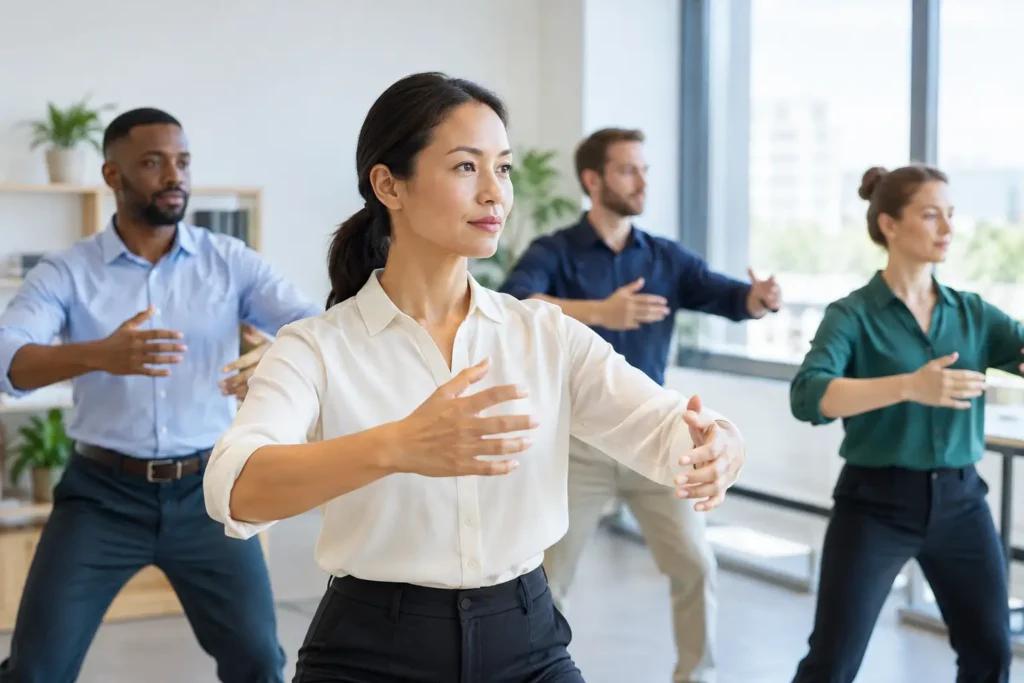
A difficult meeting, a full inbox and hours spent at a screen can leave employees physically tense before they notice they are stressed. Office tai chi offers a practical interruption: a short, guided movement session that helps people slow down, reset their posture and return to work with greater composure.
For employers, the appeal is straightforward. Tai chi is low impact, requires no specialist clothing or fitness background, and can be delivered in a meeting room or suitable open office space. It gives wellbeing programmes a visible, inclusive activity without the scheduling burden of individual appointments.
What office tai chi looks like at work
Tai chi is a traditional form of gentle, controlled movement, usually paired with steady breathing and focused attention. A workplace session does not need to replicate a long class in a leisure centre. It can be adapted into a 20 to 45-minute session focused on simple standing movements, weight shifts, arm patterns and breathing exercises.
Participants move at their own pace. There is no need for floor work, rapid changes of direction or high levels of flexibility. This makes it a realistic option for mixed groups, including employees who may not feel comfortable joining more demanding fitness sessions.
A qualified instructor can introduce each movement clearly, offer seated or reduced-movement options where appropriate, and build the session around the needs of the group. The emphasis is not on performing a sequence perfectly. It is on controlled movement, body awareness and a calmer transition back into the working day.
Why office tai chi can support workplace wellbeing
Desk-based work often encourages a fixed posture for long periods. Shoulders rise, the neck stiffens and breathing becomes shallow, particularly when people are concentrating or working under pressure. A short movement break gives employees permission to step away from their workstation and notice that tension.
Tai chi can support several useful wellbeing outcomes. Employees may use the session as a way to loosen up after sustained screen time, improve awareness of their standing and sitting posture, and create a clearer boundary between one task and the next. The quiet, deliberate pace can also appeal to people who find fast-paced group exercise intimidating.
It should not be presented as a treatment for a health condition or a replacement for clinical support. However, as part of a wider wellbeing offer, it provides a practical route into regular movement and stress-management habits. That matters when an organisation is trying to engage people who may not attend a gym class, book a consultation or identify themselves as particularly active.
For hybrid teams, the format is equally useful online. Employees can join from home in a clear space beside their desk, with the instructor demonstrating movements that can be completed safely without equipment. A live session can create a shared pause in the day even when colleagues are not in the same building.
Making tai chi sessions easy to run
The best workplace wellbeing initiatives remove friction for both employees and organisers. Office tai chi works well because the practical requirements are modest, but a little preparation improves attendance and the quality of the experience.
Start by choosing a time that fits the working pattern. A mid-morning or mid-afternoon session can be effective when energy and concentration commonly dip. A lunchtime class may suit some sites, while others will see better participation from a short session scheduled immediately before a team meeting or learning event. There is no universal answer: shift patterns, meeting culture and the availability of private space all affect uptake.
A clear, uncluttered meeting room is usually sufficient. Participants need enough room to extend their arms without touching one another or nearby furniture. They should be encouraged to wear comfortable everyday clothes and flat, secure footwear. Most sessions can be completed standing, although seated adaptations can help make the activity more accessible.
Communication should set the right expectation. Describe tai chi as gentle guided movement rather than a fitness test. Confirm the session length, location and whether colleagues need to bring anything. This reduces uncertainty, which is often the main reason people avoid trying an unfamiliar wellbeing activity.
For multi-site organisations, consider rotating sessions between locations or combining in-person delivery at key offices with online classes for remote colleagues. A programme is more likely to feel fair when access is considered from the outset, rather than treating headquarters as the default venue.
A simple delivery plan
A first session should be easy to join and easy to repeat. Book a 30-minute taster, allow a few minutes for arrival and setup, then invite participants to share brief feedback afterwards. Ask whether the timing worked, whether the movements felt accessible and whether employees would prefer a regular slot.
If there is demand, a short series often provides more value than a one-off event. Weekly sessions for four to six weeks give employees time to become familiar with the movements and build a routine. They also give organisers a clearer view of attendance patterns, preferred times and the types of wellbeing activity that resonate across the workforce.
Where tai chi fits in a year-round programme
Office tai chi is most effective when it complements, rather than carries, the whole wellbeing strategy. It can sit alongside office yoga, workplace massage, posture education and online learning on stress, sleep and resilience. Each service meets a different need and reaches different employees.
For example, a health screening day can prompt useful conversations about everyday habits after employees receive immediate readings such as blood pressure, pulse, weight, BMI and body fat percentage. A follow-up tai chi or movement session gives people a simple, non-competitive way to act on the broader message of looking after their health during the working week. The screening does not diagnose conditions, and neither does tai chi, but together they can support preventative-health awareness.
This combination is particularly useful for wellbeing campaigns that risk becoming a single busy day with little follow-through. A screening kiosk can make basic checks convenient and measurable, while recurring movement and educational sessions keep wellbeing visible over the following weeks. Relaxa can support this kind of programme with workplace screening, on-site sessions and online wellbeing learning, reducing the number of suppliers an HR team needs to coordinate.
Measuring participation without overcomplicating it
Employers do not need to turn a tai chi class into a clinical intervention to judge whether it is worthwhile. Start with practical measures: registrations, attendance, repeat attendance and the number of sites or teams taking part. A short anonymous feedback question can add context, such as whether employees felt more relaxed, more comfortable after sitting, or more likely to take movement breaks.
Use the results proportionately. High attendance may indicate that the timing and format are right. Lower participation may mean the message was unclear, managers did not actively support time away from desks, or the session clashed with operational demands. It does not automatically mean employees are uninterested in wellbeing.
Manager behaviour has a meaningful effect here. When leaders treat participation as a legitimate part of the working day, rather than an optional extra to be fitted around an impossible workload, employees are more likely to attend. A simple reminder that people can step away from their screens for half an hour can be more valuable than an elaborate launch campaign.
Choosing the right format for your workforce
A small professional-services office may prefer an informal lunchtime class in a boardroom. A larger employer with several sites may need a planned calendar of sessions, online access and a straightforward booking process. Customer-facing teams may benefit from short classes at shift handover, while employees with physically active roles may respond better to movements focused on recovery and mobility.
Consider privacy too. Some people will happily take part in an open area; others will be more comfortable in a closed meeting room away from footfall. The aim is not to make every employee join. It is to provide a credible, accessible opportunity that feels appropriate to the workplace.
A well-run office tai chi session creates a useful change of pace: less time spent locked into a chair, more awareness of how the body feels, and a calmer route back to the next piece of work. Give employees the space to try it without pressure, and the value is likely to extend beyond the session itself.