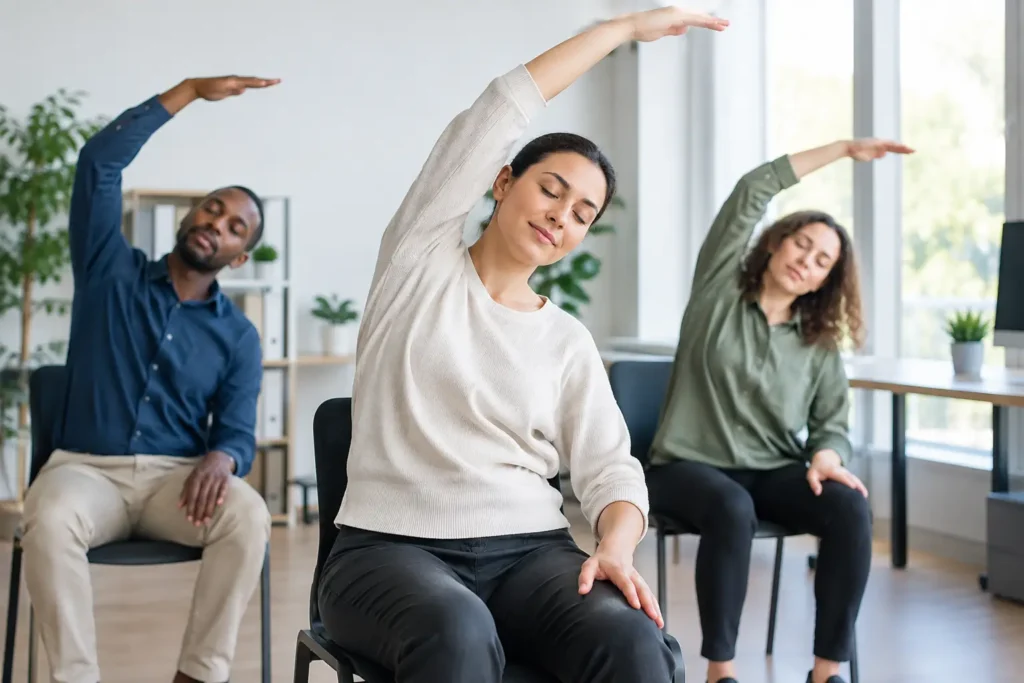
A 30-minute chair pilates session can fit between meetings, require no changing facilities and give employees a purposeful break from prolonged sitting. For organisations looking to make workplace wellbeing more accessible, it is a practical option: low impact, adaptable and suitable for a wide range of fitness levels.
Unlike a gym-based class, chair Pilates uses a stable chair as support and resistance. Employees can take part in everyday workwear, either in a meeting room or through an online session from home. That makes it especially useful where space, time and confidence are barriers to participation.
What chair Pilates involves
Chair Pilates applies core Pilates principles – controlled movement, posture, breathing, alignment and core stability – while seated or using a chair for balance. Sessions commonly focus on the neck, shoulders, upper back, hips, legs and abdominal muscles, all areas that can feel tight or underused after long periods at a desk.
A qualified instructor can adapt movements for the group in front of them. One employee may need gentle mobility work for stiff shoulders, while another may be able to work with greater range and control. The chair provides a useful point of contact, which can make exercises feel more secure for beginners or employees returning to movement after time away.
This is not a replacement for clinical assessment, physiotherapy or occupational health support where an employee has pain, an injury or a diagnosed condition. It is a general movement session designed to encourage regular, manageable activity. Employees should work within a comfortable range and seek appropriate medical advice if they are unsure whether exercise is suitable for them.
Why chair Pilates works in the workplace
The strongest workplace wellbeing activities remove friction. Employees are far more likely to join a session when they do not need to travel, change clothes, bring equipment or commit to an hour away from their workday. Chair Pilates is built around those practical realities.
For office-based teams, the session can be delivered in a meeting room with ordinary, non-wheeled chairs. For hybrid and remote teams, it can be delivered live online, giving people a shared wellbeing activity regardless of location. This flexibility helps employers offer a more consistent experience across multi-site workforces.
The format can also appeal to employees who would not normally book a fitness class. High-intensity exercise can be off-putting for some people, particularly those who are new to structured movement or concerned about keeping up with colleagues. A chair-based class feels more approachable while still encouraging focus, coordination and controlled muscular work.
From an employer perspective, it offers a visible response to common working patterns: extended screen time, back-to-back calls and limited movement during the day. It does not solve every ergonomic or musculoskeletal issue, but it can complement workstation assessments, posture education and wider health initiatives.
Benefits employees may notice
Individual experiences vary, particularly where people have different baseline fitness, health conditions and daily routines. However, regular chair Pilates sessions can help employees build greater awareness of how they sit, stand and move during the working day.
Participants often value the immediate release of moving after being stationary. Gentle work through the spine, chest and shoulders can counter the feeling of being rounded over a keyboard, while hip and lower-body movements provide a break from sitting. The focus on breathing can also create a calmer transition between demanding tasks.
Over time, consistency matters more than intensity. A monthly wellbeing event may generate interest, but shorter recurring sessions are more likely to help movement become part of the working routine. This is where chair Pilates can be particularly effective: it is realistic to repeat and does not ask employees to be athletes.
Potential benefits include improved mobility, posture awareness, balance, core control and general confidence with movement. For some teams, the social benefit is just as valuable. A shared session gives colleagues permission to step away from their desks and supports a culture where taking a short wellbeing break is accepted rather than treated as lost time.
Planning a chair Pilates session on site
Good delivery begins with a simple set-up. Employers should identify a quiet, reasonably private space where employees can move their arms and legs without obstruction. A meeting room, training space or clear area of an office can work well, provided furniture can be arranged safely.
Use stable chairs without wheels where possible. Chairs should be positioned with enough room between participants so they can extend their arms without contact. Employees do not usually need mats, specialist clothing or equipment, although they should be encouraged to wear comfortable clothing that allows easy movement.
Session length depends on the working day and the intended outcome. A 20 to 30-minute class is often easier to accommodate around meetings and can work well as a lunchtime or mid-afternoon movement break. A 45-minute session allows more time for a gradual warm-up, a broader range of exercises and relaxation at the end.
Communication is equally important. Explain that the session is suitable for beginners, that participation is optional and that people can work at their own pace. Avoid presenting it as a cure for back pain or stress. Clear, realistic messaging builds trust and helps employees decide whether the session is right for them.
Making participation easier
Low attendance is rarely just a lack of interest. It is often an operational issue. If sessions are announced late, placed over busy deadlines or held in a space that feels too exposed, people may not attend even when they would benefit.
Give employees notice and offer more than one time slot where possible. A morning session may suit some teams, while a lunchtime or late-afternoon option may be more accessible for others. For large sites, smaller repeated classes can be more inclusive than one session with limited capacity.
Managers have a role too. When leaders actively protect the time for wellbeing activities and join where appropriate, employees receive a clear signal that participation is supported. This matters most in teams where workloads are high or where people feel pressure to remain visibly available.
For hybrid workforces, a live online session can reduce location barriers. Ask participants to have a sturdy chair ready, clear a small area around them and keep their camera off if that makes them more comfortable. The aim is not perfect form on screen; it is safe, guided movement that employees can realistically sustain.
Where chair Pilates fits in a wider wellbeing plan
Chair Pilates is most effective when it is part of a considered programme rather than a one-off response to a wellbeing calendar date. It can sit alongside office yoga, massage, posture webinars, sleep education, stress management training and mental health awareness sessions.
It also pairs naturally with preventative health activity. For example, employees who complete a workplace health screening may be more receptive to practical opportunities that support healthier routines. Screening provides a snapshot of measures such as blood pressure, BMI and body fat percentage; movement sessions give people a simple way to act on broader wellbeing goals without needing to navigate a gym environment.
Employers should be careful not to overstate the connection between a class and any individual health result. Chair Pilates is not a prescribed intervention for a screening outcome. Its value lies in making regular movement easier to access while reinforcing a wider message: small, repeatable actions can support long-term health.
Relaxa can help organisations combine accessible movement sessions with broader on-site and online wellbeing services, allowing HR teams to build a programme around their workforce, available space and preferred delivery model.
Choosing the right format for your workforce
Chair Pilates will not be the preferred activity for every employee, and that is expected. Some people may want a more energetic session, while others may need fully seated movement or opt out due to health concerns. A varied wellbeing calendar gives people choice and avoids treating one format as a universal answer.
Before booking, consider the workforce profile, shift patterns, site layout and whether your main aim is engagement, mobility education, stress relief or a regular active break. These factors will influence the best session length, group size and delivery method.
A well-run chair Pilates class makes movement feel possible in the middle of a normal working day. That practicality is its real strength: employees can leave a meeting room feeling more mobile, more settled and more willing to make space for their wellbeing again next week.